
Lykon's DreamShaper Quietly Hits 156K Monthly Downloads Defying Newer AI Models
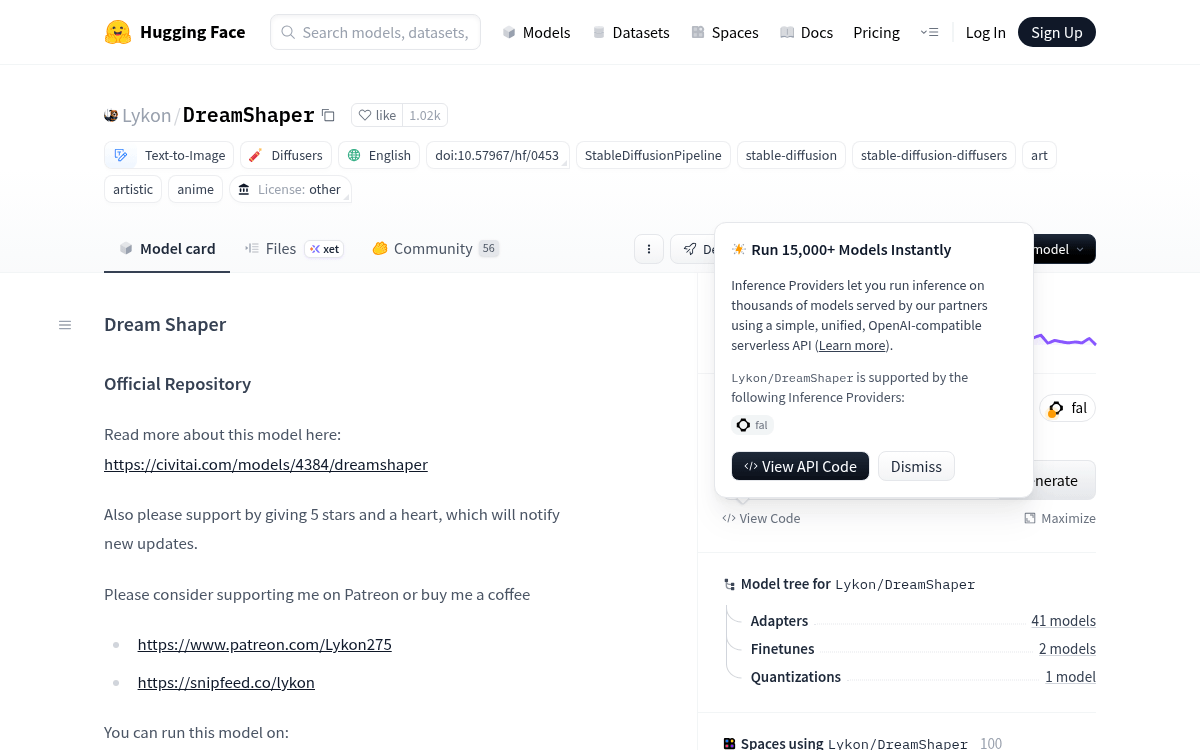
A community fine tune of Stable Diffusion built as an open source answer to Midjourney continues to trend, with over 156k downloads and a full lineage from 1.5 to XL Lightning.
 Pro
Takeaways
- DreamShaper by Lykon is trending again with 156k downloads and 1k+ likes on Hugging Face.
- General purpose SD 1.5 fine tune built as an open source alternative to Midjourney and DALL-E.
- Strong at painterly portraits, anime, and backgrounds without needing style specific LoRAs.
- Full family includes DreamShaper XL Lightning, an LCM distilled version, and an inpainting variant.
- Drops into diffusers with a standard
DiffusionPipeline.from_pretrainedcall, runs on a single consumer GPU. - Powers 100+ public Hugging Face Spaces and has 41 downstream adapters registered.
One of the most durable community models on Hugging Face is having another moment. DreamShaper, a general purpose Stable Diffusion fine tune by the creator known as Lykon, has quietly racked up over 156,000 monthly downloads and more than a thousand likes on its Hugging Face page. It shows up in roughly 100 public Spaces as a base for image editors, instant video pipelines, and more.
If you have been in the diffusion ecosystem for a while, you have almost certainly seen its outputs. For everyone else, here is what the model actually is, where it shines, and why it still earns a slot in production pipelines even as much larger models grab the headlines.
The Midjourney alternative that never left
DreamShaper started as a portrait focused mix and grew into a Swiss army knife. In the author's own words, the project began as an alternative to Midjourney in the open source world, built out of frustration with how closed MJ was and how little freedom it gave users compared to Stable Diffusion. The stated design goal is blunt: a general purpose SD model that aims at doing everything well, photos, art, anime, manga, positioned directly against Midjourney and DALL-E.
The Hugging Face repo tracks the latest diffusers weights, currently DreamShaper 8 on Stable Diffusion 1.5. Older versions are still accessible. The author treats each release as a direct upgrade and only keeps the most recent on the main branch, but you can select a specific commit and pull any previous diffusers version.
Running it in three lines
The model plugs straight into the diffusers library with no special glue code. A minimal working example:
import torch
from diffusers import DiffusionPipeline
pipe = DiffusionPipeline.from_pretrained(
    "Lykon/DreamShaper", dtype=torch.bfloat16, device_map="cuda"
)
prompt = "Astronaut in a jungle, cold color palette, muted colors, detailed, 8k"
image = pipe(prompt).images[0]
Because it is an SD 1.5 checkpoint, it inherits the entire tooling ecosystem around that architecture: ControlNet, LoRAs, textual inversions, IP Adapter, and comfortable inference on a single consumer GPU. There is also a hosted DreamShaper webui Space if you want to try it without local setup, plus Draw Things and DiffusionBee integrations for Mac users. The weights are free.
Settings that actually change the output
The recommended settings from the author are worth knowing before you judge output quality:
- CLIP skip 2 for many prompts, ENSD 31337, and highres.fix or img2img at higher resolution for almost all sample images
- Restore faces is intentionally off because it washes out the painting effect, and versions above 4 no longer need a LoRA for anime style
- For the XL Lightning variant, 2M SDE Karras or Euler at cfg 6 and 20 to 40 steps for the standard model, while the Turbo and Lightning versions run in around 8 steps
Practical strengths, based on the model card and community usage:
- Painterly portraits that avoid the plastic CG look common in early SD fine tunes
- Anime and manga styles without needing a dedicated LoRA
- Backgrounds and environment art with reasonable coherence
- A base for further fine tuning, with 41 adapter models, 2 finetunes, and 1 quantization already registered as derivatives on Hugging Face
Weaknesses are the usual SD 1.5 limitations: hands, small text, and multi subject compositions still need ControlNet or careful prompting, and prompt adherence lags behind newer transformer based models like SD3 or Flux.
The distilled and XL siblings
The DreamShaper family has expanded well beyond the original checkpoint. A distilled LCM variant trades quality for speed, useful when you need real time inference or video generation. Per the author, the distilled model has lower quality than the base but is much faster and works well for video and real time applications, running at 5 to 15 steps at around 2 cfg.
There is also DreamShaper XL, fine tuned on top of SDXL 1.0, and a Lightning inpainting variant that community members put together for outpainting workflows. The inpainting model exists to fix a specific problem: with the normal checkpoint you tend to get a very visible seam between the original part of the image and the newly extended part.
Why a 2 GB checkpoint still ships
Frontier attention has moved to Flux, SD3.5, and closed APIs, but SD 1.5 fine tunes like DreamShaper remain the workhorse for a huge slice of production image generation, particularly anywhere latency, VRAM budget, or LoRA compatibility matter more than raw prompt fidelity. The model's continued climb in downloads reflects the reality that for a lot of shipping products, especially game asset pipelines, avatar generators, and creative tools, a well tuned 2 GB checkpoint that plays nicely with the entire SD 1.5 ecosystem is still the pragmatic choice.
If you have never benchmarked it against your current base model, it is a cheap experiment: swap the from_pretrained string, keep everything else identical, and compare.