
Lykon's DreamShaper 7 Runs Multi-Style Images on 8GB GPUs in 4 Steps
Lykon published DreamShaper 7, a Stable Diffusion 1.5 fine-tune that trades single-purpose specialization for balanced realism, anime, and LoRA compatibility.
 Pro
Takeaways
- Lykon published DreamShaper 7, a 0.9B-parameter fine-tune of Stable Diffusion 1.5.
- Version 7 focuses on improved LoRA support, better realism, and NSFW handling.
- Runs via the standard StableDiffusionPipeline with DEIS scheduler at 25 steps.
- Composes with LCM-LoRA for 4-8 step inference on consumer GPUs.
- Matched inpainting variant available for edit workflows.
- Licensed under CreativeML OpenRAIL-M, allowing commercial use with responsible-AI restrictions.
Lykon's DreamShaper 7 is one of those Stable Diffusion 1.5 fine-tunes that quietly became a workhorse for people building image pipelines. It sits on Hugging Face as a drop-in checkpoint you can pull into the diffusers library with a couple of lines of code, and it takes a deliberately generalist approach in a landscape crowded with hyper-specialized models.
A generalist fine-tune of SD 1.5
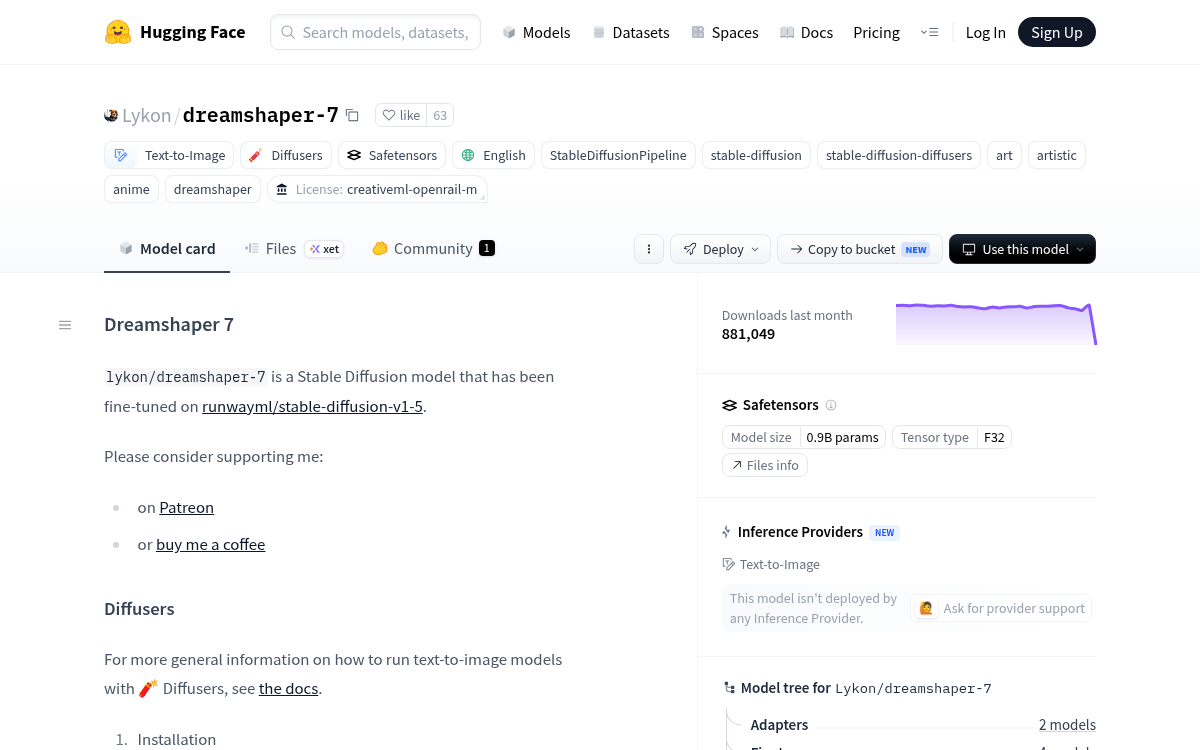
The checkpoint is fine-tuned from runwayml/stable-diffusion-v1-5, weighs in at roughly 0.9B parameters, ships as safetensors, and is released under the CreativeML OpenRAIL-M license, which permits commercial use with the usual responsible-AI restrictions.
Version 7 improves LoRA compatibility, NSFW handling, and realism over earlier releases. Lykon is candid about the trade-offs: for pure photorealism, reach for AbsoluteReality; for anime purity, a dedicated anime checkpoint will still beat it. The pitch here is versatility, with one model that handles portraits, painterly output, backgrounds, and anime-style characters without swapping weights.
How to actually run it
The model works with the standard StableDiffusionPipeline. The recommended snippet on the model card uses fp16 weights and the DEIS multistep scheduler:
from diffusers import AutoPipelineForText2Image, DEISMultistepScheduler
import torch
pipe = AutoPipelineForText2Image.from_pretrained(
    'lykon/dreamshaper-7', torch_dtype=torch.float16, variant="fp16")
pipe.scheduler = DEISMultistepScheduler.from_config(pipe.scheduler.config)
pipe = pipe.to("cuda")
prompt = "portrait photo of muscular bearded guy in a worn mech suit"
image = pipe(prompt, num_inference_steps=25).images[0]
image.save("./image.png")
Twenty-five inference steps with DEIS is the default the author lands on, noticeably faster than the 50-step DDIM baseline most people started with on SD 1.5. To push latency further, the model composes cleanly with LCM-LoRA adapters: swap in the LCMScheduler and load the latent-consistency/lcm-lora-sdv1-5 weights on top of the base pipeline. That drops usable generation into the 4-8 step range on consumer GPUs.
Strengths, weaknesses, and the sweet spot
- Strengths: painterly portraits, mixed realistic-plus-stylized scenes, anime without needing a separate LoRA, and clean compatibility with the wider SD 1.5 LoRA ecosystem.
- Weaknesses: hard photorealism, where specialized models win, and top-tier anime purity, where anime-only checkpoints win. Think Pareto-frontier, not category leader.
- Resolution: native SD 1.5 territory, so 512 to 768 pixels is the sweet spot. V7 inherits the broader LoRA support and style range introduced in V6.
The problem it actually solves
Pipelines that generate a variety of styles usually juggle several checkpoints, each several gigabytes, and swapping them at runtime is slow. DreamShaper 7 collapses several of those style buckets into one 0.9B-parameter checkpoint, which is why it shows up as the backbone for so many downstream projects.
There is also an inpainting variant fine-tuned from runwayml/stable-diffusion-inpainting for masked edits. Pairing the two gives you a matched text-to-image and edit workflow without style drift between the generation and editing stages.
Where it fits today
SDXL, SD3, and Flux have raised the ceiling for text-to-image quality, but SD 1.5 fine-tunes like DreamShaper 7 remain relevant because of latency and VRAM. A 0.9B-parameter checkpoint plus LCM-LoRA runs comfortably on an 8GB card, which is why it powers many drawing apps, canvas tools, and CPU-side experiments. The model card lists Draw Things and DiffusionBee as one-click import targets, and dozens of Spaces build on top of it, including this LCM-LoRA demo.
If you are prototyping a text-to-image feature, need predictable behavior across styles, and want to keep GPU costs low, DreamShaper 7 remains one of the safer defaults in the SD 1.5 family. For state-of-the-art fidelity or long-prompt adherence, look at newer base architectures instead.