
Lightricks Squeezes Its 22B LTX-2.3 Audio-Video Model onto One Consumer GPU
Lightricks ships an FP8-quantized build of LTX-2.3, its 22B joint audio-video diffusion transformer, with a distilled 8-step variant for consumer GPUs.
 Pro
Takeaways
- Lightricks released LTX-2.3-fp8, an FP8-quantized 22B audio-video DiT model.
- Ships as full dev checkpoint and a distilled 8-step variant with CFG=1.
- Targets native 4K, 50fps, 10-second clips with synchronized audio and lip sync.
- Runs via the LTX-2 monorepo, ComfyUI nodes, or hosted API playground.
- Requires PyTorch 2.7, CUDA 12.7+, dimensions divisible by 32, frames as 8n+1.
- Released under a community license, not Apache; check terms for commercial use.
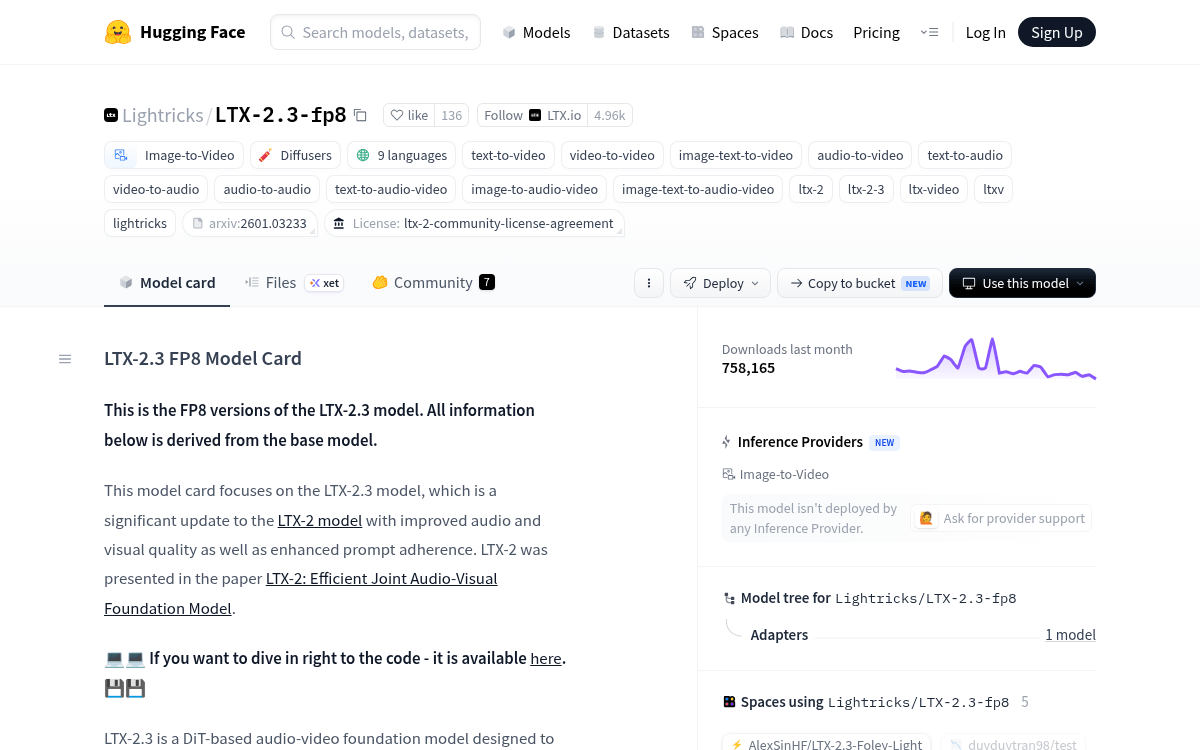
Lightricks has released LTX-2.3-fp8, an FP8-quantized version of its LTX-2.3 audio-video foundation model and an incremental update to the LTX-2 family of open-weight diffusion transformers that generate synchronized video and audio in a single pass. The FP8 build cuts memory footprint roughly in half compared to bf16, which determines whether the 22B-parameter model fits on a single high-end consumer card.
What changed in 2.3
LTX-2.3 carries the same architecture as LTX-2 with targeted improvements to audio and visual quality and prompt adherence. The FP8 release ships in two variants:
ltx-2.3-22b-dev-fp8: the full 22B model, flexible and trainable.ltx-2.3-22b-distilled-fp8: a distilled build that runs in 8 steps with classifier-free guidance disabled (CFG=1), cutting inference cost dramatically.
The distilled version is what most developers will reach for. Eight steps with no CFG delivers roughly a 5-10x speedup over standard 50-step diffusion sampling, and FP8 weights bring the whole thing within reach of a single 24-32GB GPU.
How the underlying model works
LTX-2 is a DiT-based audio-video foundation model described in the LTX-2 paper. Its 14B video parameters and 5B audio parameters are trained jointly, so motion, dialogue timing, and ambient sound align without a separate dubbing pass. The design targets native 4K at 50fps with lip sync, foley, and ambient sound in sequences up to 10 seconds, all within a single production-ready system. LTX-2.3 holds that envelope and refines quality and prompt-following inside it.
Running it locally
The FP8 checkpoint is on Hugging Face and integrates with the LTX-2 monorepo, which splits into ltx-core (model definition), ltx-pipelines (inference), and ltx-trainer. Requirements are Python 3.12+, CUDA 12.7+, and PyTorch 2.7. Three entry points are available:
- ComfyUI, via the built-in LTXVideo nodes from the ComfyUI Manager.
- The PyTorch monorepo, installed with
uv syncfrom source. - Diffusers support, listed as coming soon in the model card.
A minimal image-to-video call looks like this:
import torch
from diffusers import DiffusionPipeline
from diffusers.utils import load_image, export_to_video
pipe = DiffusionPipeline.from_pretrained(
    "Lightricks/LTX-2.3-fp8", dtype=torch.bfloat16, device_map="cuda"
)
prompt = "A man with short gray hair plays a red electric guitar."
image = load_image("...guitar-man.png")
output = pipe(image=image, prompt=prompt).frames[0]
export_to_video(output, "output.mp4")
Two hard constraints apply: width and height must be divisible by 32, and frame count must follow the 8n + 1 rule. The docs recommend padding with -1 and cropping after generation if your inputs fall outside those bounds.
License and access
The weights use the LTX-2 Community License rather than a permissive Apache-style license, so commercial teams should read the terms before shipping. Lightricks also offers a hosted API Playground for teams that prefer not to manage GPUs, with claimed output costs up to 50% below competing models.
Strengths and known limits
The primary use cases are short cinematic clips, ad and social content, previz, and image-to-video animation with matching foley. Joint audio-video training means lip sync and ambient sound come from one model rather than two stitched together.
The model card is candid about the edges. Prompt adherence depends heavily on prompting style, non-speech audio quality lags behind speech, and complex multi-subject scenes with long temporal consistency remain difficult for the whole diffusion video category. The model is also not a factual information source.
A 22B model on one GPU
A 22B joint audio-video DiT now fits into a single-GPU FP8 workflow with an 8-step distilled sampler, collapsing much of the gap between the open-weights ecosystem and closed audio-video systems for short-form generation. Add LoRA fine-tuning support and a public trainer package, and LTX-2.3 becomes one of the more practical bases for developers building video tooling on open weights rather than a hosted API.