
Lightricks' LTX-Video Runs Real-Time 30 FPS Video on Your own GPU
Lightricks' open-weights LTX-Video model renders 30 FPS clips faster than realtime using a DiT diffusion backbone, with 13B and 2B variants available.
 Pro
Takeaways
- LTX-Video is a DiT-based open model generating 30 FPS clips at 1216x704 faster than realtime
- Family includes 13B dev, 13B distilled, 2B distilled, and FP8 quantized variants for different VRAM budgets
- Supports image-to-video, video-to-video, multi-keyframe conditioning, and forward/backward video extension
- Multi-scale rendering with a latent upsampler lets you generate low-res then sharpen for speed
- Ships with IC-LoRAs for depth, pose, canny and detailer control plus native ComfyUI workflows
- Available on Hugging Face with Diffusers integration and local inference scripts
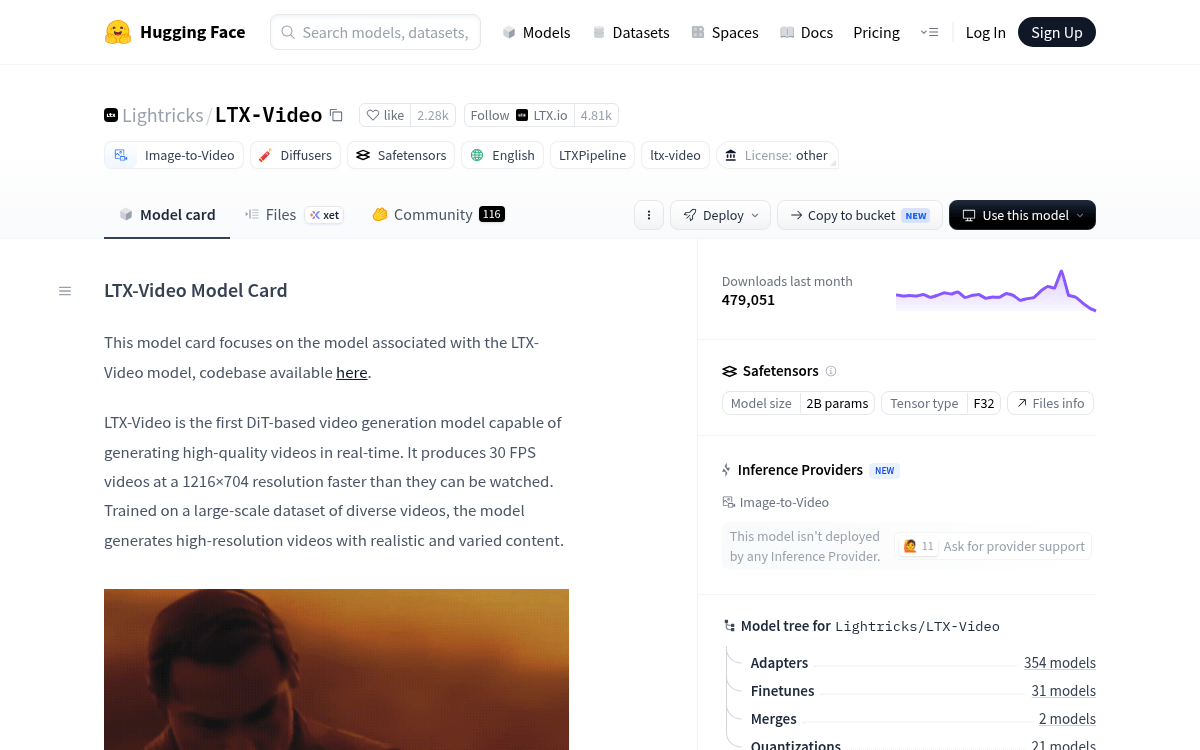
Lightricks has quietly turned its LTX-Video repository into one of the most complete open-source video generation stacks on Hugging Face, pulling in nearly half a million downloads and 2.2K likes. The model card now covers a full family of checkpoints, from a lightweight 2B distilled version aimed at low-VRAM laptops to a 13B flagship with FP8 quantization and IC-LoRA control adapters. The pitch: real-time diffusion video you can actually run yourself.
Diffusion transformers fast enough to stream
LTX-Video is the first DiT-based video generation model that produces high-quality clips in real time, hitting 30 FPS at 1216x704 faster than they can be watched. DiT here means Diffusion Transformer, the same class of architecture behind Sora and Stable Diffusion 3, where a transformer replaces the usual U-Net denoiser. These models are historically heavy, so realtime throughput on a single GPU is the entire selling point.
The trick is a family of distilled variants that trade a small amount of fidelity for large speedups. The current lineup on the card:
- ltxv-13b-0.9.8-dev: highest quality, biggest VRAM footprint
- ltxv-13b-0.9.8-distilled: faster iteration, slight quality drop
- ltxv-13b-0.9.8-mix: runs dev and distilled together in a multi-scale render for balanced speed and quality
- ltxv-2b-0.9.8-distilled: the small model for constrained hardware
- FP8 quantized versions of each, for further VRAM reduction
The older 0.9.6 distilled build already advertised being 15x faster and real-time capable, requiring fewer steps and no STG or CFG at inference. The 0.9.8 branch keeps that speed and adds a 13B tier for people who need more scene complexity.
What you can actually do with it
Text-to-video is only the start. LTX-Video supports image-to-video, multi-keyframe conditioning, keyframe-based animation, video extension (both forward and backward), video-to-video transformations, and any combination of these features. That last part matters, since it lets you chain conditions, for example seeding a clip with an image at frame 0 and a target frame at frame 96, then extending the result backwards.
The Diffusers integration exposes this through a condition object, and the recommended pattern uses a two-stage render with a latent upsampler:
from diffusers import LTXConditionPipeline, LTXLatentUpsamplePipeline
from diffusers.pipelines.ltx.pipeline_ltx_condition import LTXVideoCondition
pipe = LTXConditionPipeline.from_pretrained("Lightricks/LTX-Video-0.9.8-dev", torch_dtype=torch.bfloat16).to("cuda")
upsampler = LTXLatentUpsamplePipeline.from_pretrained("Lightricks/ltxv-spatial-upscaler-0.9.8", vae=pipe.vae, torch_dtype=torch.bfloat16).to("cuda")
condition = LTXVideoCondition(video=load_video(export_to_video([image])), frame_index=0)
latents = pipe(conditions=[condition], prompt=prompt, num_frames=96, output_type="latent").frames
upscaled = upsampler(latents=latents, output_type="latent").frames
Generate at a lower resolution, upscale the latents 2x, then run a short denoising pass on the upscaled latents to sharpen texture. It is significantly cheaper than sampling at full resolution directly.
Shape rules and sweet spots
A couple of shape rules will bite you if you ignore them. The model works on resolutions divisible by 32 and frame counts divisible by 8 + 1 (e.g. 257). If the resolution or frame count violates those constraints, the input gets padded with -1 and then cropped back to the requested dimensions.
Quality peaks below 720 x 1280 and under 257 frames. Prompts should be in English, and the more elaborate the better. Terse prompts produce weak motion, and the training documentation itself uses long, cinematographic descriptions with camera angles, lighting, and color palette callouts.
Where it fits, and where it does not
Known limitations are typical for the category. Prompt following is heavily influenced by prompting style, and the model may miss details in complex prompts. It is not intended to convey factual information, and like any statistical model it can amplify biases in the training data.
The practical use cases where it genuinely shines:
- Fast iteration on storyboards and animatics, where you need to see many candidate shots quickly
- Image-to-video where a single reference frame drives motion
- Style-controlled generation via LoRAs and the IC-LoRAs for depth, pose, and canny edge conditioning
- Local, offline pipelines through the ComfyUI-LTXVideo nodes
Lightricks has kept iterating aggressively on this same repository, and the family has since branched into a larger audio-video foundation effort. The base LTX-Video codebase remains the most accessible entry point if you want a diffusion transformer video model that runs on your own box, in your own workflow, without an API call in the middle.