
LAION's Open CLIP Matches OpenAI's Accuracy and Powers 2.4M Downloads
An open source CLIP ViT-L/14 trained on 2 billion image-text pairs matches OpenAI's original model at 75.3 percent ImageNet zero-shot accuracy.
 Pro
Takeaways
- LAION's CLIP ViT-L/14 matches OpenAI's original at 75.3% ImageNet zero-shot, fully open under MIT.
- Trained on 2 billion English image-text pairs from LAION-5B, 428M parameters total.
- Used 384 A100 GPUs on JUWELS Booster, processing 32B samples over 160 virtual epochs.
- Loss spiked at epoch 75 in float16; restarting in float32 with TF32 matmuls resolved instabilities.
- Powers zero-shot classification, retrieval, and conditioning for diffusion pipelines like PuLID-FLUX.
- English-only training, uncurated web data, and surveillance use cases are explicitly out of scope.
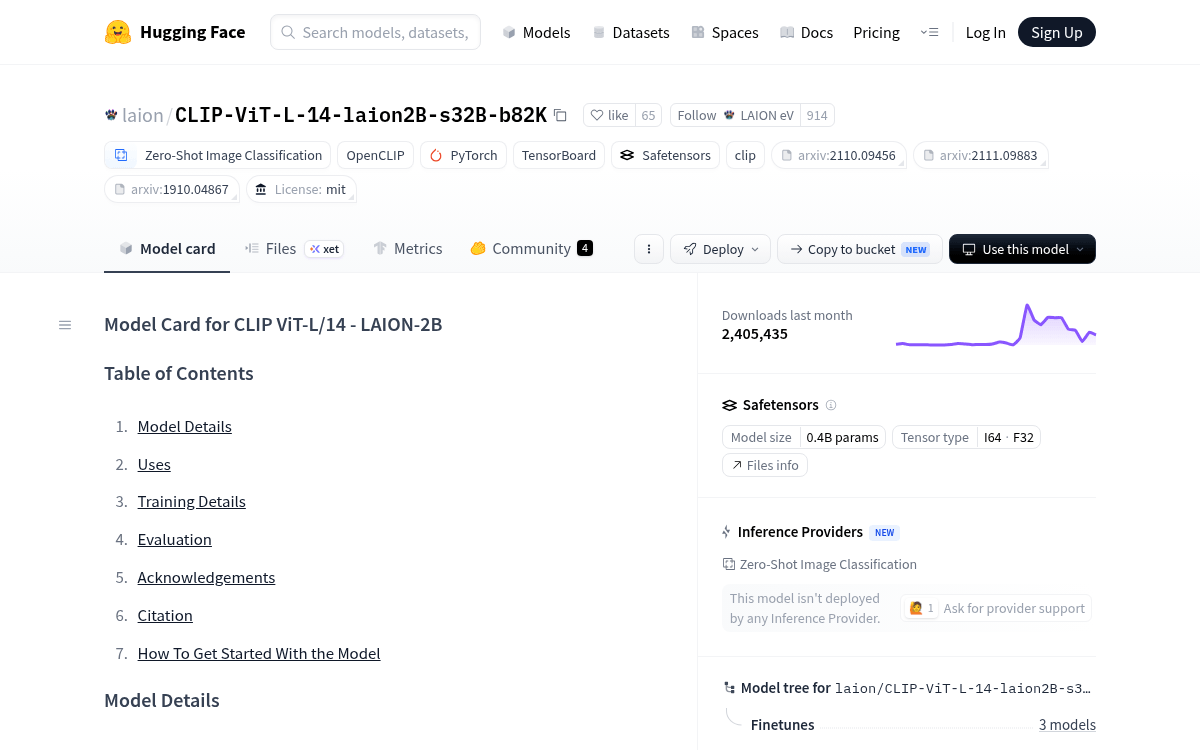
A fully open reproduction of OpenAI's CLIP has become one of the most heavily downloaded vision-language checkpoints on Hugging Face, and it quietly powers a large slice of the modern generative stack. The LAION CLIP ViT-L/14 model, trained on the 2 billion English image-text pair subset of LAION-5B, matches the original OpenAI weights on ImageNet zero-shot while shipping under a permissive MIT license.
Matching a closed model with open data
ViT-L/14 on LAION-2B reaches 75.3% accuracy on ImageNet-1k zero-shot classification, versus 75.5% for OpenAI's weights. Parity matters here because the original CLIP was trained on a private 400M pair dataset that was never released, which made independent research on scaling laws, bias, and safety nearly impossible.
There is a nice circularity to the result. OpenAI's ViT-B/32 CLIP was used to filter the LAION dataset out of Common Crawl in the first place, so producing the strongest open CLIP from that data closed the loop on replicating the paper a year after it appeared. The full CLIP benchmark suite covers 39 datasets, and the evaluation shows consistent gains over smaller baselines across all of them.
What the checkpoint actually is
The model is a 428M parameter Vision Transformer with a paired text transformer, trained contrastively so that matching image-caption pairs produce similar embeddings. Typical uses include:
- Zero-shot image classification against arbitrary text labels
- Image-to-text and text-to-image retrieval at billion-scale
- Conditioning signal for diffusion models and image generation guidance
- Feature extraction for linear probes and downstream fine-tuning
- Similarity scoring for dataset filtering and deduplication
Loading it in Python takes two calls through the open_clip library:
import open_clip
model, _, preprocess = open_clip.create_model_and_transforms(
    'hf-hub:laion/CLIP-ViT-L-14-laion2B-s32B-b82K')
tokenizer = open_clip.get_tokenizer(
    'hf-hub:laion/CLIP-ViT-L-14-laion2B-s32B-b82K')
The training run that almost did not survive
The compute recipe is documented in unusual detail, and the story reveals how brittle large contrastive runs can be. Training happened on the JUWELS Booster supercomputer using 384 A100 GPUs, processing 32B samples over 160 virtual epochs. Ross Wightman ran the job with a global batch size around 79K.
Then it broke. The first 68 epochs used float16 mixed precision, but at epoch 75 the loss spiked and training crashed with NaN values. The team tried the standard playbook: reshuffling data, lowering the learning rate, adding gradient clipping, and testing architecture tweaks like NormFormer normalization layers and Swin-V2 style scaled cosine attention. None of it stuck. The eventual fix was restarting at epoch 69 in full float32 precision, which on A100s with TF32 matmuls enabled ran only about 10 percent slower than float16 AMP. That is a useful data point for anyone chasing instabilities in large contrastive runs, where the temptation is always to change the architecture first.
Where it shines and where it does not
The strengths follow directly from the CLIP objective. Zero-shot classification against natural language prompts, embedding-based retrieval, and using the frozen vision tower as a feature extractor all work well out of the box. The checkpoint is also the workhorse text encoder for a large family of diffusion pipelines and personalization tools, which is why Spaces like PuLID and PuLID-FLUX depend on it.
The weaknesses matter just as much:
- Training and evaluation covered English only, so use should stay within English-language applications.
- Performance varies substantially with prompt phrasing and class taxonomy, so any production deployment requires in-domain testing.
- The corpus is an uncurated web scrape. The maintainers explicitly warn that collected links may lead to strongly discomforting or disturbing content, so filtering and safety review fall on the user.
- Surveillance and facial recognition are declared out of scope regardless of measured accuracy.
Why L/14 is still the default
Larger open CLIPs exist now, including the ViT-bigG/14 model that reaches 80.1 zero-shot top-1 on ImageNet-1k, with H/14 sitting in between. L/14 remains the sweet spot for most projects. It fits comfortably on a single consumer GPU for inference, is fast enough for retrieval over millions of images, and has the largest ecosystem of finetunes, adapters, and diffusion integrations. With over 2.4 million downloads and a place in more than 100 Hugging Face Spaces, this checkpoint is effectively infrastructure at this point, the default answer when you need image embeddings and do not want to send your data to an API.