
LAION's Open CLIP Beats OpenAI's Original With 66.6% Zero-Shot Accuracy
LAION released an openly reproducible CLIP ViT-B/32 trained on 2 billion English image-text pairs, hitting 66.6% zero-shot ImageNet accuracy.
 Pro
Takeaways
- LAION released an open CLIP ViT-B/32 trained on 2B English image-text pairs from LAION-5B.
- Achieves 66.6% zero-shot top-1 accuracy on ImageNet-1k, beating OpenAI's original ViT-B/32.
- Trained with the OpenCLIP framework on the stability.ai cluster by Romain Beaumont.
- MIT licensed, ~200M parameters, works via a single OpenCLIP hub reference.
- Intended for research: zero-shot classification, retrieval, fine-tuning, and generative guidance.
- Deployment, surveillance, non-English use, and unfiltered production pipelines are explicitly out of scope.
LAION's open reproduction of OpenAI's CLIP is one of the more consequential open-weight releases in vision-language modeling. The CLIP ViT-B/32 checkpoint was trained on the LAION-2B English subset of LAION-5B using the OpenCLIP framework and distributed under an MIT license for research use. It serves as a fully open counterpart to OpenAI's closed CLIP weights, with published training data, code, and logs.
The checkpoint at a glance
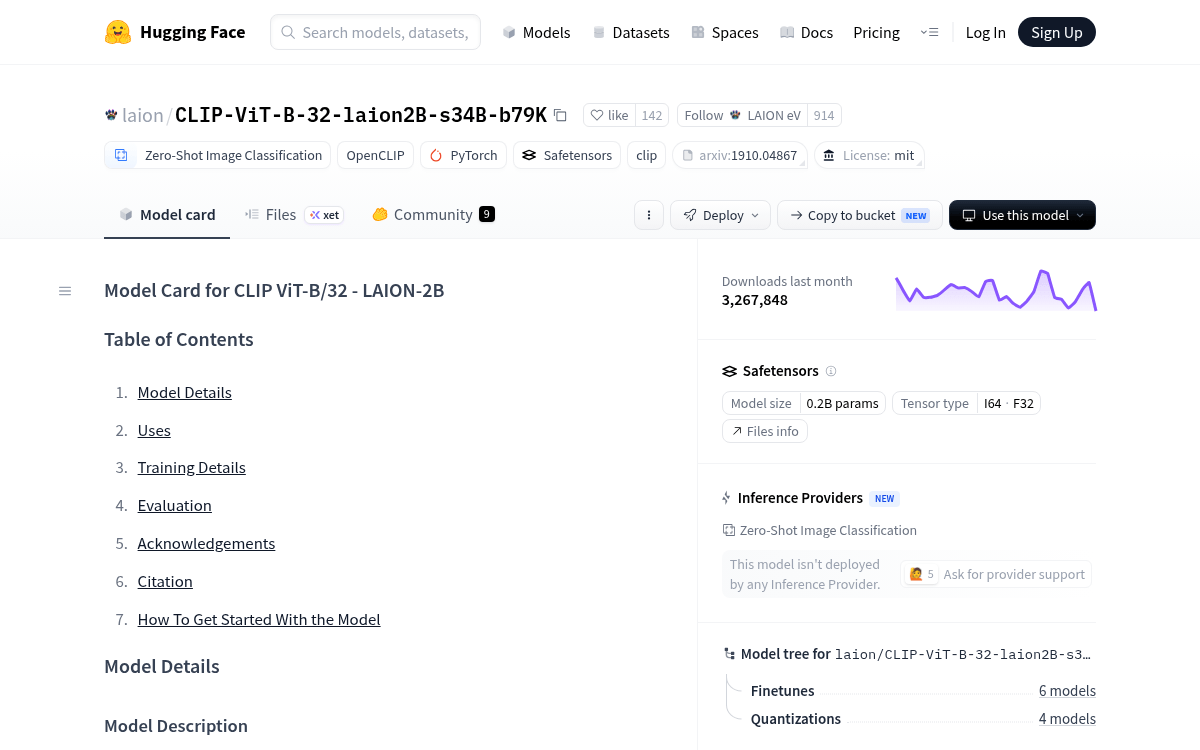
The model is a standard CLIP dual-encoder with a ViT-B/32 image tower and a text transformer, weighing in at roughly 200M parameters. Training was carried out by Romain Beaumont on the stability.ai cluster. The suffix in the model name encodes the training budget: s34B refers to samples seen and b79K to global batch size.
How it was trained
The dataset is the English-caption slice of LAION-5B, a 2-billion-sample subset drawn from an uncurated web crawl. LAION built the corpus to democratize research on large-scale multimodal training and on handling messy, internet-scale data. Training ran on the OpenCLIP codebase, an open reimplementation of the contrastive image-text objective from the original CLIP paper. LAION also published Weights and Biases logs and internal training notes so anyone can reproduce the run.
For context on scale, the sibling LAION-400M runs used comparable hardware profiles: replicating OpenAI's results on ViT-B/32 and reaching 62.96% top-1 ImageNet-1k zero-shot accuracy. That run used 128 A100 (40 GB) GPUs for roughly 36 hours, or 4,600 GPU-hours, with a per-GPU batch size of 256 and a global batch size of 32,768. The LAION-2B version scales the data by about 5x, which drives the accuracy gains.
What it does well
On the standard benchmark, ViT-B/32 on LAION-2B lands at 66.6% top-1 zero-shot on ImageNet-1k, a meaningful jump over OpenAI's original ViT-B/32 (around 63%) at the same architecture size. Direct uses include:
- Zero-shot image classification against arbitrary text labels
- Image-to-text and text-to-image retrieval
- Linear-probe classification and fine-tuning for downstream vision tasks
- Conditioning and guidance signals for diffusion-based image generation
At about 200M parameters and under a permissive license, it has become a common default embedding backbone for open source pipelines, showing up inside spaces like PuLID-FLUX, rollingdepth, and various retrieval demos on the Hub.
Where it falls down
The model was trained on uncurated web crawl data with English captions only, and the authors are explicit that it should not be treated as production-ready. Collected links can lead to strongly discomforting content, and the model card flags hard limits on deployment: any commercial use is out of scope without task-specific testing, surveillance and facial recognition are ruled out regardless of accuracy, and inputs should be limited to English.
ViT-B/32 also sits at the small end of what open CLIP now offers. If you need better zero-shot accuracy, ViT-L/14 on LAION-2B reaches 75.3% and ViT-H/14 on LAION-2B hits 78.0%, the best ImageNet-1k zero-shot for released open-source weights so far. B/32 stays relevant because it is fast enough for large-scale indexing and cheap enough to run on modest GPUs.
Using it
The model plugs directly into the OpenCLIP API via a Hugging Face Hub reference, with no manual weight download needed:
import open_clip
import torch
from PIL import Image
model, _, preprocess = open_clip.create_model_and_transforms(
    'hf-hub:laion/CLIP-ViT-B-32-laion2B-s34B-b79K'
)
tokenizer = open_clip.get_tokenizer('hf-hub:laion/CLIP-ViT-B-32-laion2B-s34B-b79K')
image = preprocess(Image.open('cat.jpg')).unsqueeze(0)
text = tokenizer(['a cat', 'a dog', 'a car'])
with torch.no_grad():
    image_features = model.encode_image(image)
    text_features = model.encode_text(text)
    probs = (image_features @ text_features.T).softmax(dim=-1)
Why the release still matters
The broader significance is reproducibility. Before OpenCLIP, the CLIP paper's numbers were essentially unverifiable by outsiders because the weights and training data were closed. LAION's series showed that scaling laws hold for contrastive image-text training on fully public data, with LAION-5B explicitly framed as a way to reproduce CLIP's results and validate the data collection pipeline across several models trained on LAION-400M and one on LAION-2B-en. Training those models demands significant compute given the dataset and model sizes, which is why this specific checkpoint has become a default embedding backbone across the open ecosystem, from retrieval benchmarks to diffusion model conditioning.