
LAION's ConvNeXt CLIP Beats ViT on ImageNet With 3x Fewer Samples
LAION's ConvNeXt-Base CLIP hits 71.5% ImageNet zero-shot on LAION-2B, matching ViT-B/16 with fewer samples seen.
 Pro
Takeaways
- LAION released the first known ConvNeXt-Base CLIP trained at scale on LAION-2B.
- The augreg variant hits 71.5% ImageNet zero-shot top-1 after 13B samples seen.
- Beats ViT-B/16 at matched sample budget (68.1%), suggesting better sample efficiency.
- Stronger augmentation (RRC, Random Erasing, Stochastic Depth) yields better cross-resolution generalization, reaching 72.2% at 384x384.
- Trained on Stability.ai A100 clusters and the JUWELS Booster supercomputer with batch size 81920.
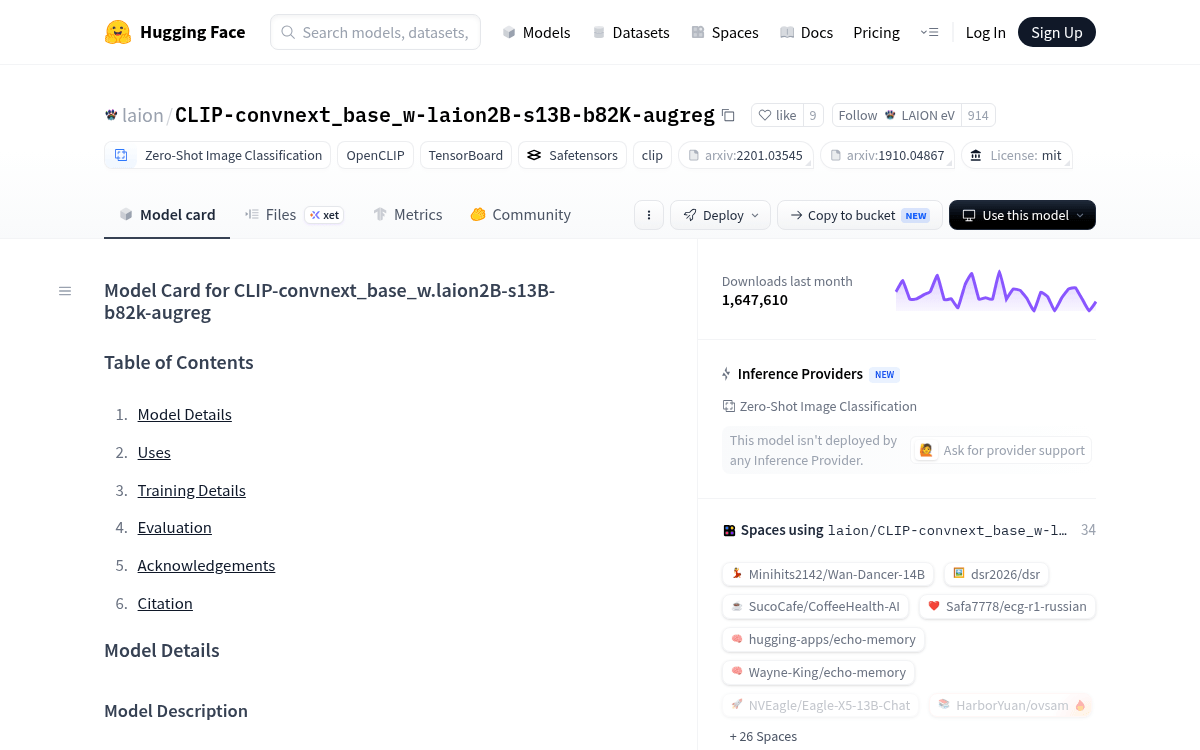
- Loadable via OpenCLIP, MIT license, over 1.6M downloads.
LAION quietly shipped something interesting: the first known ConvNeXt-based CLIP models trained at scale, breaking the near-monopoly ViT has held over contrastive vision-language pretraining. The augreg variant of the base model hits 71.5% ImageNet zero-shot top-1 accuracy after seeing 13B samples of LAION-2B, matching an RN50x4 in FLOPs.
The release is a family of five checkpoints on Hugging Face under the MIT license, downloadable through OpenCLIP with a single call. It has already crossed 1.6 million downloads and is embedded in dozens of Spaces, quietly becoming a default backbone for retrieval and guidance pipelines.
A ConvNet crashes the ViT party
CLIP training at scale has been almost exclusively ViT or ResNet-with-attention-pooling territory. The stated goal here is to explore an alternative that scales well with model size and image resolution, using the ConvNeXt architecture from the "A ConvNet for the 2020s" paper as the image tower.
The architecture pairing is specific: the models use the timm ConvNeXt-Base as the image tower, and the same text tower as the RN50x4 (depth 12, embed dim 640) from OpenAI CLIP. Base models train at 256x256, with a _320 variant at 320x320. The "w" in the name refers to a wider embedding dimension than stock ConvNeXt.
Sample efficiency, quantified
The headline comparison is where things get interesting. All models in this series were trained for 13B samples and reach ImageNet zero-shot top-1 of at least 70.8%. ViT-B/16 at 34B samples seen posts 70.2% zero-shot (68.1% at 13B samples), which suggests ConvNeXt may be more sample efficient in this range of model scale. The team flags that more experiments are needed to confirm, but the delta is real: at matched sample budget, ConvNeXt-Base wins by 3+ points over ViT-B/16.

The augreg trick
The augreg suffix is the second first-of-its-kind claim here: the first released model weights that push augmentation and regularization harder on the image tower via a wider RRC scale range, random erasing, and stochastic depth. Concretely, the augreg recipe drops the Random Resize Crop lower bound from 0.9 to 0.33, adds Random Erasing at 0.35 probability, and turns on Stochastic Depth at 0.1.
The payoff shows up beyond native resolution. Early evaluations suggest augreg-trained models hold up over a wider range of input sizes. The 320x320 LAION-A model illustrates this well: the augreg run scored lower than the non-augreg at its train resolution of 320x320 (71.3 vs 71.7), but climbed to 72.2 when evaluated at 384x384, while the non-augreg dropped to 71.0. That's a genuinely useful property if you want to fine-tune or deploy at a resolution different from what the encoder saw during training.
How it was trained
The compute footprint is substantial but documented. All models were trained with a global batch size of 81920 for 64 checkpoint intervals of 203.7M samples, totaling roughly 13B samples seen. For 256x256 models, the setup used 20 8-GPU A100 40GB nodes on the Stability cluster, switching to 40 4-GPU nodes on JUWELS. The 320 variants scaled up to 32 8-GPU nodes.
Notable training details from the slurm script:
- Precision:
amp_bfloat16 - Learning rate: 1e-3 with 10k warmup steps
- Gradient clipping at norm 5.0
local-lossandgather-with-gradfor the contrastive loss- Gradient checkpointing enabled to fit the batch
Using it
Loading via OpenCLIP is a two-liner:
import open_clip
model, _, preprocess = open_clip.create_model_and_transforms(
    'hf-hub:laion/CLIP-convnext_base_w-laion2B-s13B-b82K-augreg'
)
tokenizer = open_clip.get_tokenizer(
    'hf-hub:laion/CLIP-convnext_base_w-laion2B-s13B-b82K-augreg'
)
Where it fits
The intended surface area is broad. Direct use covers zero-shot image classification and image-text retrieval, while downstream use includes classification fine-tuning, linear probes, and image generation guidance and conditioning. That last one is why you'll find this checkpoint hiding inside a lot of diffusion pipelines as a text-image alignment scorer or CLIP-guidance encoder.
The caveats are stated bluntly. Any deployed use case, commercial or not, is currently out of scope, and non-deployed uses like image search are not recommended without thorough in-domain testing against a specific fixed class taxonomy. Surveillance and facial recognition are ruled out regardless of accuracy, and the model is English-only. For research, retrieval prototyping, or a diffusion guidance signal, this is a strong drop-in that punches above its FLOPs. For production, treat it as a starting point that needs its own evaluation harness.