
LAION's CLAP Hits 17M Downloads Doing for Audio What CLIP Did for Images
LAION open-sourced CLAP, an audio-text contrastive model that maps sounds and natural language into a shared embedding space for zero-shot classification and retrieval.
 Pro
Takeaways
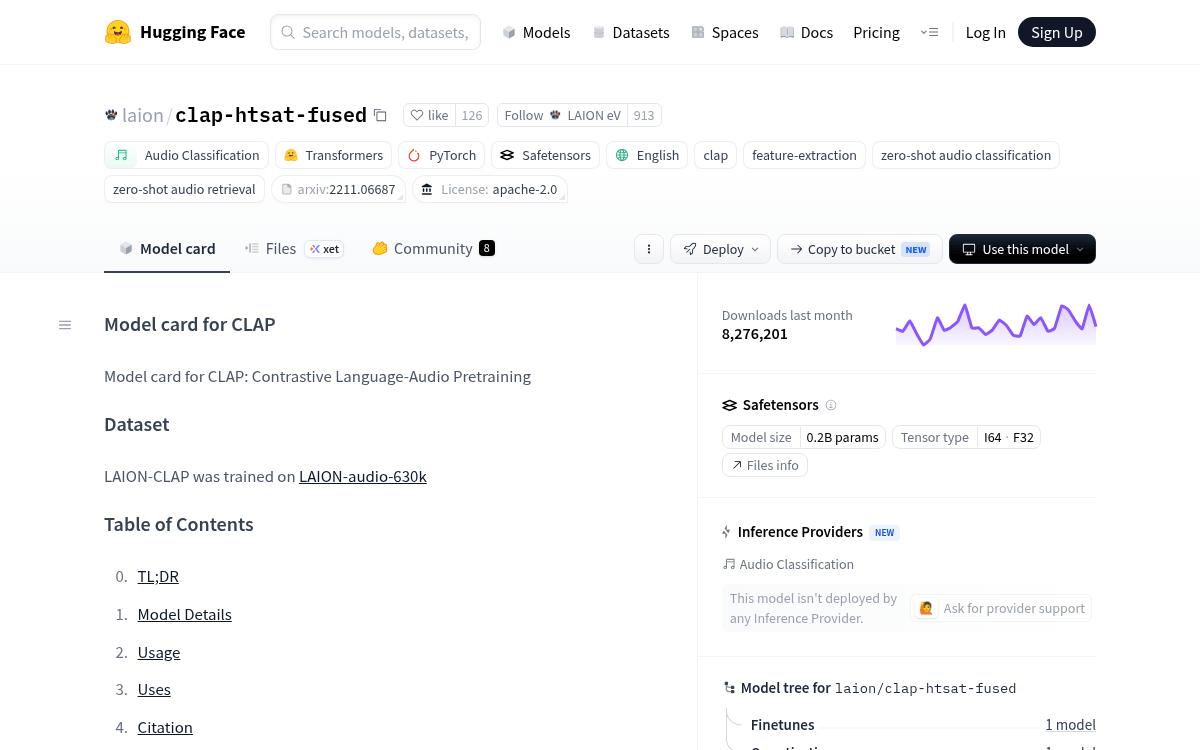
- LAION released clap-htsat-fused on Hugging Face under Apache 2.0 for open audio-text tasks.
- Dual-encoder architecture pairs HTS-AT audio transformer with RoBERTa text encoder into a 512-dim joint space.
- Trained on LAION-Audio-630K, a public dataset of 633,526 audio-text pairs.
- Feature fusion handles variable-length audio; keyword-to-caption augmentation expands supervision from tagged datasets.
- Achieves state-of-the-art zero-shot audio classification and text-to-audio retrieval per the paper.
- Native Transformers pipeline support at roughly 0.2B parameters; over 17M downloads on the Hub.
LAION has released clap-htsat-fused on Hugging Face under Apache 2.0, an open-source Contrastive Language-Audio Pretraining model that does for sound what CLIP did for images. It maps audio clips and text captions into the same embedding space, so you can classify or search recordings using plain English prompts without any task-specific training data.
The release ships with native Transformers integration, weights in safetensors, and a companion dataset. It has already crossed 17 million downloads on the Hub, making it the de facto open baseline for audio-text tasks.
Sound meets sentences
CLAP is a dual-encoder architecture trained with contrastive loss, meaning it learns to pull matching (audio, caption) pairs together in embedding space and push mismatched pairs apart. HTS-AT (Hierarchical Token-Semantic Audio Transformer) handles the audio side, RoBERTa handles text, training data comes from AudioSet, Clotho, and other audio-text pair collections, and the output is a 512-dim joint embedding space.
The training corpus is the other half of the release. LAION first put out LAION-Audio-630K, a collection of 633,526 audio-text pairs pulled from varied sources. That dataset is what makes the whole thing reproducible; anyone can retrain or extend the model on the same footing.
Why the fused variant matters
Audio is awkward for transformers because clips vary wildly in length. The fused in clap-htsat-fused refers to a design choice that fixes this. The authors added a feature fusion mechanism and keyword-to-caption augmentation to handle variable-length inputs and boost performance.
Feature fusion lets the model combine a global look at the full clip with local windows, so a 30 second field recording and a 2 second bark both get sensible representations. Keyword-to-caption augmentation synthesizes natural language captions from tag lists, expanding the effective supervision from labeled datasets like AudioSet.
What it can actually do
The authors evaluated the model across three tasks: text-to-audio retrieval, zero-shot audio classification, and supervised audio classification. Results show superior performance on text-to-audio retrieval, state-of-the-art numbers on zero-shot classification, and results comparable to fully supervised models in the non-zero-shot setting.
Concrete things you can build with it:
- Zero-shot sound tagging where you supply candidate labels as strings at inference time
- Semantic audio search over a library using natural language queries like "crowd cheering" or "rain on a roof"
- Audio embeddings for downstream classifiers, clustering, or deduplication
- Conditioning signal for text-to-audio generation models
The MTEB leaderboard and dozens of Spaces already use it as an embedding backbone, and it appears as a standard baseline in newer audio benchmarks. LAION ships several variants beyond the fused checkpoint: htsat-fused and htsat-unfused at 153M parameters, plus larger 193M variants specialized for general audio, music, and combined music-speech. The typical usage pattern is the audio encoder branch with L2 normalization applied to the output embeddings.
Three lines to a working classifier
Transformers integration means you do not need the original LAION codebase. A zero-shot classifier looks like this:
from transformers import pipeline
clf = pipeline(task="zero-shot-audio-classification", model="laion/clap-htsat-fused")
out = clf(audio_array, candidate_labels=["Sound of a dog", "Sound of vacuum cleaner"])
For retrieval or downstream tasks, ClapModel.get_audio_features and get_text_features return the joint embeddings directly. The model weighs in at roughly 0.2B parameters and runs comfortably on a single consumer GPU.
Limitations worth knowing
CLAP is English-only, trained primarily on general sound events, music, and some speech. It will not transcribe words, and its music understanding is coarser than dedicated music models. Newer follow-ups like GLAP, an open-source CLAP-style dual encoder with 855M parameters, target unified audio-text representations across speech, sound, and music, and use a multilingual text encoder based on Sonar. Multilingual or speech-heavy use cases have better options there.
For the vast majority of "tag this sound" or "find clips that match this description" problems, CLAP remains the fastest way to get a strong baseline running. A permissive license, small footprint, and Hugging Face integration are why it has quietly become the default embedding layer for open-source audio pipelines.