
Kijai's FLUX.1 FP8 Cuts Memory in Half to Fit 12GB Cards
Kijai's FP8 quantized FLUX weights cut the model size roughly in half, making the 12B parameter image generator run on consumer GPUs through ComfyUI.
 Pro
Takeaways
- Kijai's flux-fp8 packages FP8 quantized FLUX.1-dev and schnell weights, roughly halving VRAM needs.
- Includes both float8_e4m3fn and float8_e5m2 variants at about 11.9GB each versus 24GB original.
- Also ships an FP8 quantized Shakker Labs ControlNet Union Pro for spatial control workflows.
- Drop-in compatible with ComfyUI's Load Diffusion Model node by setting weight_dtype to fp8_e4m3fn.
- Dev weights are Non-Commercial License; schnell weights are Apache-2.0 and safe for commercial use.
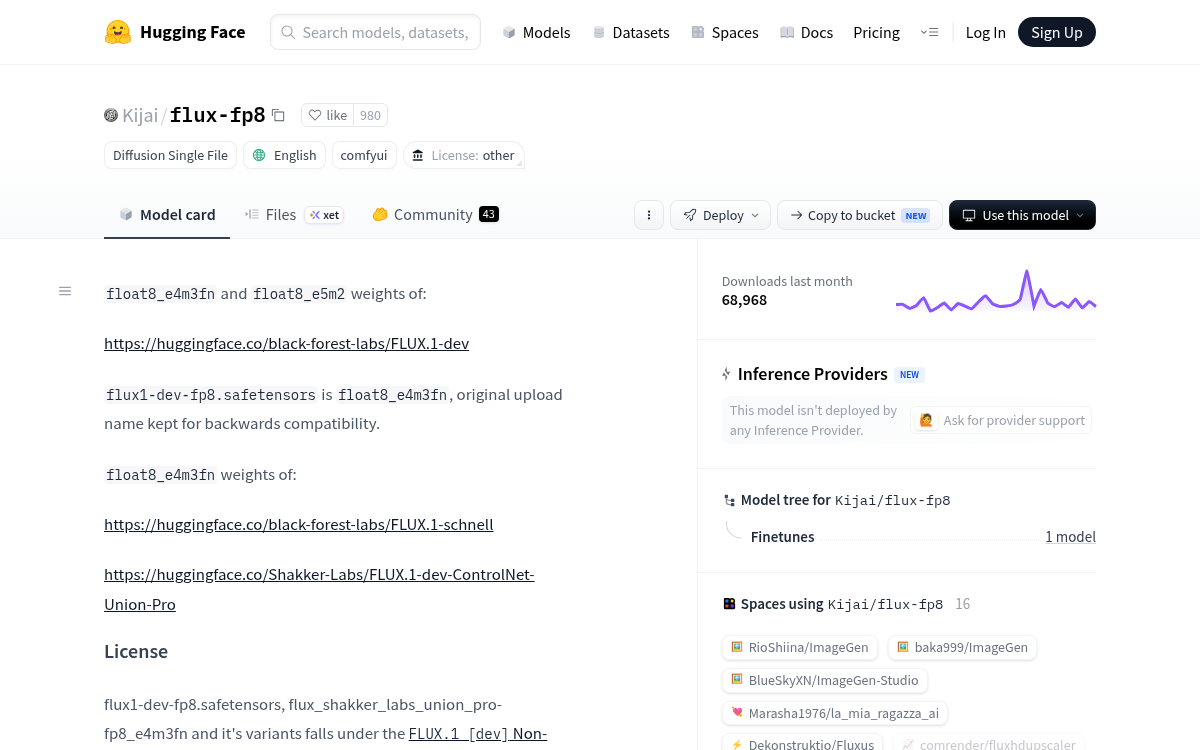
- Nearly 70,000 downloads and 980 likes make it the de facto FLUX quantization for consumer GPUs.
Running FLUX.1 at full precision is a memory hog. The original 12B parameter transformer from Black Forest Labs ships as roughly 24GB of BF16 weights, which puts it out of reach for anyone without a 24GB+ card. Kijai's flux-fp8 repository has quietly become the community's default fix, packaging FP8 quantized versions of FLUX.1-dev, FLUX.1-schnell, and a matching ControlNet into drop-in ComfyUI files. It has racked up nearly 70,000 downloads and sits at 980 likes on Hugging Face.
Inside, you'll find float8_e4m3fn and float8_e5m2 weights of FLUX.1-dev, float8_e4m3fn weights of FLUX.1-schnell, and the Shakker-Labs FLUX.1-dev-ControlNet-Union-Pro. Each quantized checkpoint clocks in at about 11.9GB, roughly half the size of the original BF16 release, which is the difference between fitting the model on a 12GB card and not.
What FP8 actually means here
FP8 is an 8-bit floating point format with two common flavors, and both are present in this repo. E4M3 uses 4 exponent bits and 3 mantissa bits, favoring precision over dynamic range. E5M2 flips that budget with 5 exponent bits and 2 mantissa bits, giving it more headroom for large activations but coarser resolution between values.
Kijai notes that the two formats produce slightly different results, but it's hard or impossible to say which is better. Most users default to E4M3 for image generation, since diffusion transformers tend to benefit from the extra precision more than the extra range.
Dropping the weights into ComfyUI
The workflow is straightforward if you're already running ComfyUI. Put the fp8 flux1-dev safetensors in models/diffusion_models/, add the T5, CLIP-L, and VAE to their folders, then load the default Flux workflow from the Manager's workflow browser. In the Load Diffusion Model node, set weight_dtype to fp8_e4m3fn. Set it in the node, not on the command line, since ComfyUI's fp8_e4m3fn-unet flag is often ignored by Flux's loader.
A typical setup looks like this:
flux1-dev-fp8.safetensorsinmodels/diffusion_models/- T5-XXL and CLIP-L encoders in
models/text_encoders/ flux-vae-bf16.safetensorsinmodels/vae/- Optional:
flux_shakker_labs_union_pro-fp8_e4m3fnfor ControlNet
The wins and the rough edges
The main win is memory. Cutting the checkpoint in half brings FLUX.1-dev into range for 12GB and 16GB cards, and pairing FP8 with the 4-step schnell variant makes rapid iteration on consumer hardware genuinely usable. On 40-series Nvidia GPUs and later, FP8 matmuls are supported natively, so you also get real throughput gains rather than just a smaller footprint.
The tradeoffs are subtle but real. Scaled fp8 FLUX.1 runs faster than Q quantized models but may show slightly lower quality, and it expects the newest ComfyUI version alongside the TorchCompileModel node. Compatibility gaps also show up: the scaled fp8 model doesn't work with Redux or some ControlNet models. For users on tighter VRAM budgets, GGUF quantizations through ComfyUI-GGUF at Q4 or Q5 have become a popular alternative when FP8 still doesn't fit.
Licensing to keep in mind
The licensing mirrors the upstream models. flux1-dev-fp8.safetensors, the Shakker Labs union pro variants, and their derivatives fall under the FLUX.1 dev Non-Commercial License, while flux1-schnell-fp8.safetensors falls under Apache-2.0. If you're building a commercial product, schnell is the only option in this repo without going back to Black Forest Labs for a commercial dev license.
Why this matters
Quantization is what turns frontier open-weight models into tools people can actually run at home. This repo did that work early for FLUX, and the numbers show it stuck: ComfyUI and Stable Diffusion WebUI ship built-in support, and the FP8 checkpoints have been forked, mirrored, and referenced across dozens of downstream projects and Spaces. If you're touching FLUX in any local pipeline, there's a good chance you're pulling weights that trace back here.