
InstantX's InstantID Clones Your Face From One Selfie Without Any Training
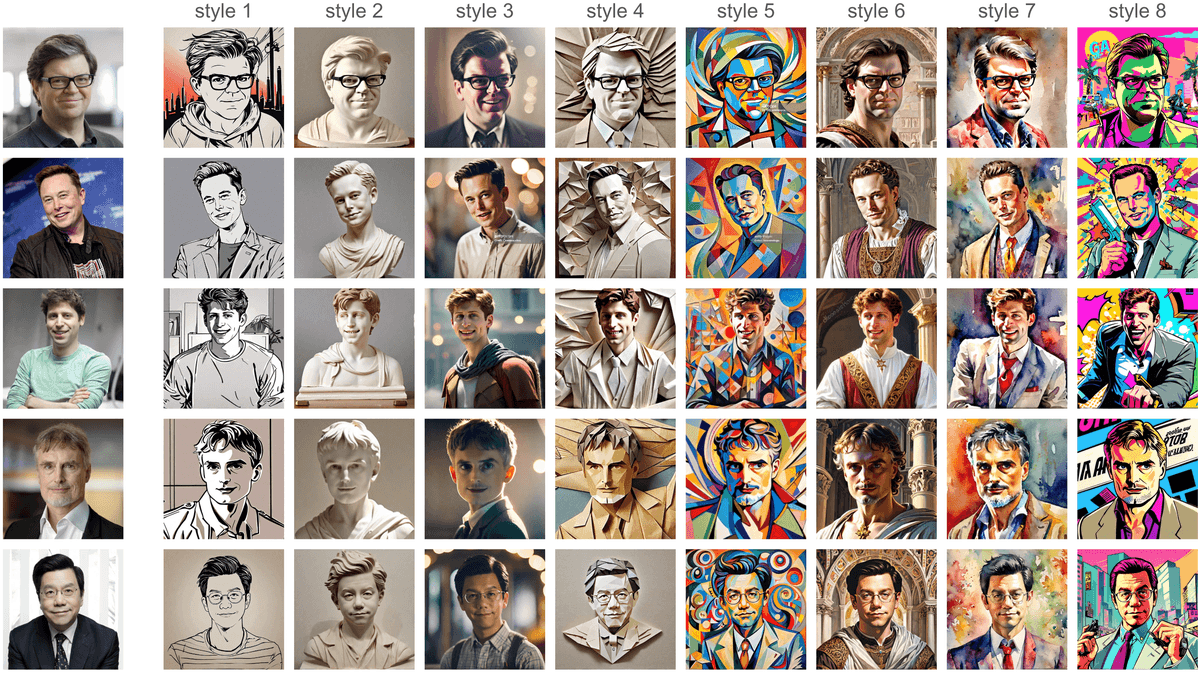
InstantID delivers zero-shot identity preservation from a single face photo, plugging into SDXL without fine-tuning, LoRAs, or multiple reference images.
 Pro
Takeaways
- InstantID generates identity-preserving images from a single face photo with no fine-tuning required.
- Uses IdentityNet: strong face-embedding conditioning plus weak facial-landmark spatial control via ControlNet.
- Plug-and-play adapter for SD1.5 and SDXL, composes with community checkpoints and other ControlNets.
- Apache 2.0 license, roughly 59,000 downloads, powering 100+ Hugging Face Spaces already.
- Weaknesses: prompt adherence degrades at high adapter strength, biased toward frontal portrait framing.
- Paper and code released, reframing personalization as conditioning rather than weight updates.
Personalized image generation has long forced a choice between quality and convenience. Methods like DreamBooth and LoRA can lock onto a person's likeness with impressive accuracy, but they demand multiple reference photos, gigabytes of storage per subject, and often an hour of GPU fine-tuning. Feed-forward alternatives are faster but sacrifice facial fidelity or fail to compose with community-trained checkpoints. InstantID from the InstantX team is a plug-and-play adapter that generates identity-preserving portraits from a single selfie in a single forward pass, with no per-subject training at all.
One photo, zero fine-tuning
Hand InstantID one face image and a text prompt, and it produces a new image of that person in whatever style, pose, or scene the prompt describes. There is no per-subject training loop, no LoRA to save, no textual inversion embedding to manage. Released under Apache 2.0 on Hugging Face with roughly 59,000 downloads, the model targets Stable Diffusion XL as its base but composes with the broader library of community checkpoints on Civitai and Hugging Face, including SD1.5 and SDXL variants.
How IdentityNet works
Prior ID-embedding approaches treat a face as a CLIP-style image embedding, which produces images that vaguely resemble the subject but drift on the fine details that make a face recognizable. InstantID splits conditioning into two channels instead:
- Strong semantic condition: a face embedding extracted by an off-the-shelf face recognition model (InsightFace's
antelopev2), which encodes identity in a compact, high-signal vector. - Weak spatial condition: a five-point facial keypoint map (eyes, nose, mouth corners) fed through a ControlNet-style branch to loosely anchor pose and layout without over-constraining geometry.
Using five landmarks rather than a full depth or edge map is the key architectural choice. Dense spatial signals from a reference photo drag the pose, lighting, and framing along with the identity, undermining the model's ability to follow the text prompt. Sparse keypoints preserve enough structural grounding while leaving the diffusion process room to follow compositional instructions.
Running it
The Hugging Face repository ships ControlNet weights, an IP-Adapter checkpoint, and a custom SDXL pipeline. A minimal working setup:
from diffusers.models import ControlNetModel
from insightface.app import FaceAnalysis
from pipeline_stable_diffusion_xl_instantid import StableDiffusionXLInstantIDPipeline, draw_kps
app = FaceAnalysis(name='antelopev2', providers=['CUDAExecutionProvider'])
app.prepare(ctx_id=0, det_size=(640, 640))
controlnet = ControlNetModel.from_pretrained('./checkpoints/ControlNetModel', torch_dtype=torch.float16)
pipe = StableDiffusionXLInstantIDPipeline.from_pretrained(
    'stabilityai/stable-diffusion-xl-base-1.0', controlnet=controlnet, torch_dtype=torch.float16
).to('cuda')
pipe.load_ip_adapter_instantid('./checkpoints/ip-adapter.bin')
face_info = sorted(app.get(img), key=lambda x: (x['bbox'][2]-x['bbox'][0])*x['bbox'][3]-x['bbox'][1])[-1]
image = pipe(prompt, image_embeds=face_info['embedding'],
             image=draw_kps(face_image, face_info['kps']),
             controlnet_conditioning_scale=0.8).images[0]
Two parameters do most of the tuning work. set_ip_adapter_scale controls how strongly the face embedding dominates the diffusion process, while controlnet_conditioning_scale controls how strictly the landmark map is respected. The model card flags oversaturation as a common failure mode when adapter scale is pushed too high, and recommends dropping adapter strength before adjusting IdentityNet strength.
Strengths and limitations
In practice, InstantID handles several tasks well:
- Recognizable likeness from a single reference, whether a celebrity, a historical figure, or a personal selfie.
- Stylization across radically different domains such as anime, oil painting, analog film, and 3D render while keeping the face identifiable.
- Composition with community SDXL checkpoints and other ControlNets, so pose control, background control, and style LoRAs stack on top.
- Single forward pass, seconds per image on a consumer GPU, with no per-subject training artifacts to store.
Several limitations are worth understanding before building on it:
- Prompt adherence weakens as adapter strength climbs. A very strong identity signal partially overrides text instructions about clothing, expression, or scene.
- The landmark ControlNet biases layouts toward frontal, portrait-style framing similar to the reference photo. Wide shots and unusual angles are harder to achieve.
- Realism from the base SDXL checkpoint is uneven; the authors recommend swapping in a photoreal community model for convincing photographs.
- Multi-subject identity control is outside the model's native capability. It handles one face per image cleanly.
Where it fits in the ecosystem
InstantID entered a field where PhotoMaker, IP-Adapter FaceID, and various DreamBooth pipelines were competing for the same job. It drew attention by satisfying three constraints simultaneously: single reference image, no training, and high identity fidelity. The GitHub repository has been forked into ComfyUI nodes, Replicate deployments, and over 100 Hugging Face Spaces, including pixel-art converters, background swappers, and identity-preserving stylizers.
Practical applications
- Consumer avatar apps that previously required 20 selfies and a fine-tuning job now need one photo and a prompt.
- Marketing and e-commerce workflows where a single approved headshot needs re-rendering across dozens of scenes.
- Storyboarding and character consistency for indie animators and comic creators.
- Research baselines for identity-preservation, face fidelity metrics, and controllability studies, since the paper and weights are both open.
Personalization as a conditioning problem
For two years, the dominant assumption was that personalization required optimization: DreamBooth's full fine-tune or a LoRA adapter trained per subject. InstantID is part of a broader wave demonstrating that a well-designed conditioning architecture on top of a frozen base model can match or beat fine-tuning for narrow tasks like face identity. That reframing has real engineering consequences: less per-user state to manage, more general-purpose adapters, and future generative pipeline work concentrated in how signals are injected into diffusion rather than in modifying the base model itself.