
Indonesian RoBERTa Tagger Hits 2.4M Downloads Tagging Bahasa Indonesia Text
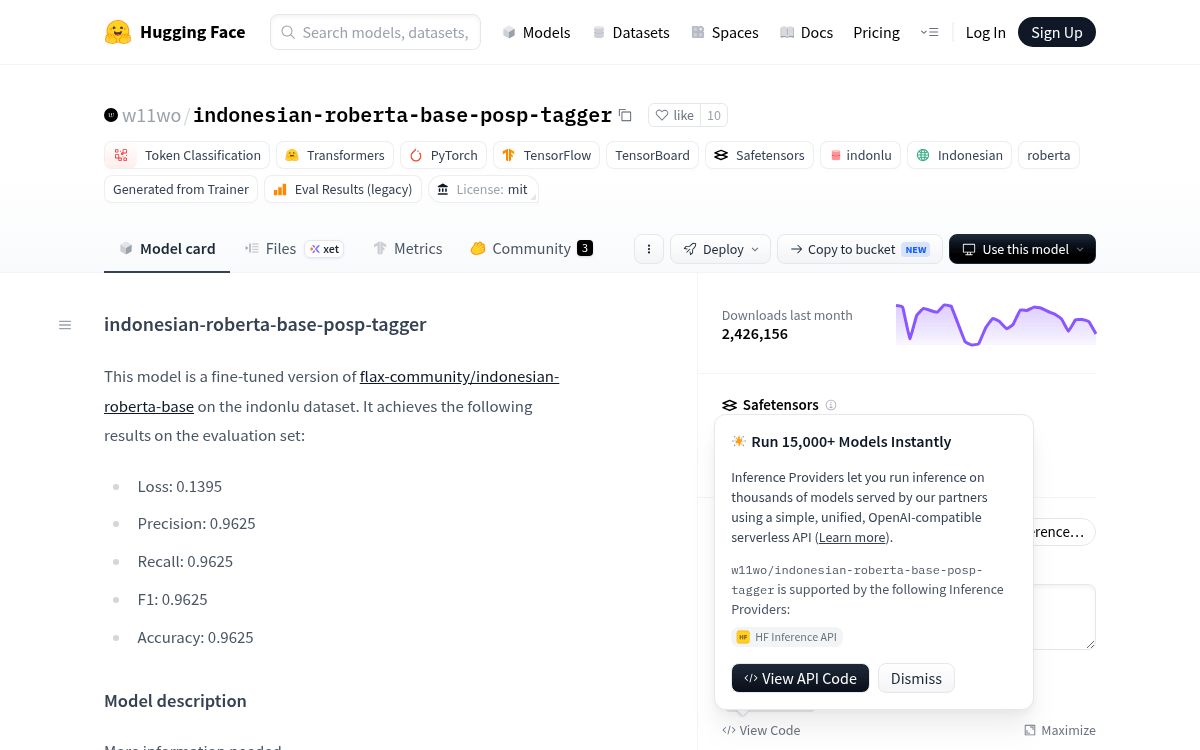
A compact RoBERTa fine-tune for Bahasa Indonesia part-of-speech tagging hits 96% F1 and quietly crosses 2.4M downloads on Hugging Face.
 Pro
Takeaways
- Indonesian RoBERTa POS tagger crosses 2.4M downloads on Hugging Face.
- Reports 96.25% F1, precision, recall and accuracy on the IndoNLU POSP evaluation set.
- Fine-tuned from flax-community/indonesian-roberta-base, a 124M-parameter model pretrained on OSCAR Indonesian.
- Trained on IndoNLU POSP: 8000 news sentences, 26 INACL POS tags.
- MIT license, PyTorch, TensorFlow and Safetensors weights, standard token-classification pipeline.
- Best for formal Indonesian text, weaker on slang, code-mixing or regional languages.
Indonesian NLP has a quiet workhorse. A RoBERTa-based part-of-speech tagger called indonesian-roberta-base-posp-tagger has racked up more than 2.4 million downloads on Hugging Face, making it one of the most heavily used Bahasa Indonesia token classifiers in the wild. It is small, permissively licensed, and posts strong numbers on the standard benchmark for the task.
What the tagger actually does
Given an Indonesian sentence, the model assigns a part-of-speech tag to every token: noun, verb, adjective, particle, and so on. It is a fine-tuned version of flax-community/indonesian-roberta-base on the IndoNLU dataset, specifically the POSP subtask. POSP contains roughly 8,000 sentences scraped from Indonesian news sites, annotated with 26 POS tags following the Indonesian Association of Computational Linguistics (INACL) convention.
On the evaluation set, the checkpoint reports a loss of 0.1395 with precision, recall, F1 and accuracy all at 0.9625. The identical precision and recall are a giveaway that the score is computed at the token level rather than per-entity, but for a POS task that framing is the norm, and 96% is a solid number for a base-sized encoder.
Plugging it in
The model is MIT-licensed, weighs in at roughly 0.1B parameters, and ships in PyTorch, TensorFlow, and Safetensors formats. The simplest way to use it is the standard token-classification pipeline:
from transformers import pipeline
pipe = pipeline(
    "token-classification",
    model="w11wo/indonesian-roberta-base-posp-tagger",
    aggregation_strategy="simple",
)
print(pipe("Budi sedang belajar di sekolah."))
Because it is a standard Hugging Face checkpoint, it drops straight into existing spaCy-transformers, Spark NLP, or ONNX export pipelines. There is no hosted API cost from the author; you pay only whatever compute you run it on, and a single modern GPU will tag thousands of sentences per second.
The base model underneath
The backbone matters because it dictates the vocabulary and pretraining distribution. Indonesian RoBERTa Base is a masked language model trained from scratch on the unshuffled_deduplicated_id subset of OSCAR, reaching an evaluation loss of 1.798 and evaluation accuracy of 62.45%. Training ran on a TPUv3-8 VM sponsored by Google Cloud during the JAX/Flax Community Week, using HuggingFace's Flax framework. That monolingual pretraining is why it tends to outperform multilingual BERT variants on Indonesian-specific downstream tasks despite its modest size.
Inside the fine-tune
The recipe is boringly standard, which is part of why it is easy to trust and reproduce. The training hyperparameters were:
- Learning rate: 2e-5
- Train and eval batch size: 16
- Optimizer: Adam, betas (0.9, 0.999), epsilon 1e-8
- Scheduler: linear
- Epochs: 10, seed 42
The training log shows validation F1 climbing from 0.9313 after epoch 1 to a peak of 0.9646 at epoch 10, with validation loss bottoming out around epoch 5 and drifting up afterward. That is the classic signature of mild overfitting past epoch 5, so if you plan to retrain on your own data you can probably stop earlier and save time.
Where it shines, where it stumbles
The POSP training data comes from Indonesian news, so the tagger is strongest on formal, edited Bahasa Indonesia. Good fits include:
- Preprocessing pipelines for search, summarization, or retrieval over Indonesian corpora
- Feature extraction for downstream classifiers that need syntactic signals
- Linguistic analytics, lemmatization heuristics, and rule-based information extraction
- Educational tools and grammar checkers
Expect weaker results on very colloquial text, Twitter-style code-mixing with English, or regional languages like Javanese and Sundanese. For those, a sibling benchmark exists: BaPOS contains about 1,000 sentences from the PAN Localization Project, tagged with 23 POS classes, and separate fine-tunes have been trained on that split.
Why a small tagger punches above its weight
Indonesian is the fourth most spoken language on the planet and remains chronically under-served by NLP tooling. IndoNLU addresses that gap with 12 downstream tasks, pre-trained IndoBERT models, and starter code. This tagger is a concrete example of that ecosystem paying off: a hobbyist-published fine-tune, built on a community-pretrained backbone, that has quietly become critical infrastructure for anyone building Indonesian text pipelines. The 2.4 million-download counter is the tell. When you need POS tags in Bahasa Indonesia today, this is the default option, and unless your domain sits far from news text, it will do the job without any additional training.