
IBM Research Opens PowerMoE-3B, a 3B Model Running on 800M Parameters
IBM Research quietly released a 3B sparse MoE that activates only 800M parameters per token, trained with a new learning-rate scheduler that removes most hyperparameter guesswork.
 Pro
Takeaways
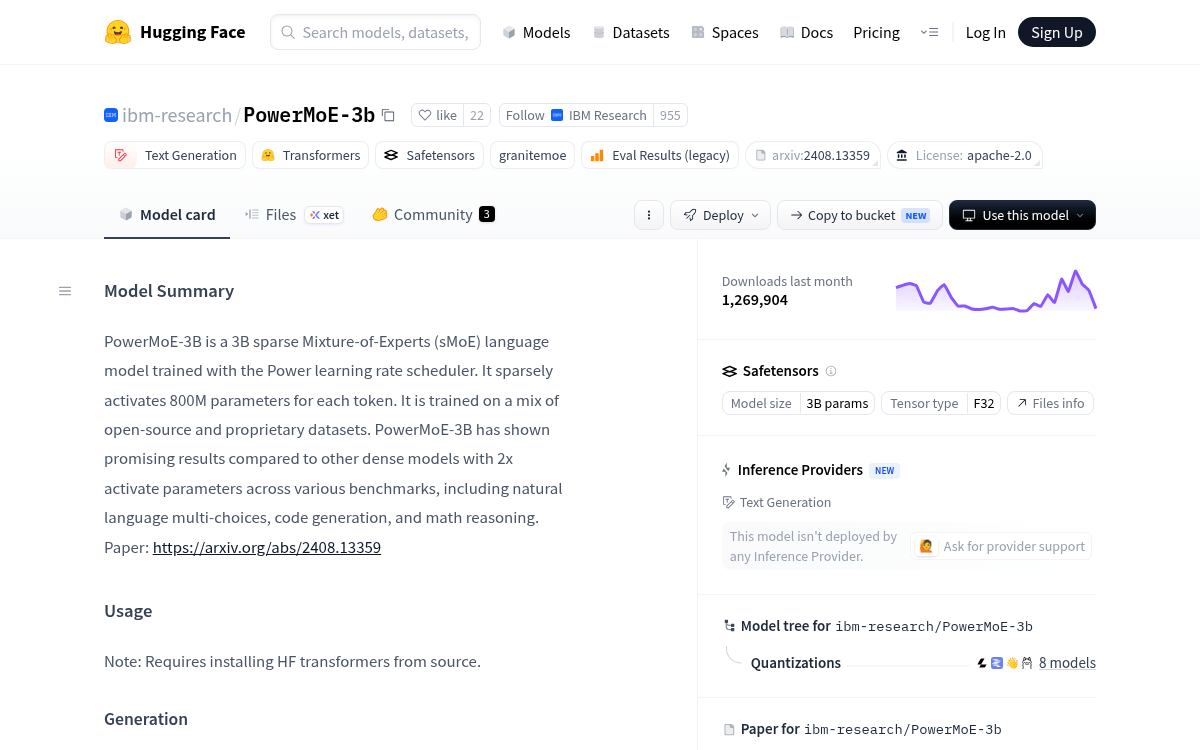
- IBM Research released PowerMoE-3b, a 3B sparse MoE activating only 800M parameters per token.
- Licensed Apache-2.0, with 1.27M downloads and support in Transformers, vLLM, and SGLang.
- Matches dense 1B-2B models on ARC (58.1), Hellaswag (71.5), PIQA (79.1), MMLU (42.8).
- Trained with the new Power scheduler, invariant to batch size and token count.
- Two-stage training: 2.5T tokens with power decay, then exponential decay on high-quality data.
- Base model only, no instruction tuning; weak at math reasoning (GSM8k 25.9).
IBM Research has open-sourced PowerMoE-3b, a small mixture-of-experts language model that has quietly racked up more than 1.2 million downloads on Hugging Face. Size is not what makes it interesting. It is the reference model for a new learning-rate scheduler that IBM claims removes the need to re-tune hyperparameters when you change batch size or training token count.
A 3B model that runs like a 1.6B one
PowerMoE-3B is a 3B sparse mixture-of-experts (sMoE) language model trained with the Power learning rate scheduler. It sparsely activates 800M parameters per token and was trained on a mix of open-source and proprietary datasets. That sparsity ratio matters for anyone deploying on modest hardware: you pay the memory cost of a 3B model but the compute cost of an 800M forward pass.
IBM reports that this compute-light configuration keeps pace with state-of-the-art 1B to 2B dense models on standard benchmarks. The self-reported numbers on the model card:
| Benchmark | Score |
|---|---|
| ARC (norm) | 58.1 |
| BoolQ | 65.0 |
| Hellaswag (norm) | 71.5 |
| PIQA (norm) | 79.1 |
| Winogrande (norm) | 65.0 |
| MMLU (5-shot) | 42.8 |
| GSM8k (5-shot) | 25.9 |
Those are respectable commonsense and reading-comprehension numbers for the active-parameter budget. Math and multi-step reasoning (GSM8k at 25.9) are the obvious weak spots, typical for small MoE models without instruction tuning or reasoning-specific post-training. There is no chat template either, so this is a base model, not a drop-in assistant.
The training recipe is the real product
The model exists to demonstrate a paper called Power Scheduler. The problem it targets will be familiar to anyone who has trained an LLM: full hyperparameter sweeps at billion- or trillion-parameter scale are prohibitively expensive.
The common workaround is to search hyperparameters on a small proxy model and transfer them upward. That works for width and depth via Maximum Update Parameterization (muP), which lets you tune a tiny model and reuse the settings on a much larger one. Zero-shot transfer from a small corpus to a large one is far less understood. muP alone will not tell you what learning rate to use when you 10x your token budget.
IBM's contribution is empirical. Extensive experiments show that muTransfer does not provide direct zero-shot learning rate transferability across token counts and batch sizes for the WSD optimizer. Instead, the optimal learning rate follows a power-law relation with batch size and token count. The authors bake that power law into the schedule itself, producing a decay curve that is invariant with respect to token count and batch size.
The practical payoff, according to the paper: combining the Power scheduler with muP achieves consistent performance with one set of hyperparameters regardless of training tokens, batch size, model size, or even model architecture. If that holds up in your own runs, you tune once on a small proxy and reuse the schedule across production training.
How the model itself was built
The recipe follows a two-stage schema. Stage 1 linearly warms up the learning rate and then applies the power decay, training on a mix of large-scale, medium-quality open-source datasets with permissive licenses. PowerLM-3B is trained on 1T tokens; PowerMoE-3B on 2.5T tokens. Stage 2 exponentially decays the learning rate to zero on a blend of stage-1 data and a smaller amount of high-quality open-source and synthetic corpora, also permissively licensed. The MoE variant uses IBM's granitemoe architecture, the same family that powers their Granite models.
Getting it running
The model is Apache-2.0 licensed and works with standard Transformers, vLLM, and SGLang. A minimal load looks like:
from transformers import AutoModelForCausalLM, AutoTokenizer
model_path = "ibm-research/PowerMoE-3b"
tokenizer = AutoTokenizer.from_pretrained(model_path)
model = AutoModelForCausalLM.from_pretrained(model_path, device_map="cuda")
prompt = "Write a function to find the maximum value in a list."
inputs = tokenizer(prompt, return_tensors="pt").to("cuda")
out = model.generate(**inputs, max_new_tokens=100)
print(tokenizer.batch_decode(out)[0])
For serving, vllm serve ibm-research/PowerMoE-3b gives you an OpenAI-compatible endpoint. Quantized GGUF forks exist in the community for llama.cpp, Ollama, and LM Studio.
Who should actually care
Two audiences stand out. Teams training their own small-to-mid-scale LLMs get a cheap swap in the training script that could save serious compute on hyperparameter sweeps. Teams shipping edge or CPU inference get MoE-style capability with a small active footprint. If you need a polished chatbot out of the box, fine-tune this base model or reach for an instruction-tuned Granite variant instead. As a research-quality base to build on, or a reproducible testbed for scheduler ablations, PowerMoE-3B is a clean starting point.