
Hugging Face Speeds Up Sparse Retrieval 3x With sentence-transformers 5.1.0
Hugging Face ships sentence-transformers 5.1.0 with ONNX and OpenVINO backends for sparse encoders, plus cross-device negative gathering for contrastive training.
 Pro
Takeaways
- sentence-transformers v5.1.0 adds ONNX and OpenVINO backends for SparseEncoder models.
- Benchmarks show up to 3x CPU speedup and 1.81x GPU speedup with bf16.
- New
gather_across_devicesflag pools in-batch negatives across GPUs with no memory cost. - Hard negative mining gains an
n-tuple-scoresoutput format for distillation losses. - Trackio integration adds local experiment tracking; MTEB evaluation guide now official.
- Fixes for Datasets v4, Router initialization under DataParallel, and FIPS compatibility.
Hugging Face cut a new release of sentence-transformers that squeezes more speed out of sparse retrieval models and hands trainers a few fresh levers for contrastive learning. Version 5.1.0 adds two accelerated inference backends for SparseEncoder models, extends hard-negative mining with a distillation-friendly output format, and lets multi-GPU training pool in-batch negatives across devices at effectively zero cost.
Alongside those headline changes, the release ships trackio support, an MTEB evaluation guide, Datasets v4 compatibility, and a batch of smaller fixes.
Sparse retrieval gets an ONNX runtime
Dense embedding models in the library already had ONNX and OpenVINO paths. Version 5.1.0 extends the same treatment to SparseEncoder, the class behind SPLADE-style models that produce high-dimensional sparse vectors (a weight per vocabulary token) rather than a compact dense embedding. Sparse retrieval slots neatly into inverted-index infrastructure like Elasticsearch, but the encoder step has historically been the bottleneck.
Selecting a backend is a single keyword argument at load time. If the repo does not already ship an exported artifact, sentence-transformers will export one on the fly:
from sentence_transformers import SparseEncoder
model = SparseEncoder("naver/splade-v3", backend="onnx")
query_emb = model.encode_query("Which planet is known as the Red Planet?")
doc_emb = model.encode_document(["Mars is often referred to as the Red Planet."])
print(model.similarity(query_emb, doc_emb))
The maintainer's benchmarks, averaged across three datasets and multiple batch sizes, report a 1.81x GPU speedup with bf16 at no accuracy cost, and up to roughly 3x on CPU with minimal accuracy loss. Install picks the runtime:
pip install sentence-transformers[onnx]for CPU ONNX Runtimepip install sentence-transformers[onnx-gpu]for CUDA ONNX Runtimepip install sentence-transformers[openvino]for Intel's OpenVINO toolkit
A mining format built for distillation
Hard negative mining teaches retrieval models to separate near-duplicates from true matches. The utility function mine_hard_negatives now supports an n-tuple-scores output that emits query, answer, N negatives, and a list of teacher scores in one row. That shape plugs directly into distillation losses like MarginMSELoss, DistillKLDivLoss, and their sparse variants, which learn from the margins between scores rather than binary labels.
Because the loss uses score deltas, false negatives that happen to score higher than the positive stop being a problem. You can mine aggressively and let the teacher scores sort it out.
Free in-batch negatives across GPUs
Contrastive losses like MultipleNegativesRankingLoss and its cached variant treat every other sample in a batch as a negative. Bigger batches mean more negatives, which means stronger models, but memory sets the ceiling. The new gather_across_devices=True flag pulls samples from other GPUs into each device's loss computation without changing per-device memory usage.
The maintainer's example makes the multiplier concrete. With 8 GPUs and per_device_train_batch_size=128, a triplet sample normally sees 255 negatives. Flip the gather flag on and that jumps to 2047 negatives per sample. In a finetune of mpnet-base on Natural Questions, the flag lifted NDCG@10 from 0.5111 to 0.5359 with runtime essentially unchanged.
Smaller wins worth knowing
- Trackio integration: install trackio and training runs log to a local dashboard automatically, with no external service required.
- MTEB documentation: the official guide for benchmarking SentenceTransformer models against the Massive Text Embedding Benchmark now exists.
- Datasets v4 compatibility, plus a fix for
Routertorch initialization that had been degrading DataParallel behavior. - FIPS compatibility restored in the hard-negative caching path by tagging SHA256 with
usedforsecurity=False. - CrossEncoder.predict no longer crashes on an empty list.
Who should upgrade first
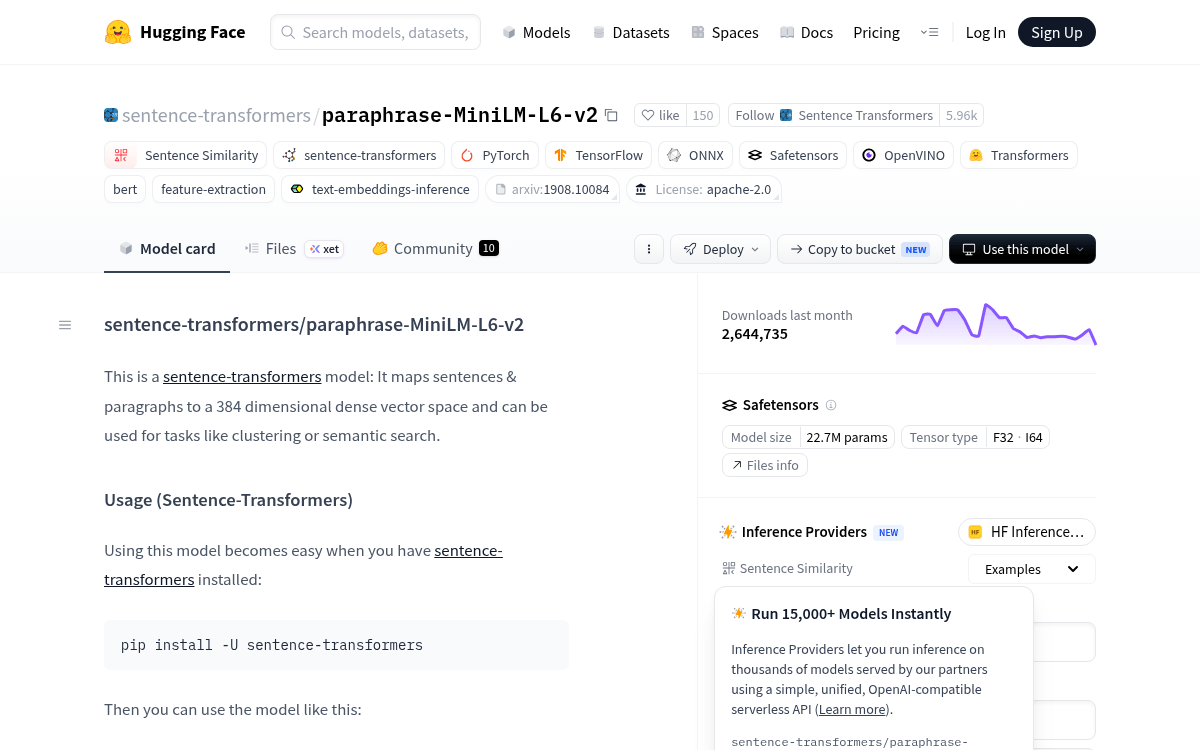
Teams running SPLADE or another sparse encoder in production have the strongest reason to move: the ONNX and OpenVINO backends alone reshape the deployment math for anyone serving sparse retrieval on commodity hardware or trimming embedding costs. Model tags on the Hub already reflect the broader ecosystem shift, with widely used checkpoints like paraphrase-MiniLM-L6-v2 now carrying ONNX, OpenVINO, and safetensors artifacts alongside the original PyTorch weights.
Teams training their own retrievers get the cheapest quality bump from the gather-across-devices flag. Anyone distilling from a strong cross-encoder teacher will appreciate that the new mining format removes an annoying data-plumbing step. The full changelog and benchmark plots live in the inference speedup docs.