
Hugging Face's timm Adds LowFormer and Lets AI Agents Hunt Bugs
Ross Wightman ships timm 1.0.29, adding the LowFormer efficient vision backbone and a batch of fixes surfaced by AI coding agents.
 Pro
Takeaways
- timm 1.0.29 released on PyPI, adding the LowFormer efficient vision backbone with pretrained weights.
- A batch of small bugs was fixed after being surfaced by AI coding agents rather than human users.
- Install or upgrade with
pip install --upgrade timm; Apache-2.0 licensed and free. - All models remain accessible through the same
create_modelfactory API, including EfficientNetV2-S. - Continues 2026's push toward small, latency-focused backbones for CPU, mobile, and edge inference.
- Fourth timm release of 2026, following 1.0.26, 1.0.27, and 1.0.28 earlier in the year.
The PyTorch Image Models library, better known as timm, just tagged version 1.0.29. One new architecture family lands in the model zoo, and a chunk of the patch notes covers bugs flagged by AI agents crawling the codebase rather than by human users.
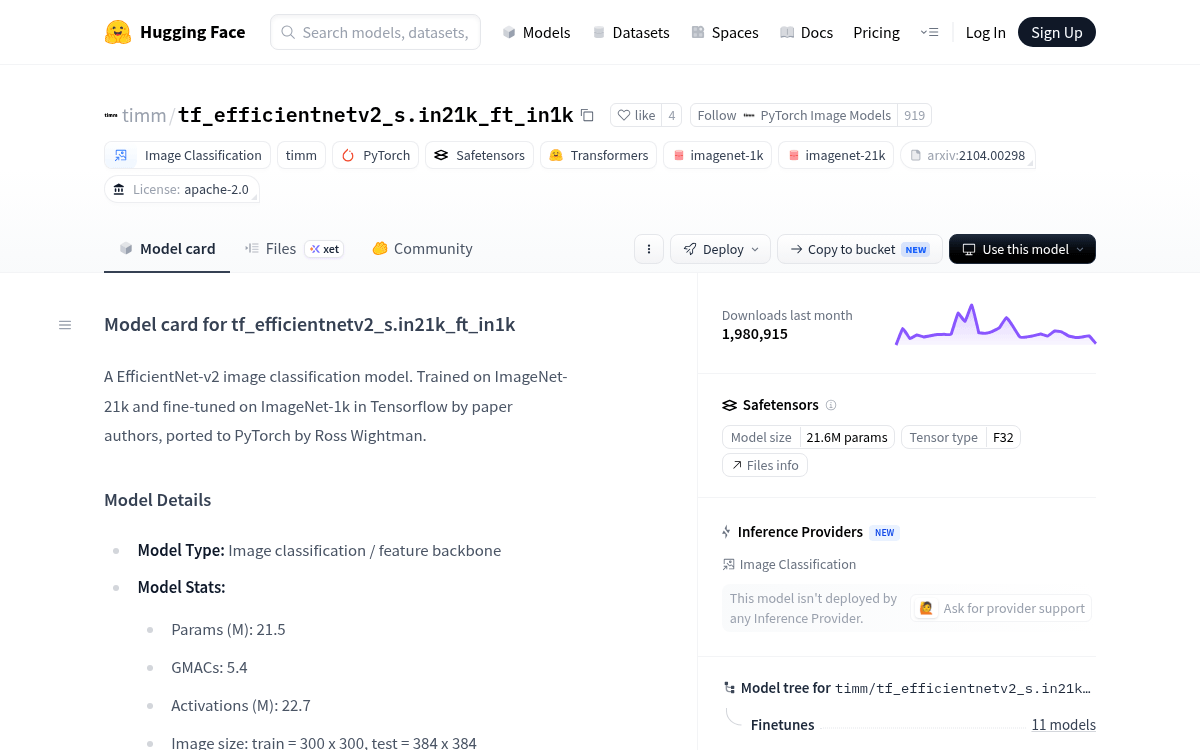
timm is the de facto backbone library for computer vision in PyTorch, shipping hundreds of pretrained image encoders (ResNet, EfficientNet, ConvNeXt, ViT, SigLIP, DINOv3, and so on) behind a single create_model API. If you have ever loaded something like tf_efficientnetv2_s.in21k_ft_in1k for a classifier or a feature extractor, you were using timm.
What actually changed
The release notes for 1.0.29 are short. The version was published on PyPI on August 28, 2026, with three headline items:
- Addition of the LowFormer model architecture along with pretrained weights.
- A round of small bug fixes surfaced by agents rather than human contributors.
- The version bump itself to 1.0.29.
LowFormer joins a growing collection of efficiency-focused backbones that timm has absorbed over the past year, alongside CPUBone, PP-LCNetV2, SwiftFormer, FasterNet, SHViT, and StarNet. After several years of scaling ViTs upward, the library is now heavily invested in small, latency-sensitive backbones designed for CPUs, mobile, and edge devices.
Agents as bug reporters
Ross Wightman describes the second bullet's fixes as a host of real but small or uncommonly encountered bugs surfaced by agents. In practice, autonomous coding agents traversing the repository found real defects in code paths that human users rarely hit, and those fixes are now landing in the release.
A widely used open source library treating agent-generated bug reports as a first-class input signal is still relatively new, and timm makes a good stress test for it: over a thousand model definitions, dozens of optimizers, and a huge surface area of edge cases in feature extraction and pos-embed resampling.
Installing and using it
The package is Apache-2.0 licensed and free. Upgrading is a one-liner:
pip install --upgrade timmOnce installed, LowFormer and every other backbone are accessible through the same factory API timm has always used:
import timm
model = timm.create_model('tf_efficientnetv2_s.in21k_ft_in1k', pretrained=True)
model.eval()
# swap in the new backbone by name
lowformer = timm.create_model('lowformer_...', pretrained=True)
All models continue to support the features_only=True flag for pulling multi-scale feature maps, and num_classes=0 for raw embeddings, which is how most downstream detection and segmentation pipelines consume timm.
Where this sits in the broader roadmap
1.0.29 is the fourth release of 2026, following 1.0.26 in March, 1.0.27 in May, and 1.0.28 in July. Bigger themes across the year include ROPE support added to NaFlexViT, coverage of every model under the EVA base (EVA, EVA02, Meta PE ViT, timm SBB ViT with ROPE, and Naver ROPE-ViT can now be loaded in NaFlexViT), additional Meta PE ViT encoders, and steady work on Muon-family optimizers.
Recent months have also brought DINOv3 ConvNeXt and ViT models, with ConvNeXt weights mapped to existing timm models and ViT support done via the EVA base model with a new RotaryEmbeddingDinoV3. If you have been putting off a timm upgrade, 1.0.29 is a low-risk moment to jump forward: the change surface is small, and you inherit everything that landed in the previous three releases at the same time.
Who should care
- Vision engineers shipping classifiers, detectors, or segmentation stacks. LowFormer is another option in the CPU/edge tier.
- Researchers benchmarking efficient architectures. There is now a consistent API for LowFormer, CPUBone, PP-LCNetV2, SHViT, StarNet, and FasterNet under one roof.
- Anyone maintaining a
timm-based pipeline in production. The agent-driven fixes are unlikely to change behavior in the hot path but are worth pulling in.
Nothing in this release forces you to rewrite code. It is a maintenance drop that keeps the library current, adds one more efficient backbone, and quietly demonstrates that automated agents are becoming a useful part of the open source maintenance loop.