
Hugging Face's SmolLM3 Beats Every 3B Model With Toggleable Reasoning
Hugging Face's SmolLM3-3B ships a fully open 3B model with dual-mode reasoning, 128k context and six languages, matching much larger rivals.
 Pro
Takeaways
- Hugging Face released SmolLM3-3B, a 3B parameter open model under Apache 2.0.
- Features dual-mode reasoning via
/thinkand/no_thinksystem prompt flags. - Supports 128k context using YaRN extrapolation from 64k training window.
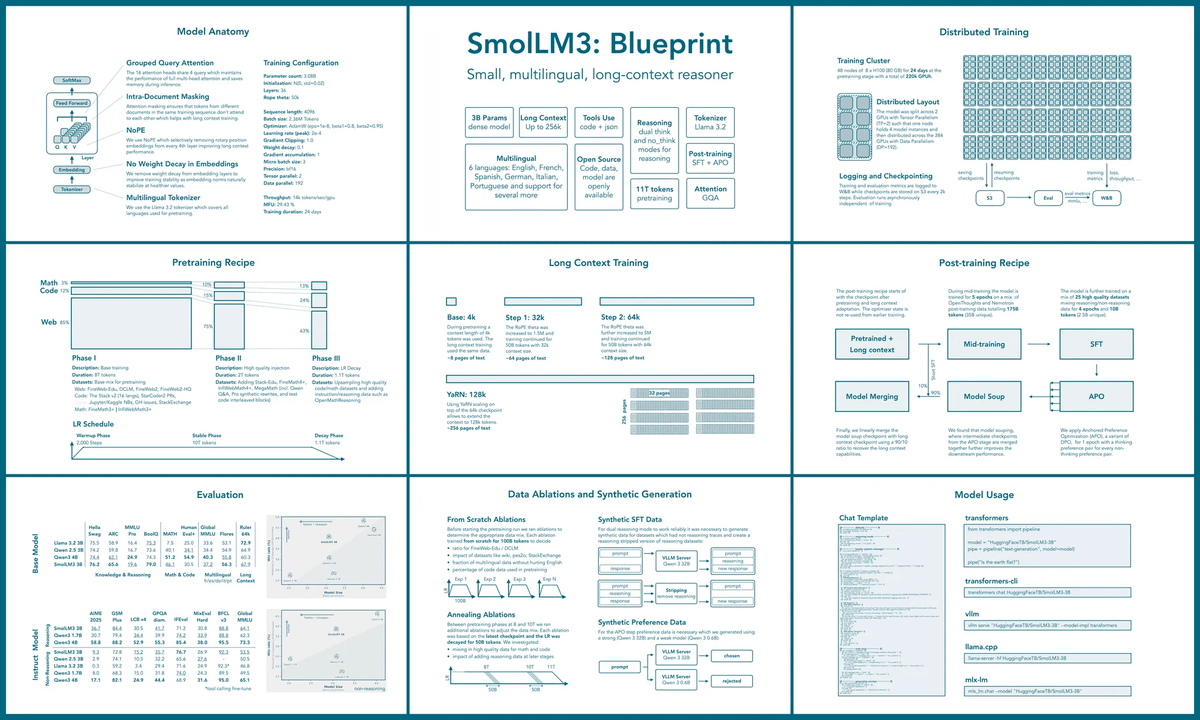
- Pretrained on 11.2T tokens using 384 H100 GPUs with staged data curriculum.
- Beats Llama-3.2-3B and Qwen2.5-3B, competitive with Qwen3-4B on benchmarks.
- Full training blueprint published in huggingface/smollm including data mixtures and configs.
Hugging Face just pushed the ceiling on what a 3 billion parameter model can do, and they gave away the whole recipe with it. SmolLM3-3B is a compact language model that supports toggleable chain-of-thought reasoning, natively handles 128k tokens of context, and speaks six languages out of the box, all under an Apache 2.0 license.
The release includes the base checkpoint, an instruct/reasoning variant, and a full engineering write-up covering the architecture and data mixtures. The 3B model outperforms Llama-3.2-3B and Qwen2.5-3B while staying competitive with larger 4B alternatives like Qwen3 and Gemma3, which puts it in an unusual efficiency sweet spot for its size class.
The efficiency frontier, plotted
The scatter below maps win rate across eight popular LLM benchmarks against parameter count. SmolLM3 sits on the shaded frontier, beating every other 3B model and closing most of the gap to Qwen3-4B despite having roughly 25 percent fewer parameters.

In non-thinking mode, SmolLM3 leads its class on instruction following with a 76.7 IFEval score against Qwen2.5-3B's 65.6, and it holds its own on tool calling at 92.3 BFCL. Flip on extended thinking and AIME 2025 jumps from 9.3 to 36.7, GPQA Diamond climbs from 35.7 to 41.7, and Global MMLU rises from 53.5 to 64.1. That is a big lift from a system prompt toggle.
How the dual-mode reasoning actually works
SmolLM3 is instruct-tuned for hybrid reasoning, meaning one model can either answer directly or produce an explicit reasoning trace before answering. You control it with a flag in the system prompt or a keyword argument on the chat template:
messages = [
    {"role": "system", "content": "/no_think"},
    {"role": "user", "content": "Explain gravity in simple terms."}
]
text = tokenizer.apply_chat_template(
    messages, tokenize=False, add_generation_prompt=True
)
Swap /no_think for /think to get the reasoning trace, or pass enable_thinking=False to the template directly. The practical payoff is that you can pay for slow, careful reasoning only when the task demands it, and get fast answers the rest of the time from the same weights.
Architecture and training details
SmolLM3 is a decoder-only transformer using GQA and NoPE (with a 3:1 ratio), pretrained on 11.2T tokens with a staged curriculum of web, code, math and reasoning data. Post-training included midtraining on 140B reasoning tokens followed by supervised fine-tuning and alignment via Anchored Preference Optimization (APO). A few things stand out here.
- NoPE (No Positional Encoding) at 3:1: three quarters of the layers drop rotary position embeddings entirely, which helps the model generalize to longer sequences than it was trained on.
- Grouped Query Attention keeps inference memory low, which matters when you want to run this on a laptop.
- Staged curriculum: the data mixture shifts progressively toward code, math, and reasoning as pretraining continues, rather than a uniform blend throughout.
- Anchored Preference Optimization: a DPO variant used for final alignment on top of supervised fine-tuning.
The training run used 384 H100 GPUs with the nanotron framework, datatrove for data processing, and TRL for post-training. Hugging Face is releasing SmolLM3 alongside its engineering blueprint, including architecture details, exact data mixtures showing how they progressively boost performance across domains in a three-stage pretraining approach, and the methodology for building a hybrid reasoning model. They note that reproducing these results would normally take months of reverse engineering, and instead the full methodology is on the table.
Long context without retraining
The base model is trained on 64k context and pushes to 128k via YaRN extrapolation, which you enable by editing the config.json:
"rope_scaling": {
    "factor": 2.0,
    "original_max_position_embeddings": 65536,
    "type": "yarn"
}
On the RULER benchmark at 64k, the base model scores 67.85, ahead of Qwen2.5-3B (64.90) and Qwen3-4B-Base (60.29). At 128k it drops to 61.03, still competitive, though Llama-3.2-3B pulls ahead here at 71.30. Long context works, but it is not the model's strongest suit.
Where it wins and where it doesn't
Native languages are English, French, Spanish, German, Italian, and Portuguese, with additional exposure to Arabic, Chinese, and Russian at lower token counts. The multilingual base benchmarks show SmolLM3 leading its 3B peers on MLMM HellaSwag across all six supported languages.
Coding is the clearest weakness. HumanEval+ sits at 30.48 for the base model, well behind Qwen3-1.7B-Base at 43.29 and Qwen3-4B-Base at 54.87. LiveCodeBench in reasoning mode reaches 30.0, respectable but not close to Qwen3-4B's 52.9. If you need a small model primarily for code generation, Qwen3 remains the stronger choice.
Running it locally
The modeling code lives in transformers v4.53.0 and above. Recommended sampling is temperature=0.6 and top_p=0.95. For serving, both vLLM and SGLang work with the standard commands:
vllm serve HuggingFaceTB/SmolLM3-3B \
    --enable-auto-tool-choice \
    --tool-call-parser=hermes
Tool calling is baked in with two modes: pass tools via xml_tools for JSON-in-XML calls, or via python_tools to have the model emit calls as Python code snippets. Quantized checkpoints are also available for llama.cpp, ONNX, MLX, MLC, and ExecuTorch, so this genuinely runs on modest hardware.
The reference implementation nobody usually ships
The interesting move here goes beyond the benchmark numbers to full transparency. Most competitive small models ship as weights plus a paper, leaving the exact data mixture, staging schedule, and midtraining tricks as black boxes. The huggingface/smollm repository contains training and evaluation configs, and intermediate checkpoints from mid-training and SFT are published separately so you can inspect the trajectory.
For teams building their own small models or fine-tuning a base for a specific vertical, this looks closer to a reference implementation than a typical open weights drop. And for anyone deploying on constrained hardware, a 3B model that can toggle between fast responses and deliberate reasoning, handle six languages, and stretch to 128k context is a legitimately useful default to reach for.