
Hugging Face's DistilGPT2 Squeezes GPT-2 Into 82M Parameters
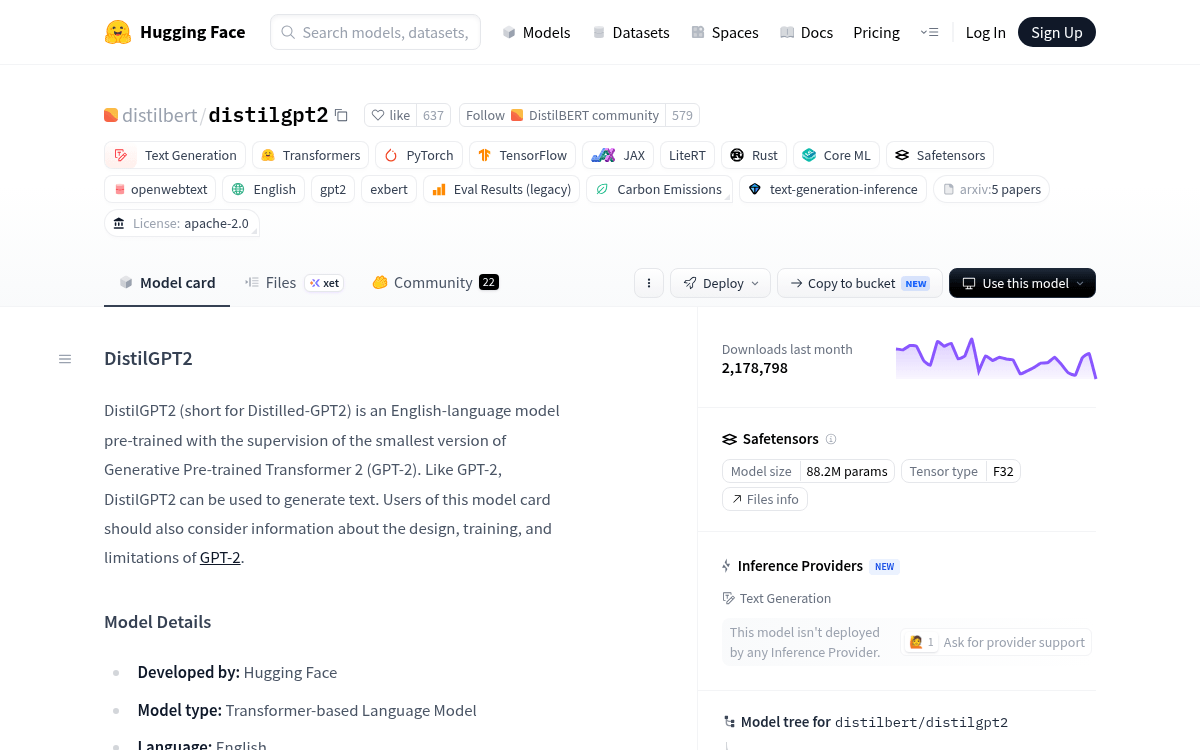
DistilGPT2 is Hugging Face's 82M-parameter compressed version of GPT-2, built via knowledge distillation for smaller, faster text generation.
 Pro
Takeaways
- DistilGPT2 is a compressed 82M-parameter version of OpenAI's 124M GPT-2 from Hugging Face.
- Trained via knowledge distillation on OpenWebTextCorpus using 8 V100 GPUs over one week.
- Perplexity on WikiText-103: 21.1 versus 16.3 for GPT-2 after fine-tuning.
- Apache 2.0 license, supports PyTorch, TF, JAX, TFLite, Rust, Core ML, Safetensors.
- Distillation method described in Sanh et al. 2019, same as DistilBERT.
- Documented bias limitations; no instruction tuning, RLHF, or factual grounding.
DistilGPT2 is a compact English text-generation model published by Hugging Face on the Hub under the DistilBERT organization. It is a compressed version of OpenAI's original GPT-2, trained through knowledge distillation to preserve most of the generative behavior of its larger teacher in a package that runs faster and uses less memory.
The compact cousin of GPT-2
DistilGPT2 is an English-language model pre-trained with supervision from the 124 million parameter version of GPT-2. The student weighs in at 82 million parameters and was designed to be a faster, lighter drop-in replacement. It ships under an Apache 2.0 license and supports text generation across PyTorch, TensorFlow, JAX, TFLite, Rust, Core ML, and Safetensors runtimes.
Knowledge distillation, in plain terms, is a compression trick where a small student network learns to imitate the output distribution of a larger teacher network instead of learning only from raw labels. Hugging Face applied the same method they used for DistilBERT to GPT-2, with training code and pre-trained weights available in their transformers repo.
How it was built
The recipe follows the DistilBERT playbook described in Sanh et al. (2019). DistilGPT2 reuses the same byte-level Byte Pair Encoding tokenizer as GPT-2, and the training corpus is OpenWebTextCorpus, an open reproduction of OpenAI's WebText.
Compute footprint from the model card:
- Hardware: 8 x 16GB V100 GPUs
- Training time: 168 hours (one week)
- Cloud provider: Azure
- Estimated carbon: 149.2 kg CO2 equivalent
The underlying distillation approach comes from the DistilBERT paper, which showed you can shrink a BERT model by 40% while retaining 97% of its language understanding capabilities and running 60% faster, by leveraging distillation during pre-training rather than only for task-specific fine-tuning.
What the numbers say
On the standard language modeling benchmark, the quality gap is measurable but modest. On WikiText-103, GPT-2 reaches a test-set perplexity of 16.3 compared to 21.1 for DistilGPT2 after fine-tuning on the train set. Perplexity measures how well the model predicts held-out text (lower is better), so DistilGPT2 pays a real but bounded quality cost for its size reduction.
Getting it running
The model plugs straight into the standard transformers pipeline API:
from transformers import pipeline, set_seed
generator = pipeline('text-generation', model='distilgpt2')
set_seed(42)
generator("Hello, I'm a language model", max_length=20, num_return_sequences=5)
It is also directly servable via vLLM or SGLang with an OpenAI-compatible completions endpoint, or via Docker Model Runner with a single command. The 88.2M parameter footprint and Core ML / TFLite exports make it a reasonable fit for on-device experiments where a full GPT-2 or a modern billion-parameter LLM is overkill.
Where it fits, and where it does not
Useful scenarios for a model of this class include:
- Autocomplete and grammar assistance in constrained environments
- Creative writing prototypes, poetry generation, toy chat bots
- A cheap student model in distillation research or a baseline for compression experiments
- Edge or browser demos, including the Write With Transformers app built on top of it
The limitations are documented candidly. As the developers of GPT-2 note in their model card, language models like GPT-2 reflect the biases inherent to the systems they were trained on, and the DistilGPT2 card includes side-by-side generation examples that expose racial and gender stereotypes. Research on compressed models is mixed on whether distillation helps or hurts here: some work finds distilled GPT-2 variants show reduced toxicity versus the teacher, while Gupta et al. (2022) report DistilGPT2 exhibits greater gender disparities than GPT-2 and propose mitigation techniques.
Practically, the model has no instruction tuning, no RLHF, no chat template, and no factual grounding. It does open-ended next-token continuation of a prompt and nothing more. For anything user-facing that needs steerability or safety, a modern small instruct model is the better default. For studying transformer internals, teaching distillation, or embedding a lightweight generator inside a bigger pipeline, DistilGPT2 remains a serviceable and well-documented baseline.