
Hugging Face's DistilBERT Hits Azure With One-Click Deployment for 3.6M Users
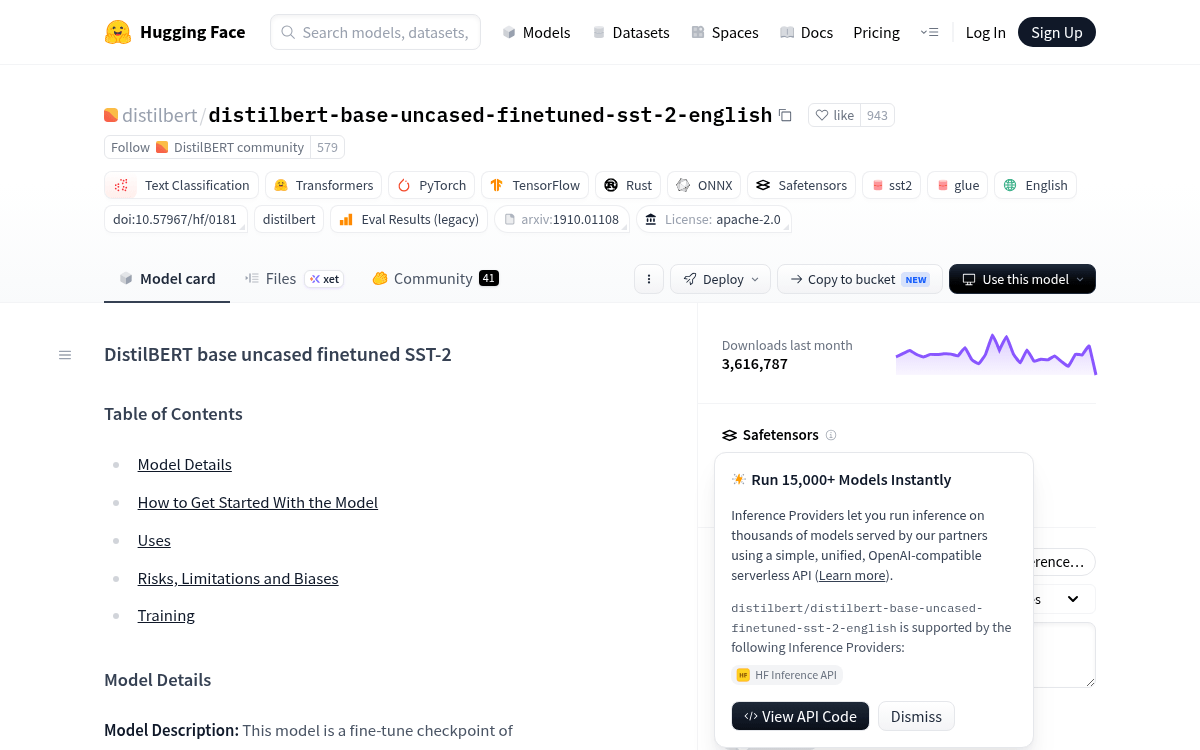
DistilBERT SST-2, one of Hugging Face's most downloaded models, is now available for one-click deployment as a managed endpoint on Azure AI Foundry.
 Pro
Takeaways
- DistilBERT SST-2 English is now enabled for one-click deployment via the Hugging Face Collection on Azure AI Foundry.
- The model has 3.6M+ downloads, 67M parameters, and reaches 91.3 accuracy on SST-2 dev.
- Deployment creates an Azure ML managed online endpoint with autoscaling and REST access.
- Part of a catalog of 10,000+ Hugging Face models now available on Azure.
- Known bias: positive probability varies wildly by country name in otherwise identical sentences.
- Best fit for English binary sentiment on short text; not neutral-aware or multilingual.
Hugging Face's veteran sentiment analysis workhorse just got a shorter path to production. The DistilBERT SST-2 model, which has racked up more than 3.6 million downloads and sits behind countless text classification pipelines, is now tagged for one-click deployment on Microsoft's Azure AI Foundry through the expanded Hugging Face and Microsoft collaboration.
The addition slots this checkpoint into the growing Hugging Face Collection on Azure, which now hosts more than 10,000 models deployable in a couple of clicks across text, audio, and image tasks. Continuous syncing means new and trending releases from the Hub land on Azure the day they ship.
From model card to REST endpoint
The model itself is unchanged. What is new is the deployment path. From the model card, the Deploy button now routes to Azure, spinning up a managed online endpoint without hand-writing infrastructure code. You select the model, click Deploy, choose the Deploy on Azure AI option, and land on the model inside Azure AI. From there you pick a VM, set an instance count, and the endpoint comes up as a REST API.
Under the hood, Azure Machine Learning handles the managed online endpoints, exposing secure REST APIs for real-time inference. Autoscaling, traffic splitting, and monitoring are built in, and both CPU and GPU deployments are supported. For a 67M parameter classifier, a cheap CPU instance is usually enough.
Why this checkpoint carries so much weight
DistilBERT SST-2 is the default binary sentiment classifier for a huge chunk of the Transformers ecosystem. It is what pipeline("sentiment-analysis") loads if you do not specify a model. It hits 91.3 accuracy on SST-2 dev, versus 92.7 for bert-base-uncased, at roughly 40 percent of the size. That tradeoff is why it shows up in production for:
- Customer feedback and review scoring
- Social media monitoring pipelines
- Content moderation pre-filters
- Chat and support ticket triage
- Baselines before training a domain-specific classifier
Known failure modes
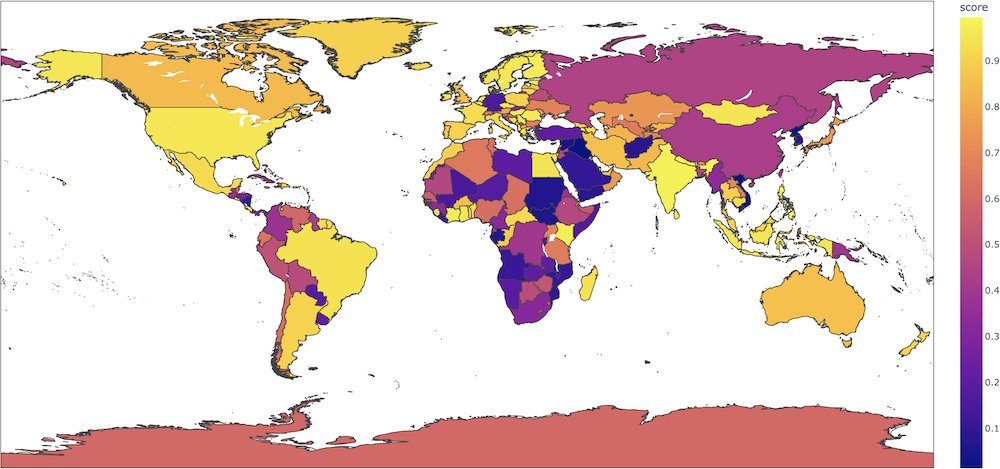
The model card is unusually candid about where the classifier breaks, and those cracks matter more once the model is one click away from production. Probing showed it assigns wildly different positive probabilities to identical sentences depending on the country named in them, ranging from around 0.89 for France to 0.08 for Afghanistan when nothing else in the sentence changed. Aurélien Géron plotted these probabilities per country on a world map, reproduced below.
Other limits worth remembering before wiring it into a customer-facing endpoint:
- Binary only. No neutral class, no intensity score beyond the softmax.
- English only, trained on movie reviews, so domain shift to tweets, code review comments, or legal text degrades quality.
- 128 token maximum sequence length from the fine-tuning setup, which truncates long reviews.
- Case insensitive (uncased), so signals like ALL CAPS shouting are lost.
Using it, with or without Azure
If you just want the model locally, the Transformers snippet has not changed:
from transformers import pipeline
pipe = pipeline(
    "text-classification",
    model="distilbert/distilbert-base-uncased-finetuned-sst-2-english",
)
print(pipe("The new deploy button is genuinely useful."))
The Azure path is aimed at teams who would otherwise be writing Dockerfiles and Bicep templates to get the same pipeline behind an authenticated REST endpoint. To send inference requests, check the Consume tab within the Azure ML Endpoint, or work from any of the Azure ML examples in the documentation.
A small tag, a bigger shift
A deploy button on a model card is a modest change, and it reflects how open-weight models are increasingly reaching production through partnerships rather than glue code. When Microsoft and Hugging Face began this collaboration two years ago, the Hub held around 200,000 open models. It now sits close to 2 million, spanning tasks, modalities, domains, and languages, which is what pushed the two companies to expand the integration.
For anyone already running a homegrown sentiment service on this exact checkpoint, the practical question is whether a managed endpoint is worth the Azure bill compared to a small container on existing infrastructure. For teams that need SOC2-friendly hosting, autoscaling, and monitoring without building it themselves, the one-click path is now a real option for a model that was already the default choice.