
Hugging Face's Distil-Large-v3 Runs 6.3x Faster Than Whisper Without Losing Accuracy
Hugging Face's distilled Whisper large-v3 runs 6.3x faster than the original while staying within 1% WER on long-form audio.
 Pro
Takeaways
- distil-large-v3 is 6.3x faster than Whisper large-v3 with 756M vs 1550M params.
- Long-form sequential WER improves 4.8 points over distil-large-v2, matching large-v3 within 1%.
- First distilled Whisper usable for speculative decoding, guaranteeing identical outputs to large-v3 at 2x speed.
- Retrained on 30-second packed audio to fix sliding-window timestamp failures from earlier versions.
- Ships with weights for Whisper.cpp, Faster-Whisper, OpenAI Whisper, Transformers.js, and Candle.
- English-only, MIT licensed, trained on 22,000 hours of pseudo-labeled speech from nine open datasets.
Hugging Face has released distil-large-v3, the third and final English installment of the Distil-Whisper series and the first distilled variant explicitly tuned to work with OpenAI's sequential long-form transcription algorithm. The result is a 756M parameter model that runs 6.3x faster than Whisper large-v3 while landing within roughly 1% word error rate on long-form audio, closing the biggest weakness of earlier distilled Whisper checkpoints.
If you have been running Whisper large-v3 in production and paying for the GPU time, this is a near drop-in replacement. Pre-converted weights ship for Whisper.cpp, Faster-Whisper, OpenAI's original Whisper package, Transformers.js, and Candle, so most existing pipelines can swap the checkpoint without touching orchestration code. MIT licensed, free to use.
What broke before and how it was fixed
distil-large-v2 had a well-known problem: it broke down on long audio when used with the sequential sliding-window decoding algorithm that Whisper.cpp, Faster-Whisper, and OpenAI's library all use by default. Earlier distilled models trained on a mean input length of 7 seconds, while the original Whisper pre-trained on 30-second inputs. That mismatch made timestamp predictions past the 15-second mark unreliable, and the sliding window kept landing in that unreliable zone.
distil-large-v3 fixes this by retraining with a context window that matches Whisper's, using four concrete strategies:
- Packing audio samples to 30 seconds so the model operates on the same context window as Whisper, with accurate timestamps up to 30 seconds.
- Freezing the decoder input embeddings to preserve Whisper's original long-context representation.
- Training on a maximum target length of 256 tokens rather than 128.
- Appending prompt conditioning to 50% of training samples, enabling use with the
condition_on_prev_tokensargument and context windows up to 448 tokens.
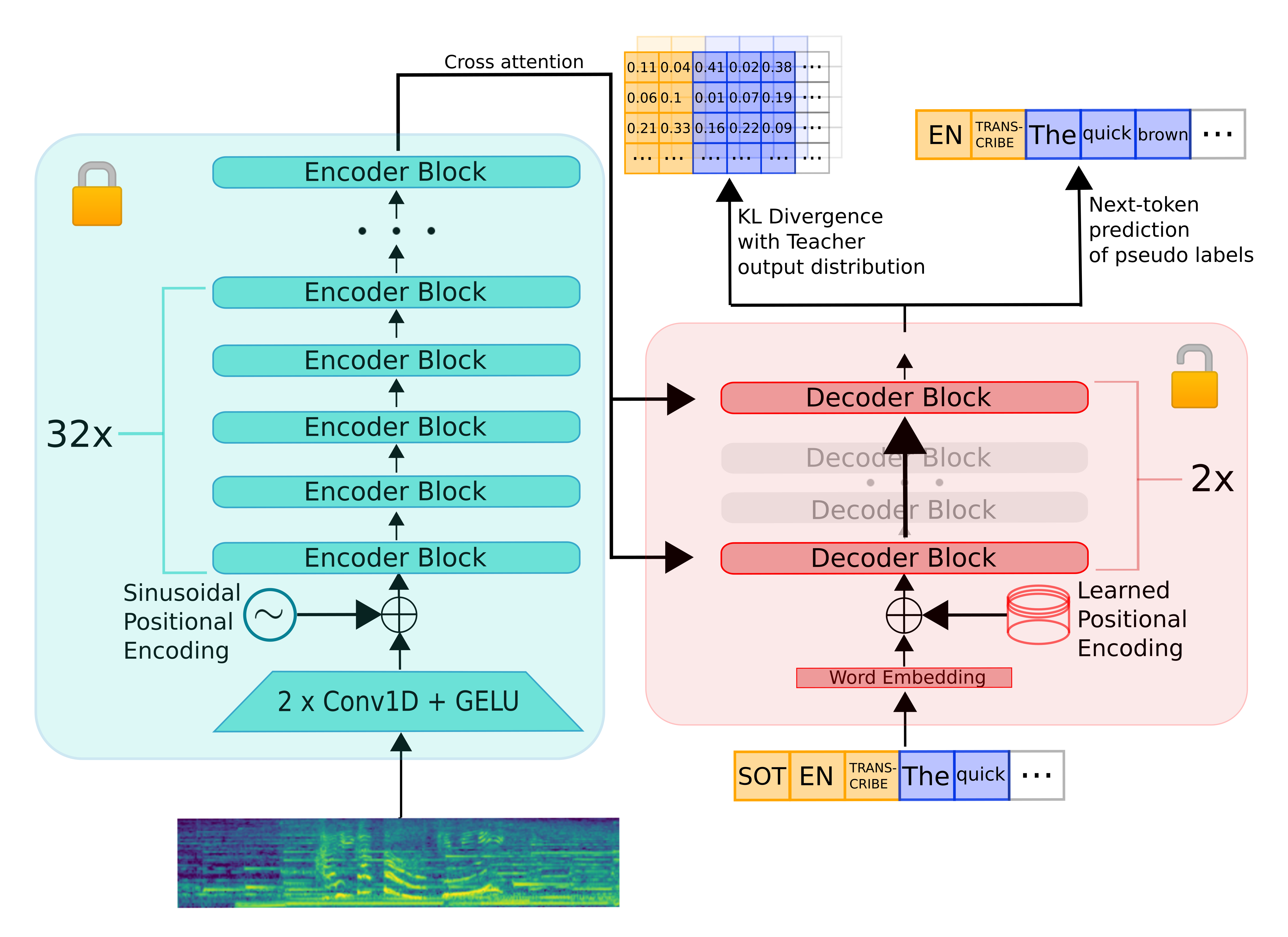
The architecture itself is unchanged. Distil-Whisper copies Whisper's encoder verbatim, freezes it, and trims the decoder to two layers initialized from maximally spaced teacher layers. Training uses a weighted sum of KL divergence against the teacher distribution and a pseudo-label cross-entropy loss.
Benchmark numbers
| Model | Params (M) | Rel. Latency | Short-Form WER | Sequential Long-Form WER | Chunked Long-Form WER |
|---|---|---|---|---|---|
| whisper-large-v3 | 1550 | 1.0x | 8.4 | 10.0 | 11.0 |
| distil-large-v3 | 756 | 6.3x | 9.7 | 10.8 | 10.9 |
| distil-large-v2 | 756 | 5.8x | 10.1 | 15.6 | 11.6 |
The sequential long-form column tells the story. distil-large-v3 lands within 1% WER of large-v3 on long-form audio under both decoding algorithms and beats distil-large-v2 by 4.8% WER on sequential decoding. On the ESB benchmark used by the OpenASR leaderboard, it comes within 0.2% WER of the full Whisper.
Speculative decoding as a lossless speedup
distil-large-v3 is the first Distil-Whisper checkpoint usable as a draft model for speculative decoding with Whisper large-v3. Speculative decoding guarantees identical outputs to full Whisper while running roughly 2x faster, making it the right path when you need Whisper's exact accuracy but want to cut inference time. Combine that with the standalone 6.3x speedup and you have two distinct operating modes depending on your accuracy tolerance.
Training recipe
The approach is knowledge distillation via large-scale pseudo-labeling, described in the original paper. The team assembled 22,000 hours of permissively licensed English speech from nine datasets spanning audiobooks, podcasts, YouTube, telephone calls, European Parliament recordings, TED talks, and meeting audio, covering 10 distinct domains and over 50,000 speakers.
Whisper large-v3 was run over the entire corpus to generate pseudo-labels used as training targets. A WER filter compares those pseudo-labels against ground-truth transcripts and discards examples where the two diverge beyond a threshold, which keeps hallucinations in check. Training ran for 80,000 steps at batch size 256, roughly 11 epochs.
Getting started
For short-form audio under 30 seconds, the Transformers pipeline API is a one-liner:
from transformers import pipeline
pipe = pipeline("automatic-speech-recognition", model="distil-whisper/distil-large-v3")
result = pipe("audio.mp3")
print(result["text"])
For long files, the choice of decoding algorithm depends on your priority. Sequential decoding is better when accuracy matters most or when batching multiple long files. The chunked algorithm, with a 25-second chunk length, delivers the lowest latency on a single long file and can run up to 9x faster than sequential in that scenario, according to the paper.
Where it fits and where it falls short
Strong use cases include podcast transcription, meeting notes, voice interfaces where low latency matters, on-device transcription with Whisper.cpp, and browser-based transcription via Transformers.js. The Whisper.cpp benchmark shows over 5x speedup on an M1 Mac within 0.8% WER on long-form audio.
Two hard limits: distil-large-v3 is English-only, so multilingual workloads still require full Whisper large-v3. On out-of-distribution short-form audio, expect roughly 1.5% WER regression versus the teacher. For most transcription workloads at scale, that tradeoff against a 6x speedup and half the parameter count is straightforward.