
Hugging Face Ports LLaVA-1.5-7B to Run in One Line With 2.3M Downloads
The llava-hf team ships a Transformers-native port of LLaVA-1.5-7B on Hugging Face with one-line deployment via vLLM, SGLang, and Docker.
 Pro
Takeaways
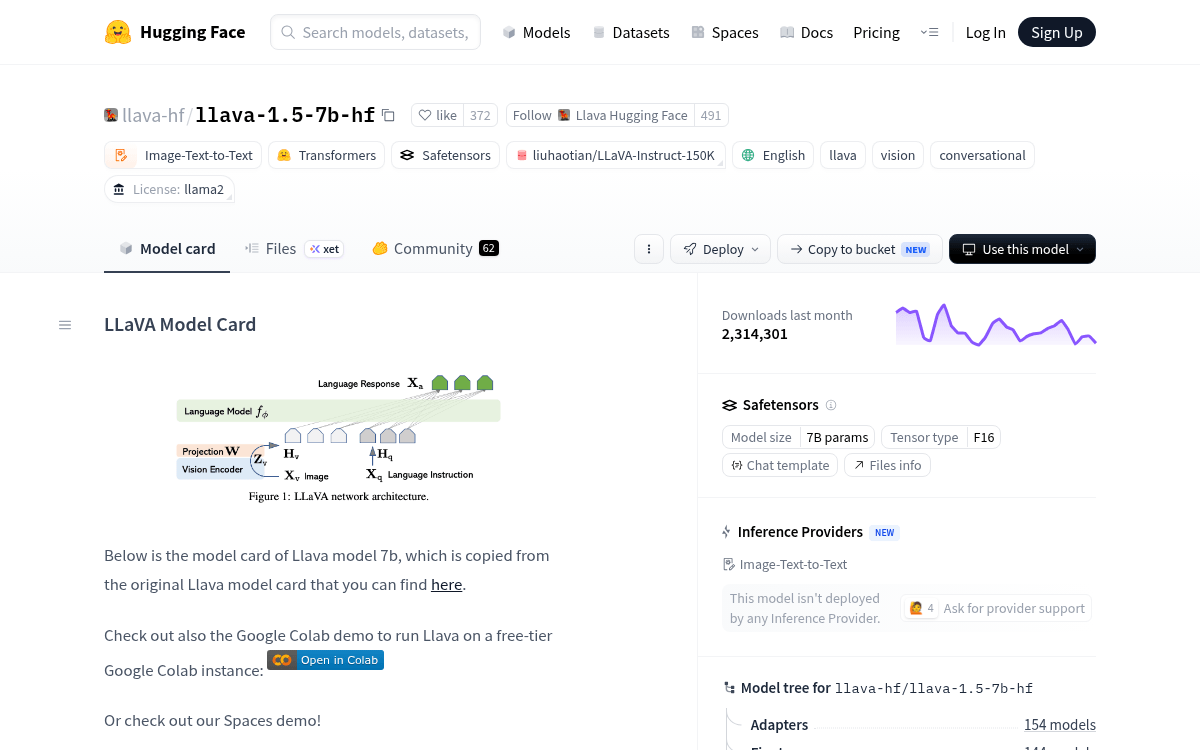
- llava-hf/llava-1.5-7b-hf ships LLaVA-1.5-7B as a Transformers-native checkpoint with 2.3M downloads.
- One-line deployment via vLLM, SGLang, and Docker Model Runner with OpenAI-compatible APIs.
- Architecture: CLIP-ViT-L-336px vision encoder plus two-layer MLP projector plus Vicuna-7B language model.
- Supports 4-bit bitsandbytes quantization and Flash-Attention 2 via single flags.
- Reference baseline for 144 finetunes and 154 adapters currently on Hugging Face.
- Original recipe detailed in the Improved Baselines paper, trained in about 1 day on 8 A100s.
The llava-hf/llava-1.5-7b-hf checkpoint is now a first-class Transformers-native port of the original LLaVA-1.5-7B vision-language model, complete with pipeline API support, chat templates, and one-line serving through vLLM, SGLang, and Docker Model Runner. The port removes the friction of the original research codebase and slots the model directly into the standard image-text-to-text workflow. It has already crossed 2.3 million downloads on the Hub, making it one of the most-used open multimodal checkpoints available.
What actually shipped
The release repackages Haotian Liu et al.'s LLaVA-1.5-7B into the Hugging Face Transformers format. Instead of cloning the original repo and wrestling with Vicuna weights and custom loaders, you can now do this:
from transformers import pipeline
pipe = pipeline("image-text-to-text", model="llava-hf/llava-1.5-7b-hf")
messages = [{"role": "user", "content": [
    {"type": "image", "url": "https://example.com/img.jpg"},
    {"type": "text", "text": "What animal is on the candy?"}
]}]
pipe(text=messages)
Serving is equally minimal. The model card documents a single vllm serve "llava-hf/llava-1.5-7b-hf" command that spins up an OpenAI-compatible endpoint, plus equivalent recipes for SGLang and docker model run hf.co/llava-hf/llava-1.5-7b-hf. Chat templates handle image URLs and local paths directly from transformers 4.48 onward, so you no longer hand-craft the USER: xxx\nASSISTANT: prompt with a <image> token placeholder.
The model under the hood
LLaVA-1.5 has a deliberately simple architecture: a frozen vision encoder, a small projection network, and a language model that does all the reasoning. A pre-trained CLIP-ViT-L-336px encoder processes images at 336x336 resolution, and a two-layer MLP with a GELU activation projects those features into the input embedding space of the Vicuna language model. Each image resolves to 576 visual tokens.

The original LLaVA-1.5 paper argued that this stripped-down recipe was surprisingly competitive. Swapping in CLIP-ViT-L-336px with an MLP projection and mixing in academic-task-oriented VQA data with simple response formatting prompts produced stronger baselines that reached state-of-the-art across 11 benchmarks. The 13B checkpoint used just 1.2M publicly available samples and finished training in about a day on a single 8-A100 node.
Why the port matters
The Transformers wrapper unlocks the surrounding ecosystem. A few practical consequences:
- 4-bit inference through
bitsandbyteswith a singleload_in_4bit=Trueflag, bringing the 7B model well under 8GB of VRAM. - Flash-Attention 2 support via
use_flash_attention_2=Truefor faster generation. - OpenAI-compatible serving with vLLM or SGLang, so existing chat clients drop in without code changes.
- An ecosystem of 144 finetunes, 154 adapters, and multiple quantizations already published against this checkpoint on the Hub.
Strengths, and where it falls over
The model is genuinely strong for its size on visual question answering, image description, and instruction-following over images, and it got there on a modest 1.2M public images thanks to the VQA data mix and formatting prompts. Its simple design and low tuning cost are why it still shows up as a default baseline in multimodal work.
The weaknesses are also well documented. The 336x336 input resolution limits fine-grained OCR and dense chart reading, which is exactly the gap that LLaVA-NeXT (LLaVA-1.6) closes by pushing resolution higher and improving reasoning, OCR, and world knowledge. The base model also hallucinates on out-of-distribution images and long conversations, and it inherits Vicuna's dated knowledge cutoff.
Where it fits today
LLaVA-1.5-7B is no longer the strongest open vision-language model. Qwen2-VL, InternVL, and LLaVA-NeXT variants outperform it on most current leaderboards. Three properties keep it central to the field:
- It is the reference architecture. New papers on token pruning, visual grounding, and multimodal reasoning consistently benchmark against LLaVA-1.5-7B because its CLIP-plus-MLP-plus-Vicuna stack is easy to modify.
- It is cheap to finetune. LoRA on LLaVA-1.5 reaches comparable quality to full-model finetuning at a fraction of the GPU RAM.
- It is small enough to run on a single consumer GPU in 4-bit, which is why the ecosystem of quantized GGUF and llama.cpp builds around it keeps growing.
For teams building visual assistants, document-understanding prototypes, or multimodal RAG pipelines that need a permissive-ish baseline you can actually finetune on a single node, the Transformers-native port is the shortest path to a working system.