
Hugging Face Gives multi-qa-mpnet a Fast OpenAI-Compatible Embeddings Server
The popular semantic search embedding model now ships with official Text Embeddings Inference deployment instructions and an OpenAI compatible endpoint.
 Pro
Takeaways
- The multi-qa-mpnet-base-dot-v1 model card now documents official Text Embeddings Inference deployment.
- Ships CPU and NVIDIA GPU Docker one-liners with correct CLS pooling and float16 dtype flags.
- Exposes an OpenAI compatible
/v1/embeddingsendpoint usable from LangChain and Milvus. - Model was trained on 215M question and answer pairs across 17 datasets for semantic search.
- Produces 768-dim unnormalized embeddings scored by dot product, not cosine similarity.
- Input capped at 512 tokens, with training data limited to 250 word pieces.
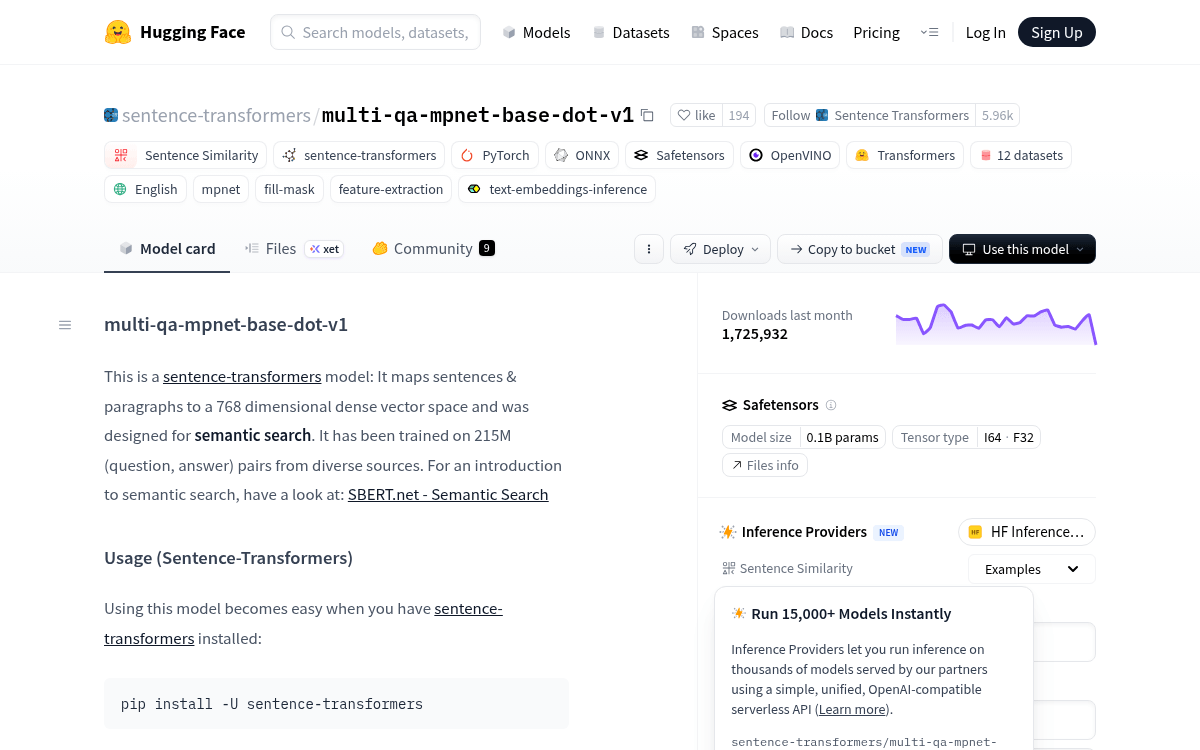
The model card for sentence-transformers/multi-qa-mpnet-base-dot-v1 has been refreshed with official instructions for serving the model through Hugging Face's Text Embeddings Inference (TEI) runtime, exposing it behind an OpenAI-compatible /v1/embeddings endpoint. A small documentation change on paper, but a meaningful one in practice: the model powering a lot of production semantic search pipelines now has a blessed path to a Rust-based inference server that most vector database and RAG tooling already speaks to.
The model itself is not new. It maps sentences and paragraphs to a 768-dimensional dense vector space, was designed for semantic search, and still sees around 1.7 million downloads per month. What changed is how easily you can put it behind a fast HTTP service without writing a Flask wrapper around SentenceTransformer.encode.
What the refreshed card gives you
The updated documentation adds a Text Embeddings Inference section with two Docker one-liners, one for CPU and one for NVIDIA GPU. Both pin the pooling method and dtype the model expects:
docker run --gpus all -p 8080:80 -v hf_cache:/data \
  --pull always ghcr.io/huggingface/text-embeddings-inference:cuda-latest \
  --model-id sentence-transformers/multi-qa-mpnet-base-dot-v1 \
  --pooling cls \
  --dtype float16
Once the container is up, you hit it the same way you would hit OpenAI's embeddings API:
curl http://localhost:8080/v1/embeddings \
  -H "Content-Type: application/json" \
  -d '{
    "model": "sentence-transformers/multi-qa-mpnet-base-dot-v1",
    "input": "How many people live in London?"
  }'
OpenAI compatibility is the interesting part. TEI serves an OpenAI-compatible /v1/embeddings endpoint, so you can consume a TEI deployment from LangChain with OpenAIEmbeddings from the langchain-openai package. The same client code you use for text-embedding-3-small works against your self-hosted mpnet server with only a base_url change.
Why TEI is the right runtime here
Text Embeddings Inference is a toolkit for deploying and serving open-source text embeddings and sequence classification models, with high-performance extraction for popular families including FlagEmbedding, Ember, GTE, and E5. The multi-qa mpnet checkpoint falls under the MPNet architecture, which TEI supports alongside BERT, XLM-RoBERTa, Mistral, Qwen2, ModernBERT, Qwen3, and Gemma3.
Compared to rolling your own inference server, you get:
- Batched, continuous scheduling instead of per-request Python overhead
- Float16 inference out of the box
- A
/healthendpoint and metrics for real deployments - The same API shape whether you swap in BGE, E5, GTE, or a sentence-transformers checkpoint
The pooling gotcha
This model is one of the sentence-transformers checkpoints where the pooling choice actually matters. The card is explicit that it uses CLS pooling and dot-product similarity, rather than the mean pooling and cosine similarity used by many of its siblings. That is why the Docker command carries --pooling cls. Get that wrong and your embeddings will silently be nonsense.
It is also a dot-product model with unnormalized outputs, so if you are dropping it into a vector store that assumes cosine similarity on normalized vectors, you need to either normalize on write or switch the index to inner product.
Where the model fits
Built for semantic search, the model was trained on 215M (question, answer) pairs drawn from WikiAnswers, PAQ, Stack Exchange, MS MARCO, GOOAQ, Amazon QA, Yahoo Answers, SearchQA, ELI5, Natural Questions, SQuAD 2.0, and TriviaQA. That training mix is why it tends to punch above its weight on retrieval-style workloads: matching a short natural-language query against a corpus of candidate passages.
Practical fits:
- Retrieval for RAG over documentation, support tickets, or FAQ-style corpora
- Question-to-passage search where the query is a real user question, not a keyword blob
- Duplicate question detection and clustering of user-submitted text
Two limits are worth knowing before you deploy. The model tops out at 512 word pieces, and the training data itself capped inputs at 250 word pieces, so long documents need chunking rather than being fed in whole. At 0.1B parameters and 768 dimensions, it will also lose on English retrieval benchmarks to newer instruction-tuned encoders like the Qwen and GTE families, which come with much larger checkpoints and heavier inference.
A quiet consolidation around one API shape
Older, well-trusted embedding models are quietly getting first-class TEI deployment recipes, which pushes them further into the OpenAI-API-shaped ecosystem that vector stores, LangChain, LlamaIndex, and Milvus have converged on. TEI works with many text embedding models from the Hugging Face Hub, including the BAAI/bge-* series, sentence-transformers/* series, E5, and GTE. For teams still running a homegrown FastAPI wrapper around model.encode, this is a nudge to delete that service and point your existing OpenAI embeddings client at a TEI container instead.