
Hugging Face Folds ColBERT's Multi-Vector Search Into Sentence Transformers v6.0
Hugging Face ships Sentence Transformers v6.0 with a new MultiVectorEncoder that makes ColBERT-style late-interaction retrieval a first-class model type.
 Pro
Takeaways
- Sentence Transformers v6.0 adds MultiVectorEncoder for ColBERT-style late-interaction retrieval as a first-class model type.
- Absorbs PyLate, Stanford-NLP ColBERT, and colpali-engine checkpoints behind one unified API.
- Keeps one vector per token and scores with MaxSim, preserving token-level matching a dense summary averages away.
- LateOn beats its dense counterpart DenseOn by roughly one NDCG point on NanoBEIR at the same parameter count.
- Handles text, images (ColPali), audio, and video through the same
encode_queryandencode_documentcalls. - Requires transformers v5.x, torch 2.2+, and huggingface-hub v1.x.
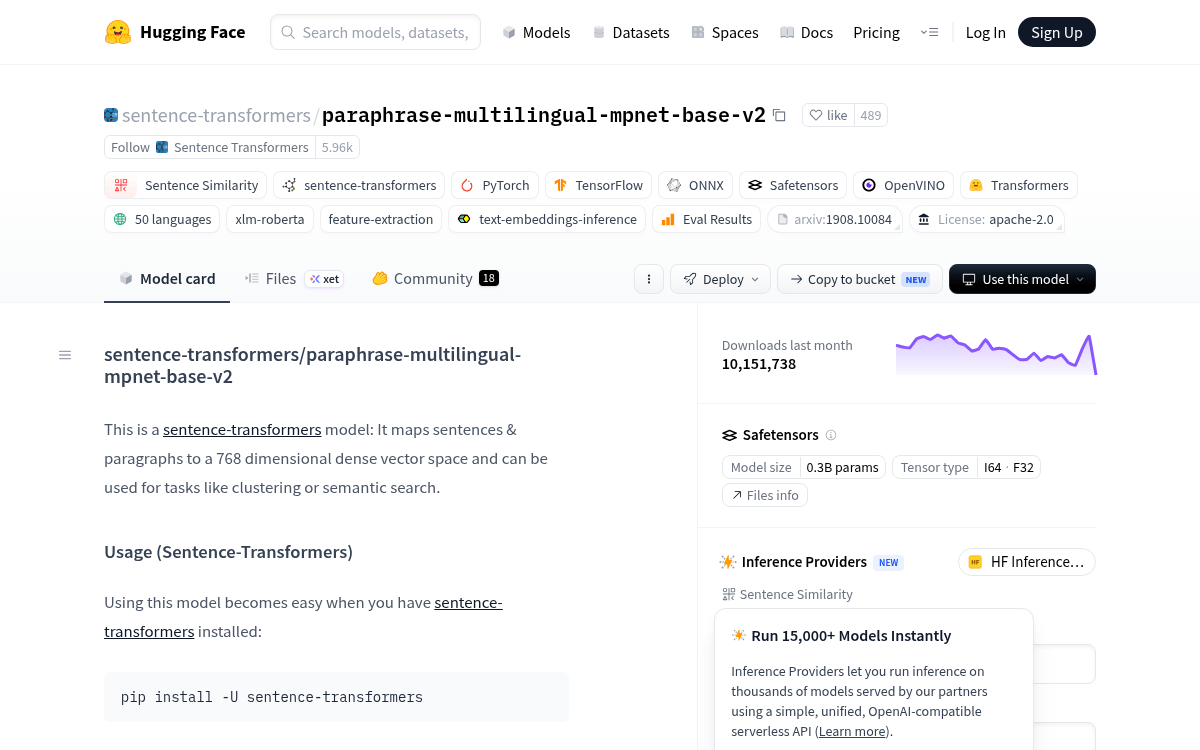
The Sentence Transformers library just picked up a new model family. With the v6.0 release, Hugging Face and LightOn have folded ColBERT-style late-interaction retrieval directly into the library, adding a MultiVectorEncoder class that sits alongside the existing dense, sparse, and reranker encoders. Any PyLate checkpoint, any Stanford-NLP ColBERT checkpoint, and ColPali-family visual retrieval models load through the same familiar API you already use for a plain SentenceTransformer.
Late interaction has been living in a separate ecosystem for years. If you wanted ColBERT, you reached for PyLate or the original Stanford implementation. If you wanted to search PDF pages as images, you reached for colpali-engine. The v6.0 release absorbs the modeling, training, inference, and evaluation from both libraries, so those approaches now share the same interface as your regular embedding pipeline.
What late interaction actually buys you
A normal embedding model reads a passage and spits out a single vector, usually 384 to 1024 dimensions. Everything the model noticed has to fit in that one summary, and similarity is a single dot product. A multi-vector model keeps one vector per token instead, and scores query against document using the MaxSim operator.
MaxSim is straightforward: for each query token, take its highest cosine similarity against any document token, then sum those maxima across the query. Read it as a soft alignment where every query token points at the document token that best explains it. That preserves token-level matching information that a single vector has to average away.
The practical payoff shows up in three places:
- Rare terms and exact identifiers like product codes or function names still sit on their own vector, instead of being blended into a summary.
- Multi-requirement queries ("green sofa with wooden legs and rounded cushions") let each requirement find its own evidence in the document.
- Out-of-domain data where a dense model's compression was tuned for a different distribution than yours.
On the 13-dataset NanoBEIR suite, LightOn's LateOn multi-vector model beats its dense sibling DenseOn (same backbone, same training data, same 149M parameters) on 9 of 13 datasets and by roughly one NDCG point on the mean. Same margin on full BEIR. Not a universal win, but a real one at the same model size.
The cost is index size
Storing one vector per token instead of one per document produces a lot more vectors. Encoding 4,874 Natural Questions passages with LateOn produced 608,414 token vectors, an average of 124.8 per passage. That comes out to roughly 42x the raw float32 storage of an all-MiniLM-L6-v2 index.
Compression narrows that gap fast. A fast-plaid index of those same vectors comes out at 92 MB, comparable to what a 4096-dimensional dense model like Qwen3-Embedding-8B would need. The library also ships HierarchicalTokenPooling, which clusters each document's token vectors with Ward linkage and replaces each cluster with its mean, keeping roughly 1/pool_factor of the tokens. The original paper measured 100.6% of unpooled retrieval performance on BEIR at pool_factor=2, so halving your index is close to free.
An API that stays out of your way
Loading and using a model is deliberately identical to the rest of the library:
from sentence_transformers import MultiVectorEncoder
model = MultiVectorEncoder("lightonai/LateOn")
queries = ["What is the capital of France?"]
documents = [
    "Paris is the capital of France.",
    "Berlin is the capital of Germany.",
]
query_embeddings = model.encode_query(queries)
document_embeddings = model.encode_document(documents)
scores = model.similarity(query_embeddings, document_embeddings)
Multi-vector models are asymmetric, so encode_query and encode_document are separate calls, each applying its own marker prefix, length cap, and scoring mask. Output is a list of 2D tensors rather than one rectangular matrix, since every input has its own token count.
Visual document retrieval, without OCR
The same interface handles ColPali-style models that embed page images directly. You pass URLs, local paths, or PIL images to encode_document, and MaxSim scores query text tokens against document image patches. Models like webAI's ColVec1.1 report state-of-the-art results on ViDoRe V3 with strong handling of chart-rich PDFs and OCR-free retrieval on unseen multimodal documents.
The library also accepts audio and video through models like vidore/colqwen-omni-v0.1, which was trained purely on image-text pairs but retrieves audio zero-shot. A query for "medicine for car nausea" pulls a conversation about carsickness out of twenty recordings with no transcription step anywhere in the pipeline.
Where you can store the vectors
Several vector databases already index and score multi-vectors natively, so you can hand what encode_document produces straight to your storage layer:
| Backend | Multi-vector support |
|---|---|
| Qdrant | Since v1.10, with a MAX_SIM comparator |
| Weaviate | Since v1.29 |
| Vespa | Long-standing, via tensor rank expressions |
| LanceDB | Since v0.15.0 |
| Milvus | Since v2.6.4, under array-of-structs |
| fast-plaid | Serverless Rust PLAID implementation from LightOn |
OpenSearch and Elasticsearch can rescore candidates with MaxSim but not retrieve on it, which slots them into the retrieve-and-rerank pattern.
Speed, interpretability, and the upgrade path
On GPU, fp16 with Flash Attention hits 2.44x the throughput of fp32 with no measurable retrieval quality loss. Flash Attention helps multi-vector models more than most because documents are truncated but never padded to a shared length, so batches with widely varying sequence lengths benefit from unpadding. On CPU, OpenVINO plus int8 quantization costs about 0.4% accuracy.
One nice side effect of MaxSim being a sum of per-token maxima: rankings decompose exactly. Every point of a document's score belongs to one query token and one document token, so you can attribute exactly why something ranked where it did. The library ships heatmap overlays for image documents and token-attribution tables for text.
The upgrade carries some cost. v6.0 requires transformers v5.x (up from 4.41+), torch 2.2+ (up from 1.11+), and huggingface-hub v1.x (up from 0.23+). Minimum Python stays at 3.10. If you were maintaining separate PyLate or colpali-engine installs, this is the release to consolidate on.