
Hugging Face Drops MM Grounding DINO With 11.8 AP Boost on Rare Objects
Hugging Face Transformers now ships MM Grounding DINO, an open-set object detector that gains up to 12.6 AP over the original on LVIS zero-shot.
 Pro
Takeaways
- MM Grounding DINO added to Hugging Face Transformers as a drop-in upgrade over the original Grounding DINO.
- Improves the contrastive class head and removes decoder parameter sharing for better zero-shot detection.
- Hits 50.6 AP on COCO (+2.2) and 41.4 AP on LVIS minival (+12.6) in zero-shot.
- Checkpoints available in Swin-T, Swin-B, and Swin-L on Hugging Face.
- Same processor and API as Grounding DINO, so existing pipelines swap in one line.
- Also supports LLMDet inference for even higher long-tail detection numbers.
Open-vocabulary object detection just got a meaningful upgrade inside the most popular model library on the internet. MM Grounding DINO has landed as a first-class model in Hugging Face Transformers, giving anyone with a pip install access to a detector that beats the original Grounding DINO by double-digit average precision on long-tail categories, driven entirely by text prompts.
The addition matters because the original Grounding DINO from IDEA Research has become the default open-set detector for pipelines like Grounded SAM, auto-labeling, and text-to-region tools. MM Grounding DINO keeps the same interface while tightening the head and training recipe, so existing code paths swap over with minimal changes.
What actually shipped
The model was published in HF papers on 2024-01-04 and contributed to Hugging Face Transformers on 2025-08-01. Researchers from OpenMMLab proposed it in a paper titled An Open and Comprehensive Pipeline for Unified Object Grounding and Detection. The Transformers integration exposes it through the same AutoModelForZeroShotObjectDetection class that Grounding DINO already uses, so a one-line model ID swap is all it takes to try it.
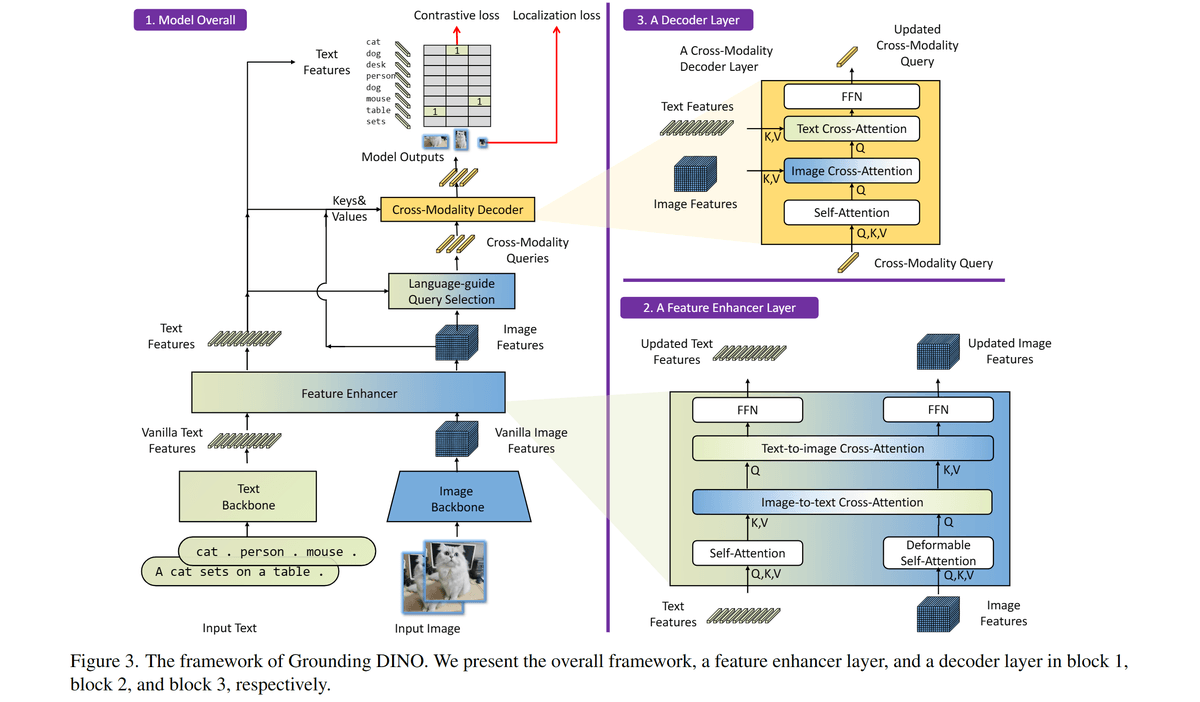
The architectural delta is small but consequential. MM Grounding DINO refines the contrastive class head and drops parameter sharing in the decoder, lifting zero-shot detection performance on both COCO (50.6, +2.2 AP) and LVIS (31.9, +11.8 val AP and 41.4, +12.6 minival AP). The jump on LVIS, which spans 1,200+ categories including a heavy rare-class tail, is where the design pays off.
Numbers that move the needle
The gains scale with pretraining data. Here is how the tiny variants stack up on LVIS minival, taken from the model documentation:
| Model | Pre-Train Data | MiniVal AP |
|---|---|---|
| mm_grounding_dino_tiny_o365v1_goldg | O365, GoldG | 35.7 (+6.9) |
| mm_grounding_dino_tiny_o365v1_goldg_grit | O365, GoldG, GRIT | 36.5 (+7.7) |
| mm_grounding_dino_tiny_o365v1_goldg_v3det | O365, GoldG, V3Det | 40.5 (+11.7) |
| mm_grounding_dino_tiny_o365v1_goldg_grit_v3det | O365, GoldG, GRIT, V3Det | 41.4 (+12.6) |
The parenthesized deltas are relative to the original Grounding DINO tiny trained on the same data. Adding V3Det, a large-vocabulary detection dataset, unlocks the biggest jumps, especially on the rare and common classes where the original struggled.
Using it in practice
The API mirrors the existing Grounding DINO processor. Text prompts are still passed as candidate labels, and boxes come back with per-label scores.
from transformers import AutoProcessor, AutoModelForZeroShotObjectDetection
from transformers.image_utils import load_image
import torch
model_id = "openmmlab-community/mm_grounding_dino_tiny_o365v1_goldg_v3det"
processor = AutoProcessor.from_pretrained(model_id)
model = AutoModelForZeroShotObjectDetection.from_pretrained(model_id, device_map="auto")
image = load_image("http://images.cocodataset.org/val2017/000000039769.jpg")
inputs = processor(images=image, text=[["a cat", "a remote control"]], return_tensors="pt").to(model.device)
with torch.no_grad():
    outputs = model(**inputs)
results = processor.post_process_grounded_object_detection(
    outputs, threshold=0.4, target_sizes=[(image.height, image.width)]
)
A few things worth knowing before dropping this into production:
- Checkpoints live under the openmmlab-community collection, with Swin-T, Swin-B, and Swin-L backbones.
- The base model trained on the "ALL" data mix hits 59.5 COCO mAP, and the large variant reaches 60.3, both in non-zero-shot settings.
- LLMDet inference is also supported through the same class, with checkpoints in the LLMDet collection. LLMDet is a follow-up that pairs the detector with a language model for stronger LVIS numbers, topping out around 56.6 minival AP for the large variant.
- Text prompts still need the dot-separated format used by the original Grounding DINO, so
"a cat. a dog."for multi-class queries.
Where it fits in the stack
Open-set detectors are the workhorse behind zero-shot annotation, robotics perception, and any system that needs to find "the red box on the left" without a fixed label list. The original Grounding DINO extended a closed-set detection model with a text encoder, enabling open-set detection and reaching 52.5 AP on COCO zero-shot. MM Grounding DINO keeps that flexibility while narrowing the gap between prompt-driven detection and specialist supervised detectors, which is what auto-labeling and vision-language agent pipelines have been waiting for.
For anyone already running Grounding DINO in Transformers, this is close to a free upgrade: same processor, same output format, same license family, better numbers. For teams that had written off open-vocabulary detection as too weak on rare classes, +11.8 AP on LVIS val is a real reason to look again.