
Huazhong University's ViTMatte Hits 1M Downloads Cutting Hair-Level Precision
A compact 25.8M parameter Vision Transformer for image matting that pulls foregrounds from photos with pixel level alpha precision, using a trimap hint.
 Pro
Takeaways
- ViTMatte-small on Composition-1k is a 25.8M parameter Vision Transformer for image matting, released under Apache-2.0.
- Available on Hugging Face and integrated in Transformers via VitMatteForImageMatting.
- Uses hybrid window plus global attention, a residual convolution neck, and a lightweight Detail Capture Module.
- Achieves SAD 21.46 on Composition-1k, beating RMat and MatteFormer with fewer parameters.
- Requires a trimap hint marking foreground, background, and unknown regions as input.
- Read the paper on arXiv or try the demo Space.
Image matting sits in an awkward spot between segmentation and Photoshop wizardry. You do not just want a binary mask of the subject, you want a per pixel alpha value that captures wispy hair, motion blur, and semi transparent edges. ViTMatte-small-composition-1k from Huazhong University of Science and Technology has quietly become one of the most downloaded models on the Hugging Face Hub for exactly this task, and it is worth knowing what makes it tick.
The model is a plain Vision Transformer with a lightweight convolutional head, trained on the Composition-1k benchmark for alpha matte prediction. It ships under Apache-2.0, weighs in at 25.8M parameters, and integrates directly with Hugging Face Transformers through the VitMatteForImageMatting class. No inference provider hosts it, so you run it locally or on your own endpoint.
How the architecture pulls this off
The core idea from the original paper is that a pretrained plain ViT already encodes enough semantic information to do matting well, removing the need for the complex hierarchical decoders that dominated prior CNN based systems. The authors argue that plain vision Transformers have shown strong performance across computer vision thanks to their modeling capacity and large-scale pretraining, and that matting is the next task to benefit.
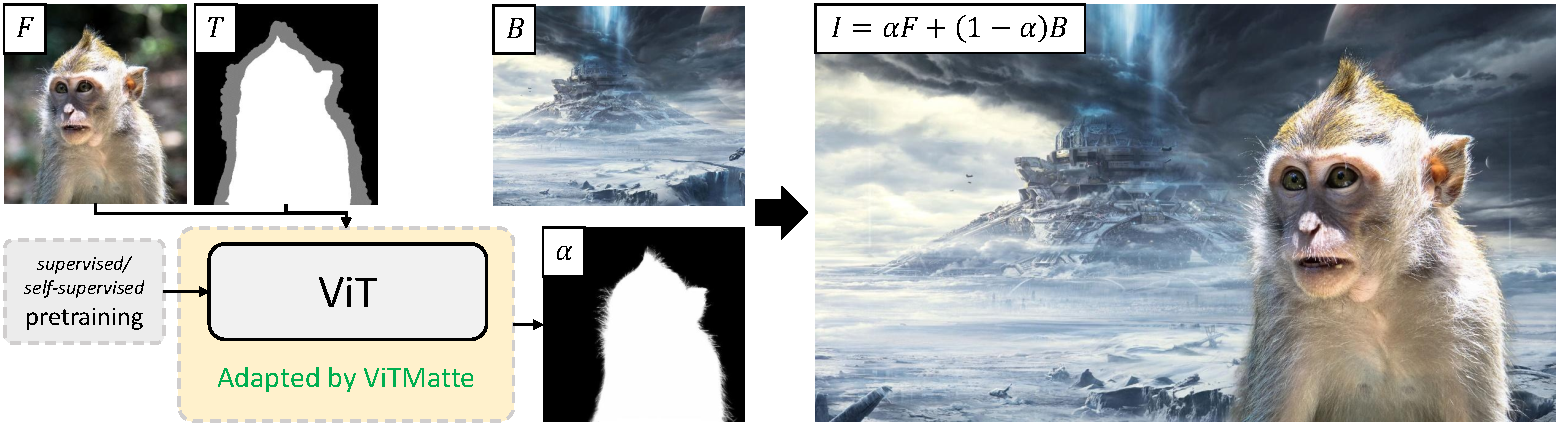
Three design choices carry the model:
- Hybrid attention. Most transformer blocks use windowed attention, and only the last block in each group applies global attention. Paired with a convolution neck, this trade-off is what keeps high resolution inputs affordable.
- Convolution neck. Residual bottleneck blocks sit between transformer groups. Attention layers tend to favor low frequency content, so the convs act like a high pass filter that recovers edges and textures.
- Detail Capture Module. A stack of simple lightweight convolutions fuses features at half, quarter, and eighth resolution back into the ViT output to produce a full resolution alpha matte.
The benchmark story
The paper reports state of the art results on both standard matting benchmarks with a smaller parameter budget than the previous best. On Composition-1k, ViTMatte-S posts SAD 21.46 and MSE 3.3 against RMat at 22.87 and 3.9, using 25.8M parameters versus 27.9M for RMat and 44.8M for MatteFormer. The larger ViTMatte-B pushes SAD to 20.33. On Distinctions-646 the margin is wider, with ViTMatte-B reaching SAD 17.05 versus 25.65 for TransMatting.
The small model was initialized from DINO self supervised pretraining, while the base variant used MAE. Training ran for 100 epochs on two V100 GPUs with AdamW, and the loss combined an L1 term computed separately in known and unknown trimap regions, a Laplacian loss, and a gradient penalty.
How you actually use it
The model expects an RGB image concatenated with a trimap, a grayscale hint where 0 is background, 1 is foreground, and 0.5 marks the unknown regions the network should solve. That trimap is the price of admission and also the reason quality is so high, since it turns matting into a constrained problem rather than open ended segmentation.
from transformers import AutoImageProcessor, VitMatteForImageMatting
import torch
processor = AutoImageProcessor.from_pretrained("hustvl/vitmatte-small-composition-1k")
model = VitMatteForImageMatting.from_pretrained("hustvl/vitmatte-small-composition-1k")
inputs = processor(images=image, trimaps=trimap, return_tensors="pt")
with torch.no_grad():
    alphas = model(**inputs).alphas
For very large images the authors describe a grid sample inference trick that splits the input into four interleaved token groups before global attention. The model has been downloaded over one million times on the Hub, and community Spaces like hysts/ViTMatte give you a browser demo with SAM based trimap generation.
Where it fits, and where it does not
ViTMatte is aimed squarely at production matting pipelines: green screen replacement, product photography cutouts, video conferencing backgrounds, and asset preparation for VFX or e-commerce. Because it needs a trimap, it slots into workflows where a rough mask already exists, either drawn by a user or produced by a segmentation model like SAM.
The main limitation is that trimap dependency. If you want fully automatic background removal with no hint, models like RMBG or BiRefNet are a better fit. ViTMatte also inherits the domain of its training data, which is composited foregrounds on natural backgrounds, so extreme domains like medical imagery or heavy motion blur will need fine tuning. For the classic hair, fur, and translucency problems that break most segmentation models, it remains one of the strongest small open weight options available.