
Huawei's ColBERT-Att Squeezes More Accuracy From RAG Without Extra Cost
Huawei researchers propose ColBERT-Att, an extension that folds token attention weights into the MaxSim scoring operator to boost retrieval accuracy at zero inference cost.
 Pro
Takeaways
- Huawei's ColBERT-Att paper adds token attention weights to the MaxSim scoring operator in late interaction retrieval
- Attention weights come free from the encoding pass, so inference latency is unchanged versus ColBERTv2
- A document-length regularizer (delta = min(1, doc_len/150)) fixes train/test attention scale mismatch
- Gains: ~1 point Success@5 on LoTTE, ~2 points nDCG@10 on ArguAna, ~5 points on Quora
- Mixed results on BEIR: wins on NFCorpus and FEVER, losses on FiQA, HotpotQA, SciFact
- Trained by fine-tuning ColBERTv2+PLAID on MS-MARCO for 1M steps on 2x A100 80GB GPUs
Late interaction retrieval has quietly become one of the workhorses of modern RAG pipelines, and a new paper out of Huawei's Dublin lab proposes a small but pointed tweak to how it works. ColBERT-Att, from Raj Nath Patel and Sourav Dutta, modifies the classic MaxSim scoring operator so that it explicitly weighs each token by its attention importance, rather than treating every token match as equally meaningful.
The pitch is that this comes essentially for free. ColBERTv2 made the late interaction recipe practical by adding residual compression and denoised supervision, cutting the space footprint by 6x to 10x while retaining state-of-the-art quality. ColBERT-Att keeps that foundation intact while nudging accuracy up on out-of-domain benchmarks.
The missing weight in MaxSim
A quick refresher on the mechanic being modified: ColBERT encodes query and document independently and then matches them through a cheap interaction step over token-level representations. The key scoring operator is MaxSim: for each query token, find the best matching document token, then sum those matches.
The authors argue this treats every token as equally important, which is not how language actually works. Consider the query "Who is going to study?" against a document about buying apples that also contains "is going to." The surface-level cosine similarity on that phrase is high, but a language model's own attention weights would tell you those tokens carry little semantic load in either sentence. ColBERT-Att exploits that signal directly.
The modified scoring function multiplies each MaxSim contribution by two exponentiated attention terms, one from the query token and one from the winning document token. Because attention weights are already computed as a byproduct of the encoding pass, the authors emphasize that this adds no inference latency. Document token embeddings and attention weights are pre-computed offline; query-side values are grabbed on the fly.
The document length trap
A subtler engineering problem lurks underneath: attention weights are not scale-invariant across document length. Short documents concentrate attention mass on a few tokens; long documents spread it thin. Training on MS-MARCO (average length around 55 tokens) and then evaluating on Quora (around 10) or NFCorpus (around 230) creates a distribution mismatch that can degrade retrieval.
The fix is a document-length regularizer applied to the document-side attention term:
delta = min(1, doc_len / l)   # l = 150 empirically
score = sum over qi of exp(A_qi) * max over dj of (E_qi . E_dj) * exp(A_dw)^delta
This scales down high attention weights for short documents while leaving longer ones alone. In their ablation, the regularizer alone drives a roughly 5% nDCG@10 jump on Quora, where documents are five times shorter than the training distribution.
What the numbers show
The gains are real but modest, and uneven across benchmarks. Training was done by fine-tuning ColBERTv2 with PLAID on MS-MARCO for 1M steps on two NVIDIA A100 80GB GPUs, with inference tested on a 16GB RTX card.
- On MS-MARCO dev (in-domain), Recall@100 improves by only 0.2 points over ColBERTv2 with PLAID
- On LoTTE search and forum queries (out-of-domain), Success@5 improves by roughly 1 point on average, with the biggest lifts on Technology and Writing splits
- On BEIR ArguAna, ColBERT-Att posts a ~2 point nDCG@10 gain
- Results are mixed on other BEIR tasks: small wins on NFCorpus, NQ, FEVER, SCIDOCS; small losses on FiQA, HotpotQA, and SciFact
The ablation also shows that both query-side and document-side attention terms are needed to get the best results; using either alone underperforms the combined formulation on most LoTTE splits.
Why this matters for retrieval stacks
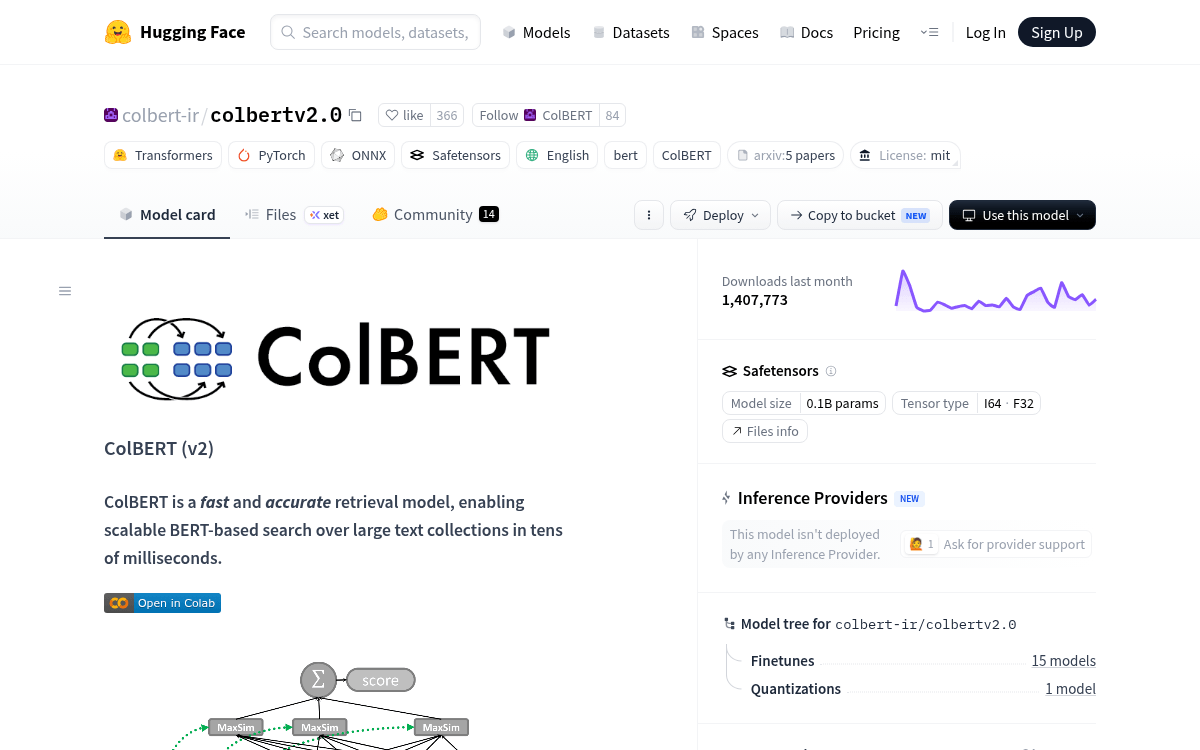
Late interaction has been having a moment. While ColBERT became a common baseline in IR research, widespread real-world adoption lagged behind, largely due to poor ecosystem integration compared to the simpler single-vector methods. That changed in early 2023 with the rapid rise of LLM Retrieval-Augmented Generation pipelines, combined with an increase in user-friendly tooling for late interaction such as RAGatouille and PyLate. ColBERT models now clock millions of monthly downloads.
Against that backdrop, the interesting property of ColBERT-Att is that it composes cleanly with the existing PLAID engine and imposes no runtime penalty, even if absolute score gains are small. If you already have a ColBERTv2 index in production, the modification is a training-time change to the objective, not an architectural rewrite. The authors flag GTE-ModernColBERT as a natural next target for the same objective, which could push the numbers further given that ModernColBERT already incorporates rotary embeddings and updated activations.
Where it fits, and where it does not
Practically, the technique looks most useful when your retrieval corpus has document lengths that diverge sharply from MS-MARCO, since that is where the attention regularizer earns its keep. It is less compelling if you are already saturating on in-domain benchmarks or running a domain-specific reranker downstream. The mixed BEIR results also suggest that attention-weighted scoring is not universally better; on tasks like HotpotQA, where multi-hop reasoning demands broader token coverage, downweighting low-attention tokens may actually hurt.
Still, ColBERT-Att is a useful reminder that the MaxSim operator is not sacred, and that the attention weights already sitting inside every BERT encoder are a signal late interaction has been leaving on the table.