
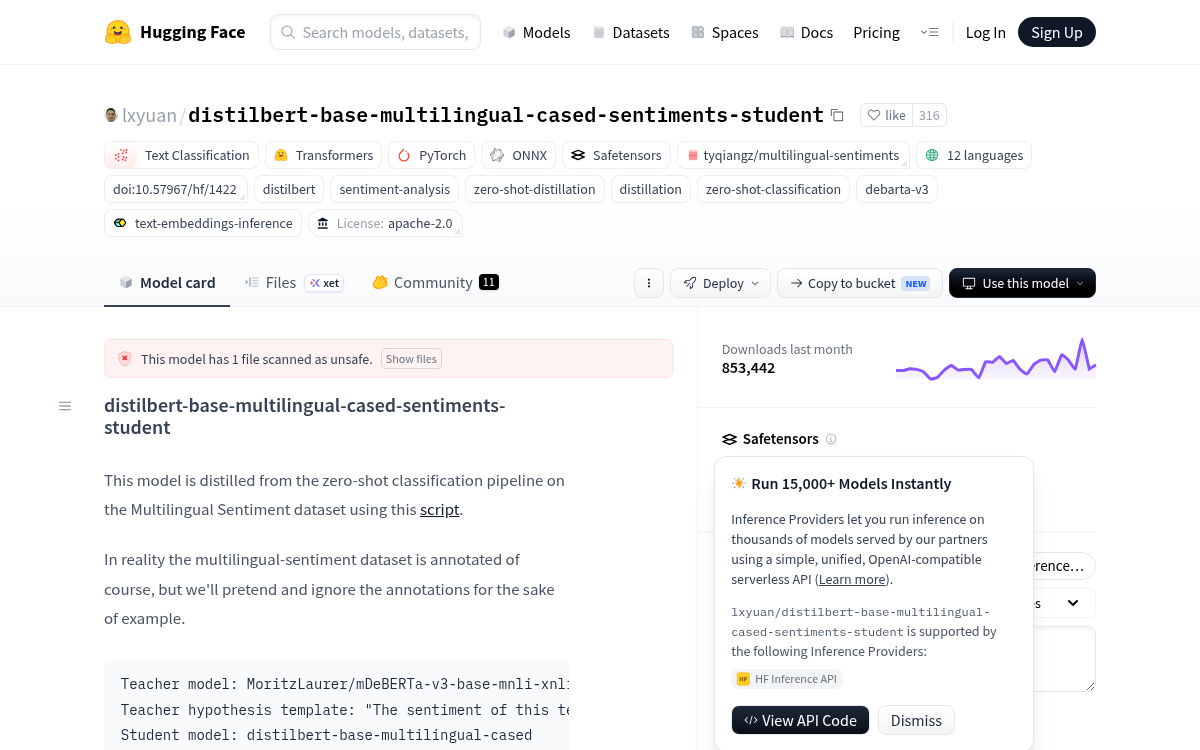
How a Label-Free Multilingual Sentiment Model Hit 853K Monthly Downloads
A compact multilingual sentiment classifier built via zero-shot distillation reaches 853k monthly downloads by covering 12 languages in one lightweight model.
 Pro
Takeaways
- Multilingual sentiment classifier on Hugging Face hitting 853k monthly downloads.
- Covers 12 languages with positive, neutral, negative labels in a 100M-parameter DistilBERT.
- Distilled from mDeBERTa-v3 NLI teacher using Hugging Face's zero-shot-distillation script.
- Reported 88.29% student-teacher agreement on 146k evaluation examples.
- Ships in PyTorch, Safetensors, and ONNX formats under Apache 2.0.
- Strong baseline for review, moderation, and feedback pipelines without labeled data.
A three-way sentiment classifier called distilbert-base-multilingual-cased-sentiments-student has quietly become one of the most-used text classification models on Hugging Face, pulling in over 853,000 downloads a month. It classifies positive, neutral, and negative sentiment across a dozen languages in roughly 100 million parameters, and it was built without a single human label.
Distilled from a zero-shot classifier
Rather than fine-tuning on annotated sentiment data, the author used a natural language inference (NLI) model as a teacher and let it label a raw multilingual text corpus on the fly. The teacher is MoritzLaurer/mDeBERTa-v3-base-mnli-xnli, prompted with the hypothesis template "The sentiment of this text is {}." The student is distilbert-base-multilingual-cased, trained using Hugging Face's zero-shot-distillation script.
Zero-shot NLI classifiers work by turning a class label into a hypothesis and scoring whether the input text entails it. That is powerful but slow at inference. Distillation collapses that behavior into a tiny classifier head, preserving most of the accuracy without the cost of running a large NLI model on every request. The dataset used here does carry annotations, but they are deliberately ignored to simulate a pure zero-shot workflow.
What you get in practice
The model exposes a standard three-label output and works with a pipeline("text-classification", ...) call. On the author's own examples, it returns confident positive scores across English, Malay, and Japanese sentences with the same semantics:
from transformers import pipeline
clf = pipeline(
    model="lxyuan/distilbert-base-multilingual-cased-sentiments-student",
    return_all_scores=True,
)
clf("Saya suka filem ini dan saya akan menontonnya lagi dan lagi!")
# -> positive 0.976, neutral 0.018, negative 0.006
Supported languages: English, Arabic, German, Spanish, French, Japanese, Chinese, Indonesian, Hindi, Italian, Malay, and Portuguese. Weights ship as PyTorch, Safetensors, and ONNX, so it drops into transformers, onnxruntime, or a text-embeddings-inference server. The license is Apache 2.0.
How closely it tracks its teacher
The training log offers one concrete quality signal: student and teacher predictions agreed on 88.29% of the evaluation set. That figure matters more than any accuracy metric here, since the student is reproducing the NLI teacher rather than a gold label set. A few other numbers from the training run:
- One epoch took roughly 2,010 seconds at 73 samples per second and 4.56 steps per second, with a final training loss of 0.647.
- Evaluation ran on 146,721 examples at batch size 128.
- Parameter count and memory footprint match the base
distilbert-base-multilingual-casedcheckpoint.
Where it fits, where it falls short
This model is a solid default for cheap, batchable sentiment scoring across many languages: tagging product reviews, social posts, or support tickets in a pipeline that cannot afford a large LLM call per row. It runs on CPU, quantizes cleanly to ONNX, and has accumulated 23 fine-tunes and community quantizations listed on the model page. The limits follow directly from the recipe:
- Coarse labels only. No intensity score, no emotion breakdown, no aspect-level sentiment.
- Domain drift. The teacher labeled generic multilingual text, so sarcasm, finance jargon, or medical notes will likely need fine-tuning.
- Ceiling set by the teacher. Errors from mDeBERTa-v3 NLI are baked into the student, and the 88% agreement figure is not a ground-truth accuracy.
- Uneven language coverage. Japanese and Hindi will lag English quality, because distillation quality tracks how well the teacher handled each language.
Why the download count keeps climbing
Zero-shot distillation turns out to be a practical path to production classifiers when labeled data is unavailable. Pick a strong NLI model, write a hypothesis template, run it over in-domain text, train a small student. The result is a standard AutoModelForSequenceClassification checkpoint with none of the runtime overhead of NLI-based inference.
For multilingual moderation, review-monitoring, or feedback-triage pipelines, this checkpoint is a strong baseline before spending on annotation. If 88% teacher-student agreement falls short, the same script run over an unlabeled in-domain corpus is a clear path to a domain-adapted version.