
HiDream-ai's HiDream-O1 Beats 56B Models With an 8B Pixel-Native Image Generator
HiDream open-sourced an 8B pixel-native transformer that unifies text, images, and task conditions in one shared token space at up to 2K resolution.
Takeaways
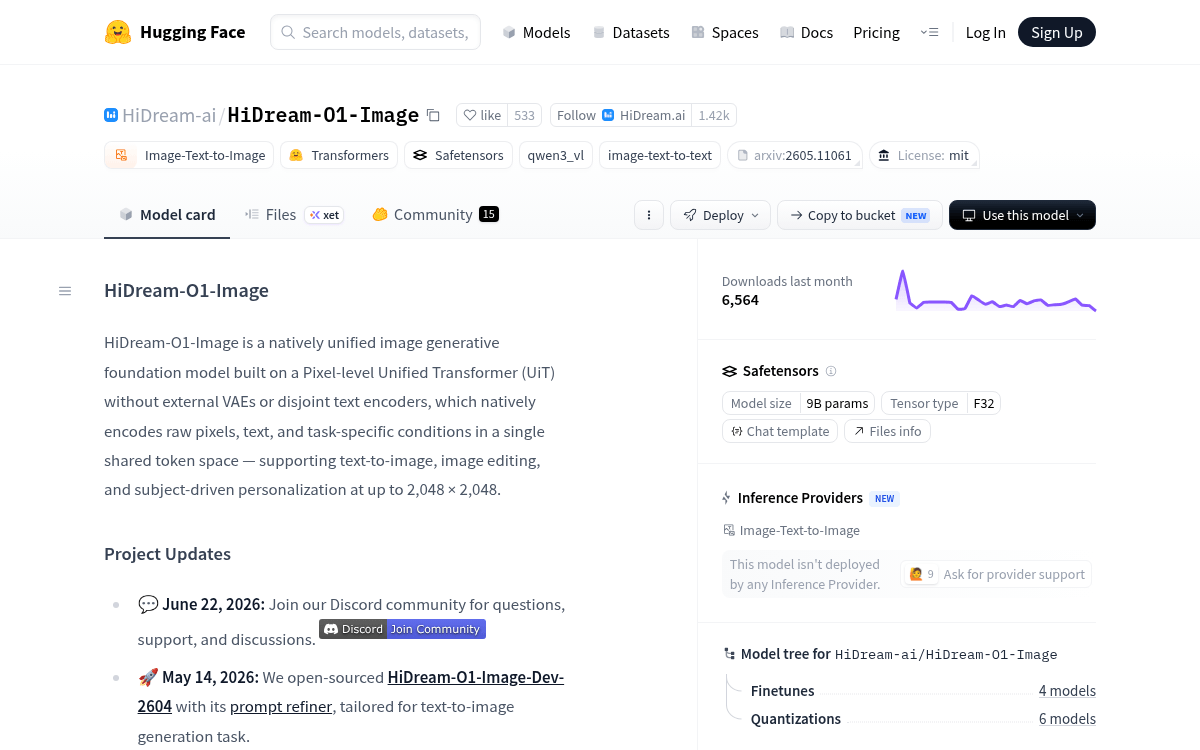
- HiDream-ai released HiDream-O1-Image, an 8B pixel-native image foundation model, MIT-licensed.
- No VAE, no separate text encoder. Raw pixels and text tokens share one transformer.
- Handles text-to-image, editing, subject personalization, layout, and skeleton conditioning up to 2048x2048.
- Scores 0.90 on GenEval and 0.978 on Chinese long-text, beating FLUX.2 Dev (56B) and Qwen-Image.
- Ships with a reasoning-driven prompt agent using Gemma-4-31B-it or any OpenAI-compatible API.
- Distilled Dev variant runs in 28 steps at guidance scale 0; full technical report on arXiv.
Most image generators today are Frankenstein stacks: a frozen text encoder (usually T5 or CLIP) pumps embeddings into a diffusion transformer that operates in the latent space of a separately trained VAE. HiDream-ai just released a model that throws all of that out. HiDream-O1-Image is an 8B-parameter generative foundation model that operates directly on raw pixels, with text tokens flowing through the same transformer instead of being pre-encoded by a separate model.
The weights, code, and a distilled Dev variant are all up on Hugging Face under an MIT license, and the Dev-2604 checkpoint has already landed at #8 on the Artificial Analysis Text to Image Arena, which the team claims makes it the leading open-weights text-to-image model on that leaderboard.

Killing the VAE and the text encoder
The architectural pitch is the whole story here. Visual generative models have long been constrained by fragmented architectures relying on disjoint text encoders and external VAEs, and HiDream-O1-Image is presented as a pixel-space Diffusion Transformer that shifts from modular architectures to an end-to-end in-context visual generation engine.
By mapping raw image pixels, text tokens, and task-specific conditions into a single shared token space, HiDream-O1-Image achieves structural unification of multimodal inputs within a Unified Transformer (UiT) architecture. This eliminates the need for separate VAEs or disjoint pre-trained text encoders and lets the model treat diverse generation and editing tasks as a consistent in-context reasoning process.
In practice that means three things:
- No VAE. The model operates on raw RGB patches, so nothing is being compressed and decoded around the diffusion process.