
Helsinki-NLP's MultiSynt/MT Gives 36 Languages 4.8T Tokens Using Tiny Translation Models
A 22-author consortium released MultiSynt/MT, a 4.8T-token synthetic multilingual corpus built with OPUS-MT that beats native web data at pre-training.
 Pro
Takeaways
- MultiSynt/MT releases 4.8T tokens across 36 European languages, translated from Nemotron-CC.
- Built with Tower+ LLMs and OPUS-MT, the classical NMT models cover all 36 languages.
- Models trained on MultiSynt/MT match native HPLT 2.0 with 72% fewer tokens, and beat it by 15% at 100B tokens.
- Coverage jumps 182x for Maltese, 153x for Irish, 79x for Norwegian Nynorsk versus native HPLT 3.0.
- Multiple-choice benchmarks miss translation-quality differences that fluency judges and native tasks expose.
- Released under CC0 on Hugging Face with row-aligned parallel outputs from multiple MT systems.
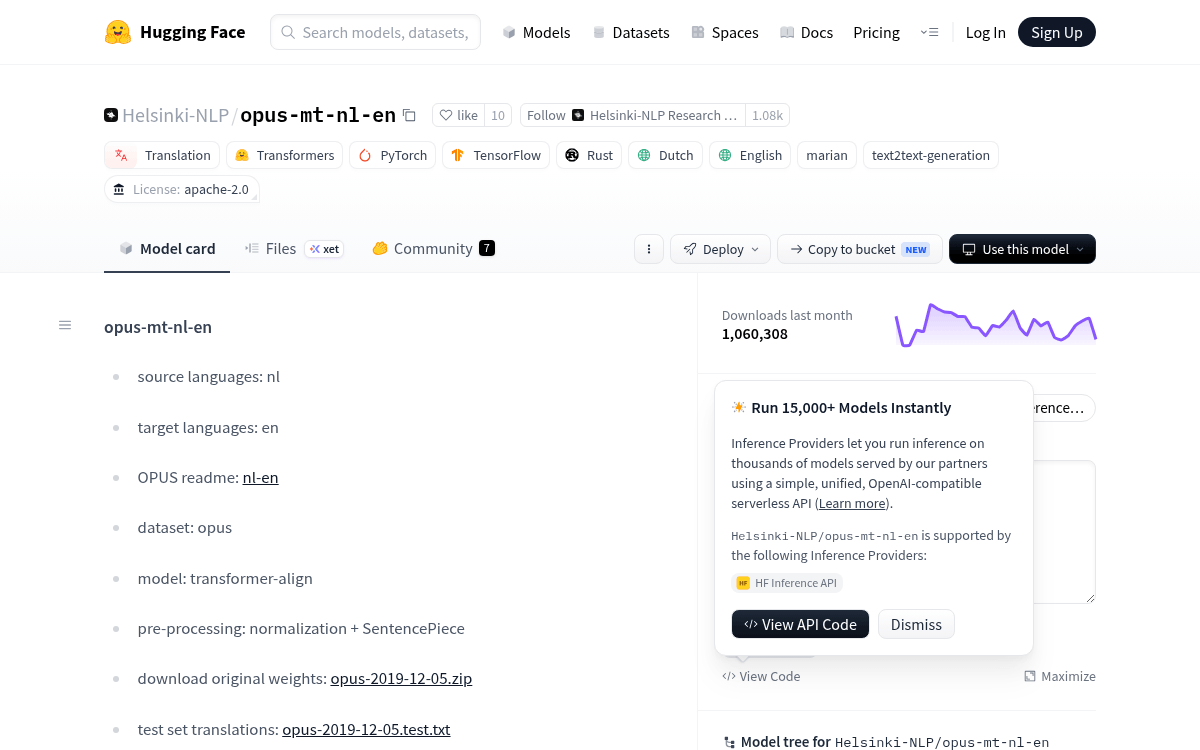
A large European research consortium has released MultiSynt/MT, an openly licensed multilingual pre-training corpus that leans heavily on the veteran OPUS-MT translation models to close the English-versus-everything-else data gap. The corpus contains roughly 4.8 trillion target-language tokens across 36 European languages, produced by translating 100 billion high-quality Nemotron-CC tokens with Tower+ and OPUS-MT/HPLT-MT systems. The workhorses doing most of that translation are the same small transformers many teams already pull off Hugging Face for cheap inference, including the Dutch-to-English and dozens of other bilingual OPUS-MT checkpoints maintained by Helsinki-NLP.
Why translating the web beats scraping it
Open web-scale data has always been lopsided. Common Crawl and its descendants are overwhelmingly English, and filtered multilingual pipelines like HPLT and FineWeb2 still leave medium- and low-resource languages starved of quality tokens. The consortium's fix is blunt: take a high-quality English pool, translate it into 36 languages, and use the output as pre-training data. For many medium- and lower-resource European languages, this is now the largest openly available pre-training resource.
The size gap over native data is dramatic in the long tail. MultiSynt/MT is larger for 19 of 24 languages, by over an order of magnitude for the lowest-resource ones (Maltese 182x, Irish 153x, Norwegian Nynorsk 79x). HPLT 3.0 wins only on German and Spanish, by roughly 5-6x. Maltese, Irish and Nynorsk suddenly have real pre-training budgets. German and Spanish, already well served, do not.
OPUS-MT gets a second life at trillion-token scale
The OPUS-MT family, including the widely used opus-mt-nl-en Dutch-English model, is a collection of over a thousand bilingual transformers trained with Marian NMT on the OPUS parallel corpora. Compared to modern translation-tuned LLMs they are tiny, roughly 75M to 230M parameters, and at this scale that turns out to be the point.
The production pool combines two very different systems. The LLM pipeline deploys Tower+ 9B and 72B on the Leonardo HPC cluster (CINECA, NVIDIA A100 nodes) with vLLM under a Slurm-native orchestration toolkit released as open source, consuming roughly 3.1 million A100 GPU-hours in aggregate. The classical NMT side runs on Helsinki-NLP/Opus-MT with Marian on AMD MI250x GPUs, wrapped in a sentence-splitting pre-processor and document-reassembly post-processor that preserve both per-sentence and per-document alignments. OPUS-MT ends up covering 31 of the 36 target languages, with HPLT-MT filling in Basque, Irish, Icelandic, Maltese and Albanian.
The rough coverage split:
- Tower+ 9B (Gemma-based): 16 languages, 1.7T tokens
- Tower+ 72B (Qwen-based): 5 high-resource languages, 0.5T tokens
- OPUS-MT and HPLT-MT: all 36 languages, 4.8T tokens
The uncomfortable benchmark result
The more provocative finding is what happens when you actually pre-train on this stuff. The team trained matched 1.7B parameter Llama-style reference models on each corpus variant with a 100B-token budget. On a broad multilingual benchmark suite, models trained on MultiSynt/MT reach the final score of the HPLT 2.0 native-data baseline using roughly 72% fewer pre-training tokens, and beat it by about 15% relative at a matched 100B-token budget.
The choice of translation system barely moves standard benchmarks. Human raters rank Tower+ 72B well above Tower+ 9B, and both above OPUS-MT. Once those translations become pre-training data, the resulting LLMs are almost indistinguishable on Belebele, HellaSwag, ARC and their multilingual siblings. Standard multiple-choice evaluations are blind to real translation-quality differences that do exist downstream.
Where the story gets messier
To probe the gap the multiple-choice tests hide, the authors ran an LLM-as-judge fluency probe on free-form generations, using DeepSeek V3.1 to compare continuations against a native-data baseline. The judge cleanly recovered the human ranking of the underlying MT systems: Tower+ 72B beats Tower+ 9B beats OPUS-MT. All three still matched or exceeded the native HPLT 2.0 baseline on fluency, so this is a benchmark blind spot rather than a MultiSynt/MT deficiency.
Native data still wins on things translation cannot invent. In a Norwegian case study on NorEval, models trained on translated data lost consistently to models trained on native Norwegian for the NorIdiom idiom-completion task, and only caught up on commonsense reasoning late in training. Idioms, named entities and culturally grounded knowledge stay anchored to the English source frame even when the translations read fluently.
The paper is unusually candid about a confound. Many multiple-choice benchmarks are themselves translations of English originals, and an embedding-space check finds Belebele, ARC-Challenge and friends sit closer to MultiSynt/MT documents than to native HPLT text. A translated-data model is partly being scored on how well it absorbed the same source frame that produced the test set.
What you actually get
What this release gives you today:
- A CC0-licensed corpus of roughly 4.8T target-language tokens across 36 languages on Hugging Face, with row-aligned parallel translations from multiple MT systems for controlled experiments.
- An open Marian-based translation pipeline you can rerun yourself against the same OPUS-MT checkpoints many teams have been quietly using for years.
- Reference recipes for a 1.61B-parameter transformer trained on 100B tokens with the Gemma-3 tokenizer, useful as a low-cost multilingual baseline.
- Evidence that for medium- and lower-resource European languages, pointing a fleet of small NMT models at a high-quality English corpus beats waiting for more native web data.
If you have been building multilingual applications on the assumption that small classical NMT models are relics, this release argues the opposite. The same Helsinki-led group has separately argued that inference-time scaling of reasoning models offers limited gains on translation without domain-specific fine-tuning, which fits the same theme: for the translation-shaped part of the multilingual data problem, specialized small models still pull their weight. Translated data complements native corpora rather than replacing them, and multiple-choice leaderboards are the wrong tool to tell the difference.