
HauhauCS Strips All Refusals From Qwen3.5 Hitting 130K Downloads
A community abliteration of Qwen3.5-35B-A3B claims zero refusals across 465 test prompts while keeping the full multimodal MoE stack intact.
 Pro
Takeaways
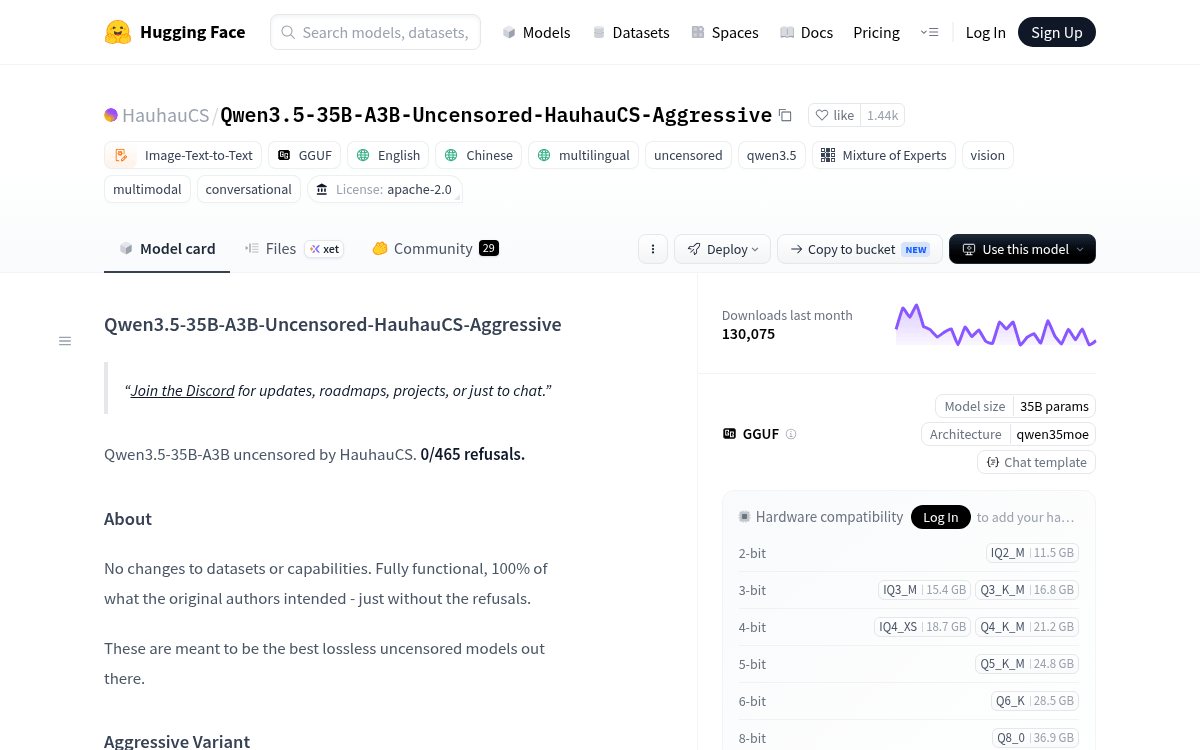
- HauhauCS released an abliterated GGUF of Qwen3.5-35B-A3B claiming 0 refusals across 465 test prompts.
- 35B MoE with 3B active parameters, 256 experts routed 8-per-token plus one shared expert.
- Hybrid gated DeltaNet plus full softmax attention in a 3:1 ratio, 262K native context extendable to 1M via YaRN.
- Natively multimodal for text, image and video, 248K vocab, 201 languages, MTP support.
- GGUF quants from BF16 (65 GB) to IQ2_M (11 GB), all built with imatrix; runs on llama.cpp, LM Studio, Jan, Ollama.
- Apache 2.0, no dataset changes; a more conservative Balanced variant is promised later.
A community modder going by HauhauCS has pushed out an uncensored GGUF build of Qwen3.5-35B-A3B that has already crossed 130,000 downloads on Hugging Face. Same weights, same benchmarks, same multimodal stack, but the refusal behavior has been stripped out with an abliteration pass.
The author claims 0/465 refusals on an internal benchmark and frames the release as a lossless uncensor rather than a fine-tune. A Balanced variant that keeps some safety guardrails is promised later.
What abliteration actually did here
Abliteration is a weight-editing technique that identifies the internal direction a model uses to express refusal and zeros it out, so no new training data is introduced. That is why the model card insists there are no changes to datasets or capabilities, just the removal of refusals.
The Aggressive build shipping now is fully unlocked and won't decline prompts, though it may occasionally append short disclaimers that were baked into the base training. All quants were generated with importance matrix (imatrix) calibration, which uses activation statistics to preserve the weights that matter most. That preservation step carries extra weight here because abliteration already perturbs the residual stream, and naive quantization on top of that compounds the damage.
The architecture underneath
The base is Alibaba's Qwen3.5-35B-A3B, a mixture-of-experts model where only a fraction of parameters fire per token. Specs from the card:
- 35B total parameters, 3B active per forward pass
- Gated DeltaNet linear attention mixed with full softmax attention in a 3:1 ratio across 40 layers
- 256 experts routed 8 per token, plus one shared expert
- Text input with optional images or video frames, text output across 201 languages
- 262K native context window extendable to 1M tokens, with single and multi-token prediction
The DeltaNet plus softmax hybrid is worth flagging. DeltaNet is a linear-attention variant that runs in constant memory per token, so mixing three DeltaNet layers with one full-attention layer buys long context without paying quadratic cost on every layer. The card notes this hybrid preserves the thinking capabilities essential for reasoning while keeping compute in check.
Running it locally
The repo ships as GGUF, so it plugs straight into llama.cpp, LM Studio, Jan, koboldcpp, and Ollama. Quant sizes cover a wide hardware range, from a 65 GB BF16 down to an 11 GB IQ2_M that will squeeze onto a single 16 GB card. A separate mmproj file handles the vision encoder.
A minimal launch with vision enabled looks like this:
llama-cli -m Qwen3.5-35B-A3B-Uncensored-HauhauCS-Aggressive-Q4_K_M.gguf \
  --mmproj mmproj-Qwen3.5-35B-A3B-Uncensored-HauhauCS-Aggressive-f16.gguf \
  --jinja -c 131072 -ngl 99
Two config notes from the card matter in practice: keep context at least 128K to preserve chain-of-thought behavior, and pass --jinja so the correct chat template is applied. Recommended sampling for reasoning is temperature=1.0, top_p=0.95, top_k=20, presence_penalty=1.5 in thinking mode.
Who this is actually for
Legitimate reasons to reach for an uncensored base include red-teaming, security research on jailbreak transferability, adversarial dataset generation, and content moderation training where you need a model that will produce the policy-violating text your classifier needs to catch. It also helps in domains where mainstream RLHF over-refuses, such as medical, legal, or offensive-security tooling.
The tradeoffs
Abliteration typically causes small regressions on instruction-following benchmarks, and the disclaimer artifacts the author acknowledges mean prompts still leak safety-training residue into outputs. There is also no way to verify the 0/465 refusals figure without the test set, and community threads on the repo suggest users are hitting the usual abliteration side effects around repetition and looping at aggressive sampling settings. The Aggressive repo currently carries 29 open discussion threads.
The release is Apache 2.0, free to download, and a follow-up Qwen3.6 build from the same author is already live for anyone who wants the newer Alibaba base. As always with abliterated models, whatever it generates is your problem, not the base model provider's.
