
Harveen Chadha's Vakyansh Tamil Model Hits 1.35M Downloads on Hugging Face
A Tamil speech-to-text model fine-tuned from the CLSRIL-23 multilingual base has crossed 1.3M downloads, becoming a default open ASR pick for Tamil audio.
 Pro
Takeaways
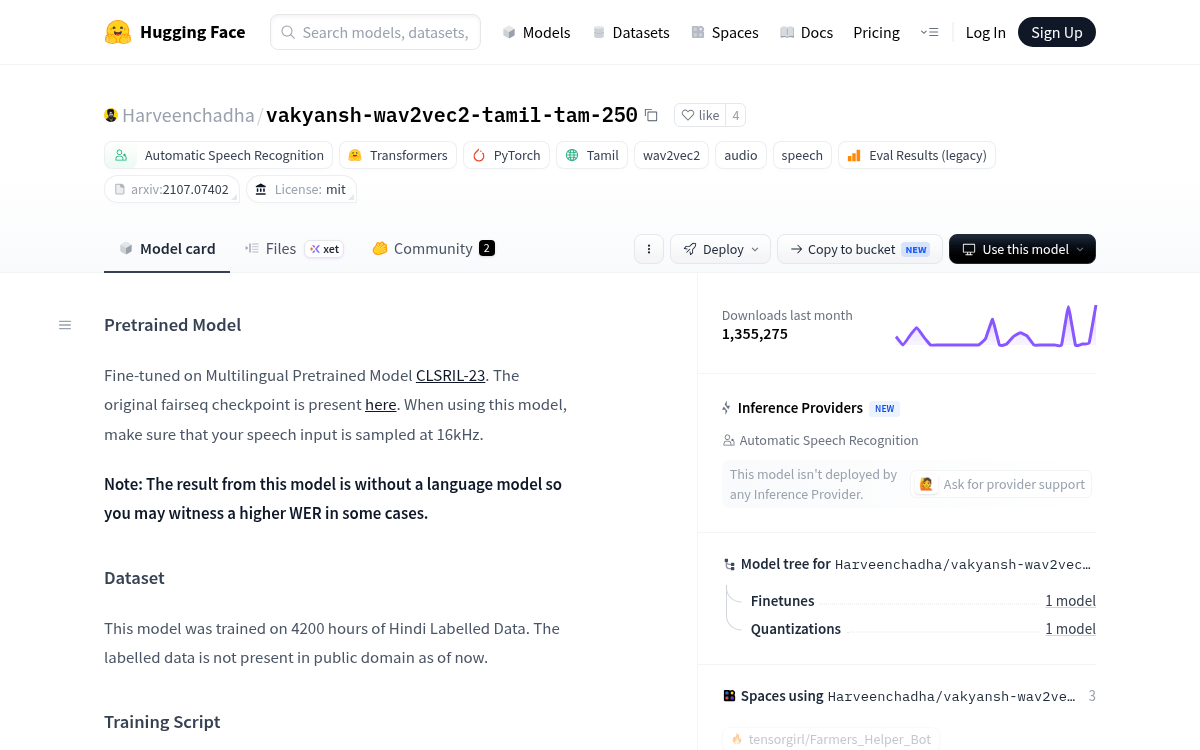
- Vakyansh Tamil wav2vec2 model on Hugging Face has crossed 1.35M downloads.
- Fine-tuned from CLSRIL-23, a wav2vec2-Base pretrained on 10,000 hours of 23 Indic languages.
- Reports 53.64% WER on Common Voice Tamil test, greedy decoding without any language model.
- MIT licensed, drops into standard
transformersASR pipeline, requires 16 kHz mono audio input. - Backed by Ekstep Foundation and the Vakyansh open source Indic speech initiative.
- Best suited as a small on-prem Tamil ASR base for further fine-tuning or LM rescoring.
Tamil automatic speech recognition has long been a gap in the open source stack, and one wav2vec2 checkpoint has quietly become the workhorse filling it. The Vakyansh Tamil wav2vec2 model from Harveen Chadha has now pulled in more than 1.35 million downloads on Hugging Face, making it one of the most used Indic ASR checkpoints on the hub.
The model is a fine-tuned wav2vec2 CTC head sitting on top of CLSRIL-23, a multilingual Indic speech encoder. It ships under an MIT license, drops straight into the standard transformers pipeline, and expects mono 16 kHz audio at the input, which is the usual wav2vec2 sample rate constraint.
Roots in CLSRIL-23
The checkpoint is fine-tuned on top of CLSRIL-23, a self-supervised representation model built specifically for Indian languages. The approach extends wav2vec 2.0 and earlier cross-lingual pre-training work, restricting pretraining to Indic languages on the premise that cross-lingual pre-training on related languages outperforms monolingual pre-training for downstream ASR.
The base encoder is not small. CLSRIL-23 was trained on 10,000 hours of data across 23 Indic languages using a wav2vec2-Base architecture. The Tamil head was then fine-tuned on top of that encoder using the Vakyansh training platform built by the Ekstep team, with training logs available on Weights and Biases for anyone who wants to inspect the run.
How well it actually transcribes
The headline number is a Test WER of 53.64 on the Tamil split of Common Voice, reported without any language model rescoring. That trails modern multilingual giants like Whisper large or SeamlessM4T on Tamil, with important context:
- The number reflects greedy CTC decoding only. The authors explicitly note the result is without a language model, so higher WER is expected, and an n-gram or transformer LM on top can shave several points.
- Common Voice Tamil is a hard, noisy benchmark with heavy speaker and dialect variance.
- The model is small enough to run on a single consumer GPU or even CPU for streaming use cases, unlike Whisper large.
Plugging it into your stack
Usage is deliberately boring, which is part of why it gets picked up so often. A three-line pipeline is enough to get transcripts:
from transformers import pipeline
pipe = pipeline("automatic-speech-recognition",
                model="Harveenchadha/vakyansh-wav2vec2-tamil-tam-250")
text = pipe("sample_ta.wav")["text"]
For more control, you can load the processor and CTC head directly with AutoProcessor and AutoModelForCTC, run torch.argmax over the logits, and decode with processor.batch_decode. That is also the path you take if you want to bolt on a KenLM decoder for lower WER.
Sweet spots and rough edges
The practical sweet spot is clear:
- Batch transcription of Tamil audio at scale where cost per hour matters more than absolute accuracy.
- On-prem or edge deployments where sending audio to a cloud API is a non-starter, for example in agritech, healthcare, or government voice interfaces.
- A starting checkpoint for further fine-tuning on domain-specific Tamil data like call center logs or broadcast news.
- Feeding downstream NLP pipelines where a language model or spellcheck layer cleans the output.
The weak spots are equally clear. There is no punctuation or casing, no built-in speaker diarization, and no timestamps beyond what CTC alignment gives you. Code-mixed Tamil-English utterances, extremely common in real conversational data, will hurt WER noticeably. A 53% error rate also means you should not push raw outputs to any user-facing surface without a correction layer.
Why the download counter keeps climbing
The Indic ASR landscape has moved on since this checkpoint first appeared, with newer entries from AI4Bharat, IndicWav2Vec, and multilingual foundation models. This one keeps getting pulled because it is small, permissively licensed, easy to fine-tune, and part of a broader open effort. The work was funded by Ekstep Foundation, with the Vakyansh team open sourcing speech models across the Indic languages. That model family, released through the Vakyansh models repo, covers Hindi, Tamil, Telugu, Marathi, Bengali, Gujarati and more, all fine-tuned from the same CLSRIL-23 backbone.
For anyone building Tamil voice features and unwilling to pay per minute to a hosted API, this remains one of the shortest paths from raw audio to a working transcript on your own hardware.