
Gustavosta's MagicPrompt Turns Short Ideas Into Stunning AI Image Prompts
A tiny GPT-2 model turns short scene ideas into the verbose, detail-packed prompts that Stable Diffusion actually rewards.
 Pro
Takeaways
- MagicPrompt-Stable-Diffusion is a GPT-2 fine-tune that expands short ideas into detailed Stable Diffusion prompts.
- Trained for 150,000 steps on ~80,000 prompts scraped from Lexica.art.
- Only ~0.1B parameters, runs locally via Transformers, vLLM, Ollama, or Core ML.
- MIT licensed and free; dataset published as Stable-Diffusion-Prompts.
- Powers prompt-expansion in 100+ Hugging Face Spaces and creative tools.
- Best for classic SD 1.x aesthetics; not tuned for SDXL, Flux, or instructions.
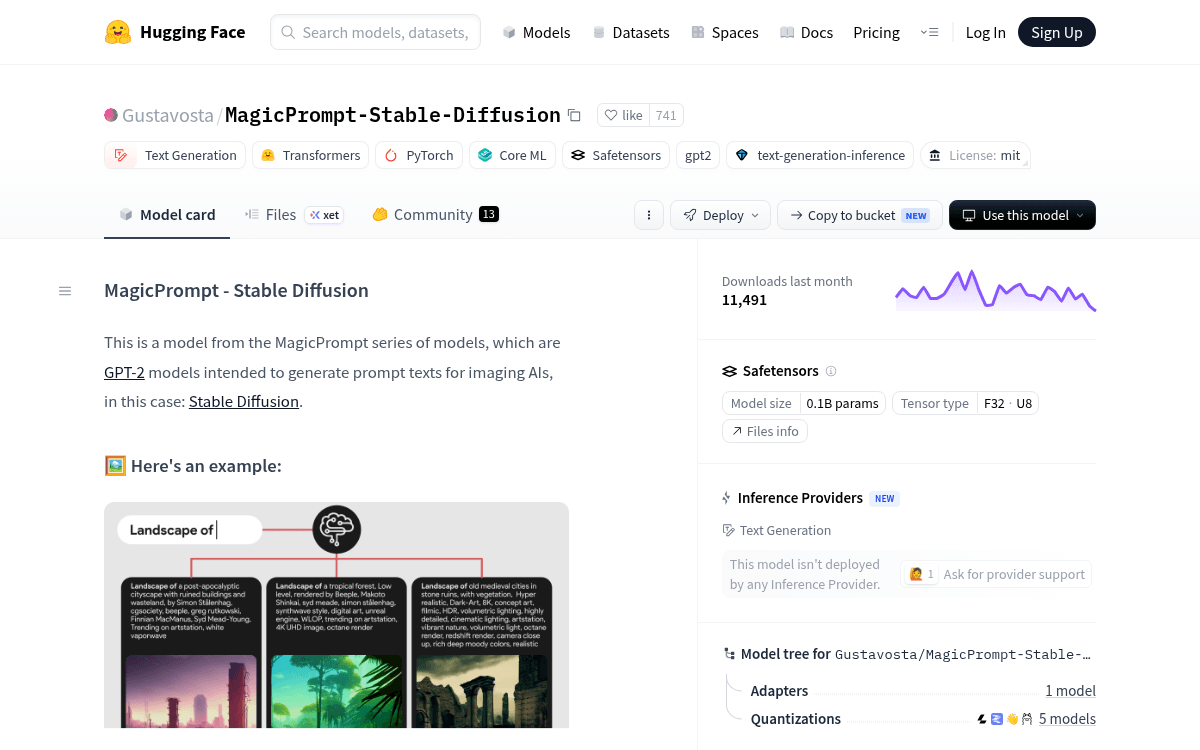
Anyone who has spent time with Stable Diffusion knows the frustration: type a castle and get a mediocre image, but paste in a 60-word incantation full of artist names, lighting terms, and camera details and suddenly the output looks like concept art. MagicPrompt-Stable-Diffusion automates exactly that gap, taking a short idea and expanding it into the dense, comma-separated prompt that image models respond to best.
Released by Gustavosta on Hugging Face under an MIT license, it is a GPT-2 checkpoint fine-tuned to write prompts for Stable Diffusion. At roughly 0.1B parameters it runs almost anywhere and slots in as a preprocessing step before an image pipeline.
How it was built
Training ran for 150,000 steps on around 80,000 prompts scraped and cleaned from Lexica.art, the Stable Diffusion image search. Because Lexica had no public API, the author built the corpus manually and published it as the Stable-Diffusion-Prompts dataset. The training signal is straightforward: given a fragment, learn to continue it in the style of prompts that produced good images on Lexica.

Dropping it into a pipeline
Usage is a two-line Transformers call. Feed it a seed phrase, sample a completion, and pass the result to your diffusion model:
from transformers import pipeline
pipe = pipeline("text-generation", model="Gustavosta/MagicPrompt-Stable-Diffusion")
seed = "a medieval castle on a cliff"
prompt = pipe(seed, max_length=80, num_return_sequences=1)[0]["generated_text"]
# feed `prompt` into Stable Diffusion
The repo ships weights in PyTorch, Safetensors, and Core ML formats. Community quantizations cover llama.cpp, Ollama, LM Studio, and Jan, so running it locally on a laptop or phone requires no GPU. A hosted Space is available for quick experimentation.
Strengths and limits
The model reliably handles:
- Adding the stylistic scaffolding Stable Diffusion responds to: lighting descriptors, artist references, medium, resolution tags, and ArtStation-style flavor.
- Turning one-liners into varied prompt candidates for batch generation.
- Running as a cheap local step in a larger creative tool without a GPU.
Its limits follow directly from its training data. Frozen on a Lexica snapshot from early Stable Diffusion, it skews heavily toward fantasy, portrait, and concept-art aesthetics. It has no knowledge of newer models like SDXL or Flux, will suggest artist names that modern checkpoints ignore, and cannot accept plain-English instructions since it was never instruction-tuned. For other image targets, Gustavosta also released MagicPrompt-Dalle.
Worth knowing for image tooling
Prompt engineering remains a genuine bottleneck for anyone building image-generation UX, and a 100M-parameter helper model is a pragmatic answer. With 21,088 downloads last month, 741 likes, and over 100 Hugging Face Spaces listing it as a dependency, MagicPrompt has become a standard building block for prompt-expansion features in open-source image tools. For a text-to-image feature where users should type short phrases and still get good results, the integration takes about five minutes.