
Grosman's wav2vec2 Portuguese Model Hits 4.8M Downloads With 11% Error Rate
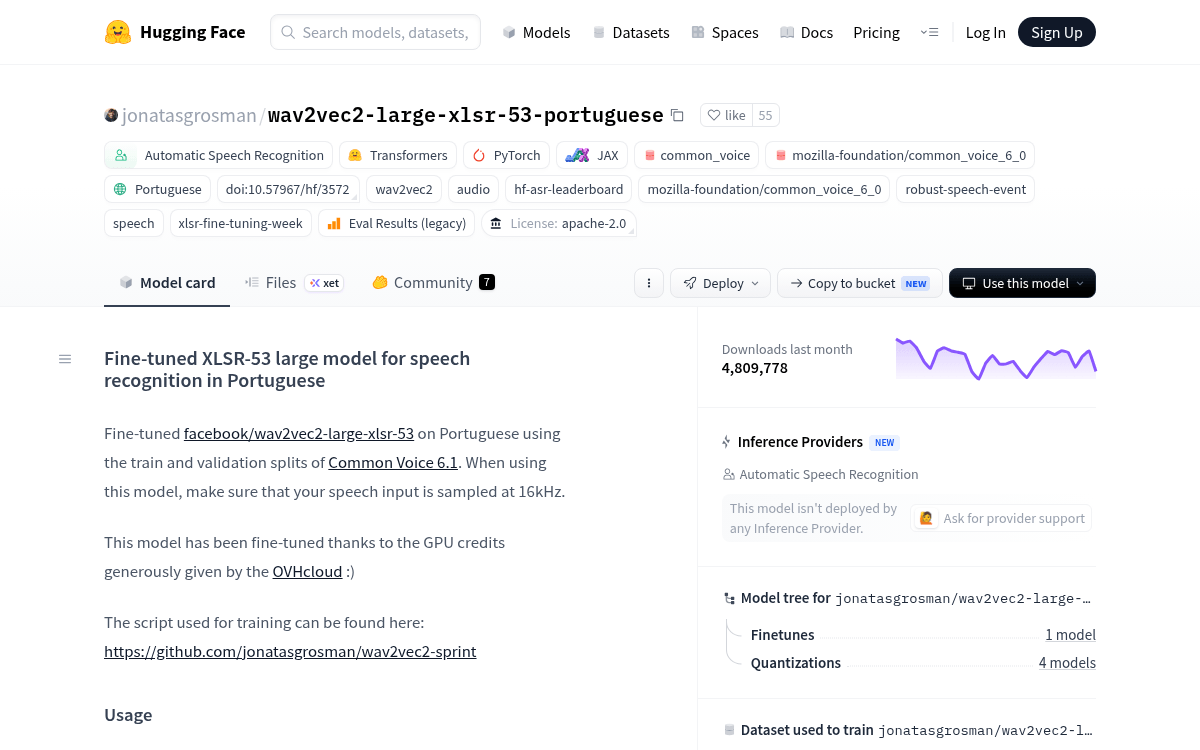
A community fine-tune of Facebook's XLSR-53 for Portuguese speech recognition has quietly crossed 4.8 million downloads on Hugging Face.
 Pro
Takeaways
- Community fine-tune of facebook/wav2vec2-large-xlsr-53 for Portuguese ASR, Apache 2.0 licensed.
- Crossed 4.8M downloads on Hugging Face, one of the most used audio models.
- Reports 11.31 percent WER on Common Voice Portuguese test, 9.01 with a language model.
- Backbone has 24 transformer layers, ~300M params, pretrained on 56,000 hours across 53 languages.
- Requires 16 kHz audio input, usable via transformers pipeline or the HuggingSound library.
- Weaker on noisy real-world audio, hitting 42 percent WER on Robust Speech Event dev set.
A community Portuguese speech recognition model has quietly become one of Hugging Face's most downloaded audio checkpoints, racking up 4.8 million downloads without any fanfare. Jonatas Grosman released it under Apache 2.0 as a fine-tune of Meta's XLSR-53 backbone specialized for Portuguese, and it keeps trending because it happens to be one of the cheapest, fastest ways to bolt Portuguese transcription onto an application without paying per-minute API fees.
The backbone doing the heavy lifting
The base model is facebook/wav2vec2-large-xlsr-53, Meta's cross-lingual speech encoder. XLSR-53 is a multilingual extension of Wav2Vec2 with 24 Transformer layers and a hidden size of 1024, pretrained on roughly 56,000 hours of unlabeled speech covering 53 languages. The pretraining objective matters here: the model solves a contrastive task over masked latent speech representations and jointly learns a quantization of the latents shared across languages, then gets fine-tuned on labeled data.
Cross-lingual pretraining lets lower-resource languages inherit representations learned from higher-resource ones. On the CommonVoice benchmark, XLSR shows a relative phoneme error rate reduction of 72 percent compared to the best known results, which is why a Portuguese fine-tune of a 300M parameter multilingual encoder actually works with modest labeled data.
What the Portuguese fine-tune actually is
Grosman took the XLSR-53 checkpoint and fine-tuned it on the Common Voice 6.1 Portuguese train and validation splits, using GPU credits from OVHcloud. The training script lives in his wav2vec2-sprint repo. One constraint to remember: audio must be sampled at 16 kHz, otherwise the feature encoder falls apart.
Self-reported numbers on the Common Voice Portuguese test set:
- Word Error Rate: 11.31 percent
- Character Error Rate: 3.74 percent
- With a language model bolted on: WER 9.01, CER 3.21
- Robust Speech Event dev set (noisier, real-world audio): WER 42.10, dropping to 36.92 with a language model
The gap between 11 percent WER on clean Common Voice and 42 percent on noisier data is the honest story of this checkpoint. It performs well on read speech that resembles its training distribution and struggles on conversational or noisy audio, which shows up directly in the sample transcriptions where clean short utterances come out perfect while longer, harder sentences get mangled.
Getting it running
The path of least resistance is the standard transformers pipeline:
from transformers import pipeline
pipe = pipeline(
    "automatic-speech-recognition",
    model="jonatasgrosman/wav2vec2-large-xlsr-53-portuguese",
)
text = pipe("audio_16khz.wav")["text"]
Grosman also maintains HuggingSound, a thin wrapper that handles batching, decoding, and timestamps. It works with any CTC model on the Hugging Face Hub, and the API is a two-liner:
from huggingsound import SpeechRecognitionModel
model = SpeechRecognitionModel("jonatasgrosman/wav2vec2-large-xlsr-53-portuguese")
transcriptions = model.transcribe(["file1.mp3", "file2.wav"])
Under CTC decoding you also get per-token start and end timestamps in the output dict, which is enough to build subtitle files without a forced aligner.
The cost-quality sweet spot
This checkpoint keeps showing up in production pipelines because of a very specific cost-quality tradeoff. Whisper-large-v3 is more accurate and more robust, but at roughly a billion parameters and 680,000 hours of multilingual pretraining, inference is heavier. This model sits around 300M parameters, runs comfortably on a single mid-range GPU or even CPU with quantization, and already has four community quantizations linked from the model card.
Good fits:
- Batch transcription of Portuguese podcasts, lectures, or call-center recordings where audio is reasonably clean
- On-device or self-hosted ASR where sending audio to a cloud API is a non-starter for privacy or cost reasons
- Forced alignment and subtitle generation, since CTC gives you frame-level timestamps for free
- A starting point for further fine-tuning on domain-specific Portuguese audio, whether medical, legal, or regional accents
Look elsewhere for heavy background noise, code-switching between Portuguese and English, or anything where you need punctuation and casing out of the box. The model outputs uppercase, unpunctuated text, and it has no built-in voice activity detection, so long files need to be chunked before inference. For those workloads, Whisper or a newer XLS-R fine-tune on 128 languages is usually the better call.