
Google Shrinks Gemma 3 1B to 529 MB for Any Phone
Google's Gemma 3 1B lands in LiteRT format with quantized builds that hit 85 decode tokens per second on phone NPUs.
 Pro
Takeaways
- Gemma 3 1B IT ships as LiteRT flatbuffers ready for Android, iOS, web, and desktop deployment
- Int4 QAT build is just 529 MB and runs at 47 tk/s decode on a Samsung S24 Ultra CPU
- NPU backend on Snapdragon 8 Elite reaches 5836 tk/s prefill and 85 tk/s decode
- WebGPU on M4 Max delivers 133 tk/s decode with 0.51 second time-to-first-token
- One-line install via
pip install litert-lmplus alitert-lm runcommand - Gated under the Gemma license, free to use, includes fine-tuning Colab
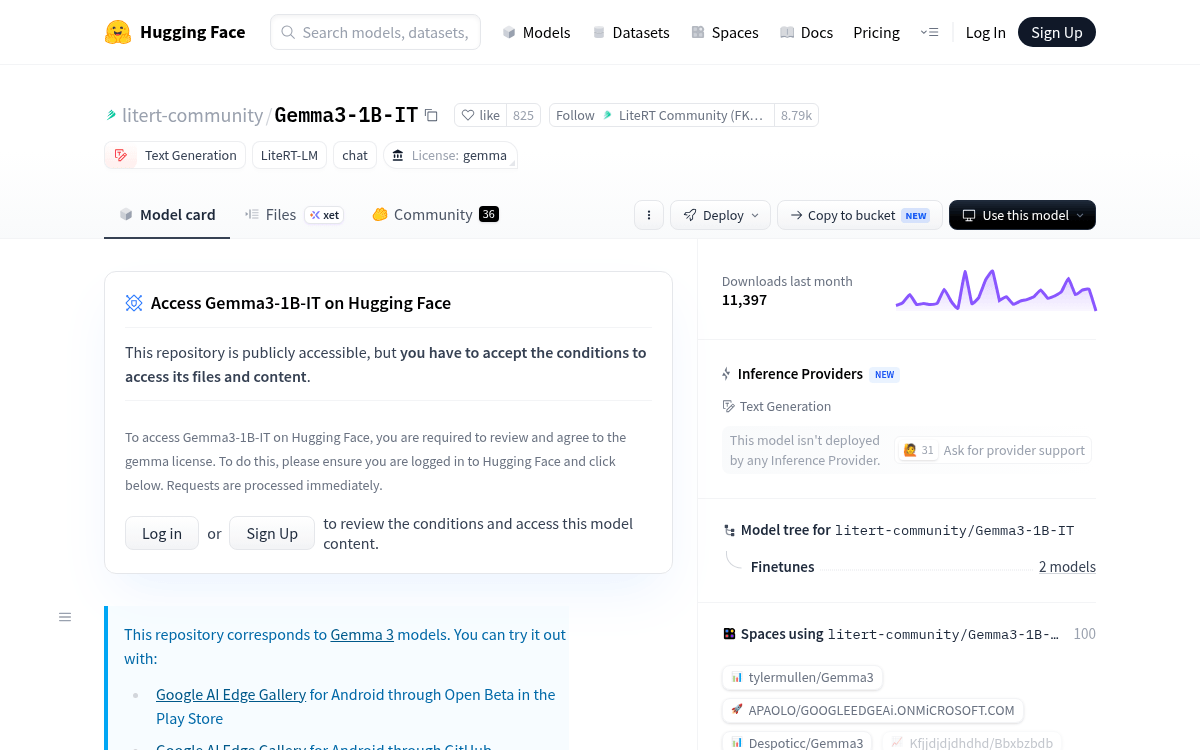
Google's on-device runtime team has packaged Gemma 3 1B into a matrix of ready-to-run variants optimized for phones, tablets, browsers, and desktops. The litert-community/Gemma3-1B-IT repository ships the instruction-tuned 1B parameter model with quantization schemes that shrink it to as little as 529 MB while pushing decode speeds past 80 tokens per second on modern mobile silicon.
The community org publishes compiled .tflite and .litertlm flatbuffers targeting Android via the LiteRT stack (the rebranded TensorFlow Lite runtime) and the MediaPipe LLM Inference API. These are the same artifacts Google's edge tooling consumes directly, so there's no conversion step between download and deployment.
One command to run it
The fastest path is the LiteRT-LM CLI:
pip install -U litert-lm
litert-lm run \
  --from-huggingface-repo=litert-community/Gemma3-1B-IT \
  --prompt="Write me a poem"
On mobile, Google ships two entry points: the AI Edge Gallery APK for Android and the MediaPipe LLM Inference sample app for iOS built through Xcode. A Colab notebook is also available for exploring the API, though the repo notes that memory and latency there will be substantially worse than on a local device.
Benchmark numbers worth knowing
On a Samsung S24 Ultra via MediaPipe, the quantization-aware trained int4 build hits 322 tk/s prefill and 47 tk/s decode on CPU alone, with a 529 MB footprint and a 2048-token context. Switch to the GPU backend and prefill jumps to 2,585 tk/s while decode climbs to 56 tk/s.
The sharpest figures come from NPU execution on a Samsung S25 Ultra, where the a16w4 build (int4 weights, int16 activations) reaches 5,836 tk/s prefill and 85 tk/s decode using only 626 MB of RAM. On the web side, a MacBook Pro M4 Max running the int4 build through WebGPU delivers 4,339 tk/s prefill, 133 tk/s decode, and time-to-first-token under 0.51 seconds.
Picking a quantization scheme
Rather than a single blob, the repo offers a matrix so you can match the build to your target device:
| Scheme | Size | Best for |
|---|---|---|
| fp32 baseline | 3,824 MB | Reference quality |
| dynamic_int8 | 1,005 MB | Balanced quality and speed |
| dynamic_int4 QAT | 529 MB | Smallest footprint, best mobile throughput |
| a16w4 QAT (NPU) | 689 MB | Flagship Snapdragon NPUs |
| Q4_0 web | 776 MB | Browser via WebGPU |
Context lengths are configurable at 1,280, 2,048, or 4,096 tokens depending on the build, with memory scaling accordingly. The CPU path runs through the LiteRT XNNPACK delegate with 4 threads.
Scope and limitations
Gemma 3 1B was trained on 2 trillion tokens with a knowledge cutoff of August 2024, and caps at a 32K token context per request. The larger 4B, 12B, and 27B Gemma 3 models support 128K context, so for long-document work they remain the better fit. Practical uses the 1B unlocks:
- On-device chat assistants that work offline with no server round-trip
- Text summarization, rewriting, and classification inside mobile apps
- In-browser AI features shipped as static web pages via WebGPU
- Fine-tuned domain adapters deployed to phones, using the provided fine-tuning notebook
- Edge agents requiring sub-second time-to-first-token
The model is gated by the Gemma license rather than a paid tier. Accept the terms on Hugging Face and the download unlocks immediately, with no ongoing API cost beyond local compute. For teams building mobile apps that need a capable language model without cloud API calls, this is one of the more complete packages currently available.