
Google Ships Gemma 7B IT as an Open Rival to Mistral and Llama
Google's instruction-tuned 7B open model brings Gemini-derived tech to laptops and single GPUs, with strong reasoning benchmarks and permissive deployment.
 Pro
Takeaways
- Google released Gemma 7B Instruct, an open instruction-tuned LLM built from Gemini research.
- Trained on 6T tokens of web, code, and math data using TPUv5e with JAX and ML Pathways.
- Scores 64.3 on MMLU, 46.4 on GSM8K, and 32.3 on HumanEval pass@1.
- Ships as safetensors and GGUF, runs on llama.cpp, Ollama, vLLM, SGLang, and LM Studio.
- Uses a strict start_of_turn/end_of_turn chat template; bitsandbytes 4-bit and 8-bit modes supported.
- Gated under Google's Gemma license; available on Hugging Face, Kaggle, and Vertex Model Garden.
Google's Gemma 7B Instruct is the conversational sibling of the Gemma base model, a lightweight open-weights decoder-only LLM designed to run on a laptop, a desktop, or your own cloud without the friction of an API. It sits in the crowded 7B open-model tier alongside Mistral and Llama, but it comes from the same recipe as Gemini and ships with Google's Responsible AI tooling.
What you actually get
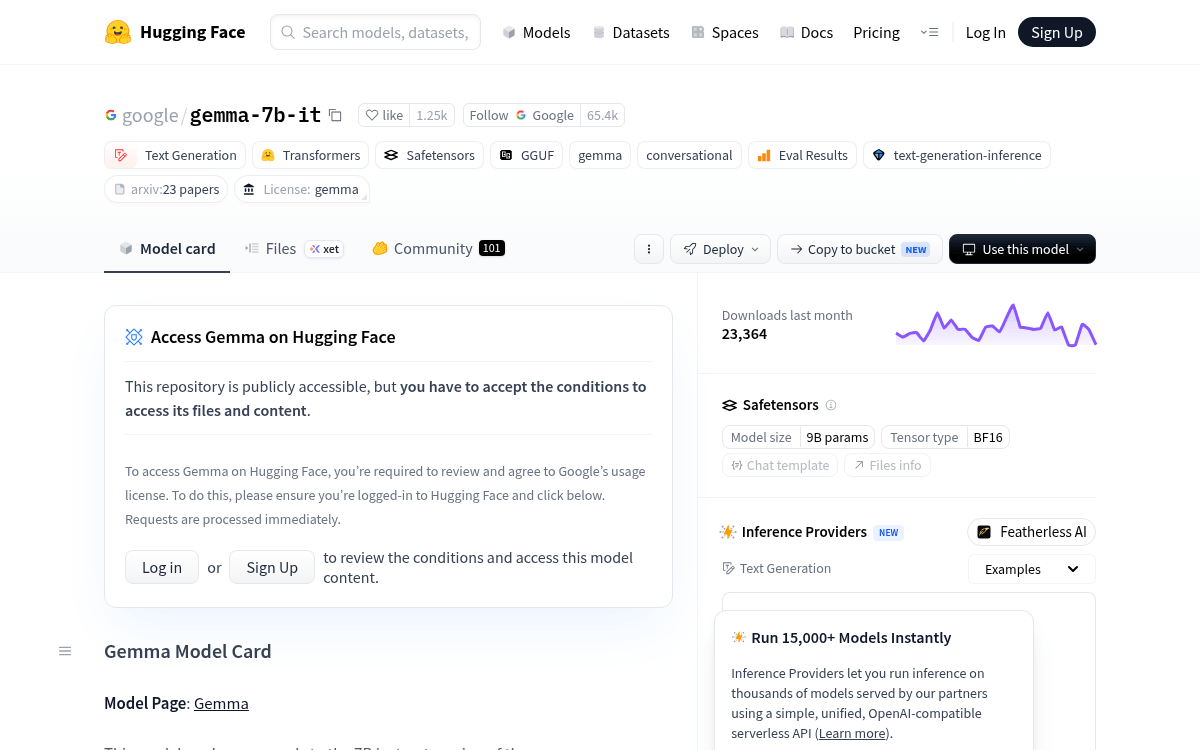
Gemma is a family of lightweight open models from Google, built from the same research used to create Gemini. The models are text-to-text, decoder-only, English-only, and available with open weights in both pre-trained and instruction-tuned variants. The -it suffix marks this checkpoint as instruction-tuned, so it responds to chat-style prompts out of the box rather than just continuing text.
Despite the 7B name, the model weighs in at around 9B actual parameters, ships in BF16 by default, and is distributed in both safetensors and gguf so it drops straight into llama.cpp, Ollama, LM Studio, vLLM, or SGLang. Access is gated behind Google's Gemma license, which you accept once on Hugging Face.
Training mix and hardware
Gemma 7B was trained on 6 trillion tokens drawn from web documents, source code, and mathematical text. The mix leans intentionally toward code and math to build reasoning and coding ability rather than just conversational fluency.
Training ran on TPUv5e hardware using JAX and ML Pathways, the same single-controller programming model described in the Gemini paper, which Google credits with simplifying orchestration across large TPU pods.
Reported benchmark scores for the 7B variant land where you would expect for a strong small-model release:
| Benchmark | Setting | Score |
|---|---|---|
| MMLU | 5-shot | 64.3 |
| HellaSwag | 0-shot | 81.2 |
| BoolQ | 0-shot | 83.2 |
| HumanEval | pass@1 | 32.3 |
| MBPP | 3-shot | 44.4 |
| GSM8K | maj@1 | 46.4 |
| MATH | 4-shot | 24.3 |
Averaged across the reported suite, the 7B model lands at 56.9 versus 45.0 for the 2B variant. The GSM8K jump from 17.7 at 2B to 46.4 at 7B is particularly notable, showing that multi-step arithmetic reasoning is where the extra parameters earn their keep.
Getting it running
The chat template is strict, so you generally want to let the tokenizer handle it. A minimal example:
from transformers import AutoTokenizer, AutoModelForCausalLM
import torch
tok = AutoTokenizer.from_pretrained("google/gemma-7b-it")
model = AutoModelForCausalLM.from_pretrained(
    "google/gemma-7b-it",
    device_map="auto",
    torch_dtype=torch.bfloat16,
)
chat = [{"role": "user", "content": "Write a hello world program"}]
prompt = tok.apply_chat_template(chat, tokenize=False, add_generation_prompt=True)
inputs = tok(prompt, return_tensors="pt").to(model.device)
print(tok.decode(model.generate(**inputs, max_new_tokens=150)[0]))
Under the hood, each turn is preceded by a start_of_turn delimiter followed by the role (either user for user-supplied content, or model for LLM responses), and closed by an end_of_turn token. If you assemble prompts by hand for something like a raw llama.cpp call, that format matters.
For tighter memory budgets, the model card provides drop-in configurations for float16, 8-bit and 4-bit quantization through bitsandbytes, and flash_attention_2 for faster inference. GGUF quants make it feasible to run on a single consumer GPU or even CPU.
Where it fits, where it doesn't
Google positions Gemma 7B IT as a general-purpose small model for text generation, chatbots, summarization, and NLP research. Realistic use cases:
- Local chat assistants and RAG backends where API latency or data residency rules out hosted models
- Fine-tuning targets, with QLoRA and FSDP-on-TPU scripts provided in the base repo
- Code and math scratchpads at the low end, given the training mix and GSM8K score
- Educational or research baselines for probing small-LLM behavior
The limitations are the usual ones for a model of this class, and the card is upfront about them. Gemma generates responses from patterns in its training data rather than a knowledge base, so it can produce incorrect or outdated factual statements. It is also English-only, has no vision or tool-use capabilities, and will struggle with long-context or subtly ambiguous prompts.
Why the release matters
Gemma matters less as a benchmark leader and more as a signal: Google is putting Gemini-lineage weights on Hugging Face under a license that permits commercial use, with first-class integration into Vertex Model Garden and Kaggle. For anyone building on open models, the small-model tier is now a three-way contest between Meta, Mistral, and Google, and any evaluation harness or fine-tuning pipeline you maintain probably needs a Gemma column. The official Gemma docs cover the responsible-use toolkit and prohibited-use policy worth skimming before shipping anything into production.