
Google's Tiny ALBERT-base-v2 Still Pulls 900K Monthly Downloads Without a GPU
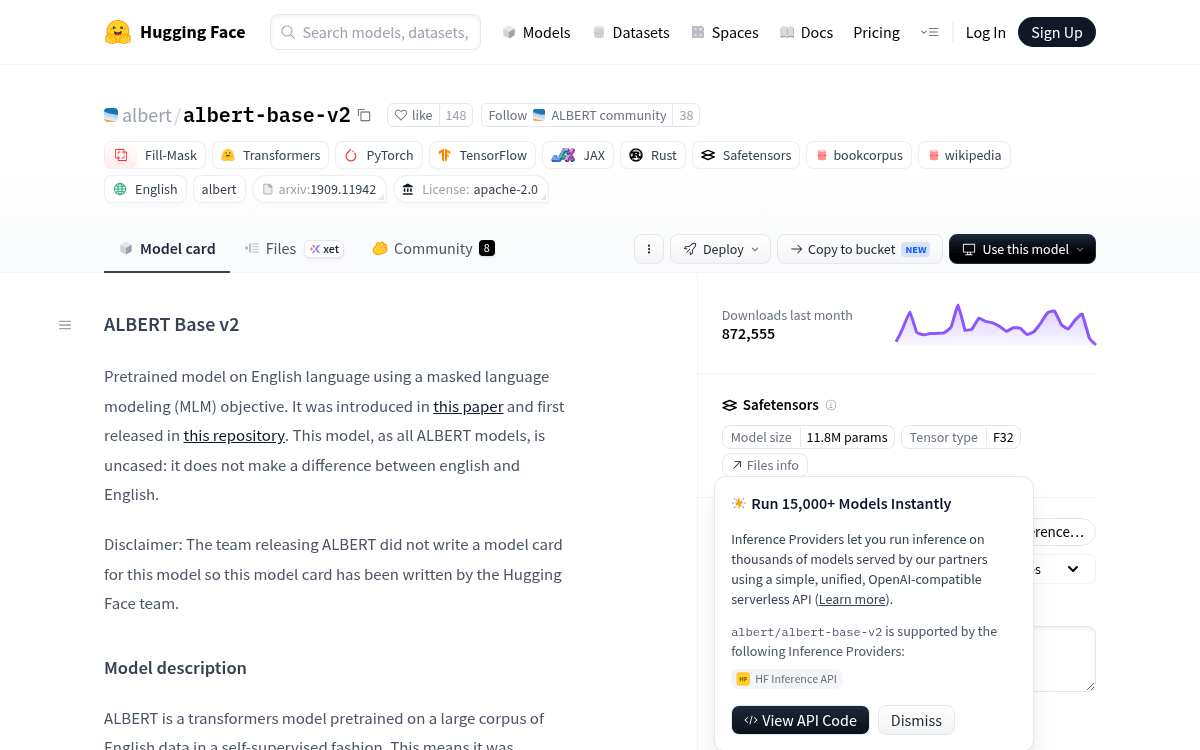
A compact 11M-parameter BERT variant using cross-layer weight sharing keeps racking up nearly a million monthly downloads for lightweight NLP fine-tuning.
 Pro
Takeaways
- ALBERT-base-v2 continues trending on Hugging Face with over 907K monthly downloads.
- 11M-parameter encoder uses cross-layer weight sharing across 12 layers for a small memory footprint.
- Factorized embeddings (128-dim to 768-dim) decouple vocabulary size from hidden layer width.
- Fine-tuned scores: 82.3 GLUE-style average, 90.2/83.2 on SQuAD1.1, 92.9 SST-2.
- Best for classification, token labeling, and extractive QA; not for text generation or chat.
- Apache 2.0, ships in PyTorch, TF, JAX, Rust, Safetensors; 246 fine-tunes already exist.
While the industry chases trillion-parameter frontier models, a nine-year-old encoder weighing just 11 million parameters still pulls nearly a million downloads a month. ALBERT-base-v2 sits at 907,667 downloads on Hugging Face, evidence that plenty of production NLP work needs neither a GPU cluster nor a chat interface.
ALBERT (A Lite BERT) came out of Google Research and Toyota Technological Institute at Chicago, built on the observation that scaling model size improves downstream performance up to a point, then hits GPU and TPU memory walls and ballooning training times. The v2 checkpoint is the second iteration, with tweaked dropout and longer training that improved nearly every downstream benchmark over v1.
One Transformer block, reused twelve times
The central idea is cross-layer parameter sharing. ALBERT shares all parameters across layers by default, covering both the feed-forward network and the attention weights. In practice, the 12 layers of ALBERT-base are the same weights applied 12 times, which compresses the parameter count without reducing depth.
The second technique is factorized embedding parameterization. Decomposing the vocabulary embedding matrix into two smaller matrices decouples the embedding dimension from the hidden dimension, making it cheap to scale the hidden size independently. ALBERT-base uses a 128-dim embedding table projected up to a 768-dim hidden space; BERT ties both dimensions together at 768.
The resulting configuration:
- 12 repeating layers (same weights throughout)
- 128 embedding dimension, 768 hidden dimension
- 12 attention heads
- ~11M parameters, roughly 9x smaller than BERT-base
Worth knowing before you deploy it: parameter sharing shrinks memory and download size, not compute. The forward pass still runs 12 layer applications, so inference latency is comparable to a same-depth BERT.
Two pretraining objectives
ALBERT trained on BookCorpus and English Wikipedia. The first objective is standard masked language modeling, where 15% of tokens are masked and predicted from bidirectional context. The second is Sentence Order Prediction (SOP), which replaced BERT's Next Sentence Prediction. Rather than classifying whether sentence B follows sentence A in a document, SOP asks whether two consecutive segments appear in the correct order or are swapped. The task pushes the model toward discourse coherence rather than topic overlap.
How to use it
The model is Apache 2.0 and works out of the box with the transformers pipeline:
from transformers import pipeline
unmasker = pipeline('fill-mask', model='albert-base-v2')
unmasker("Hello I'm a [MASK] model.")
For feature extraction or fine-tuning:
from transformers import AutoTokenizer, AutoModelForMaskedLM
tok = AutoTokenizer.from_pretrained("albert/albert-base-v2")
model = AutoModelForMaskedLM.from_pretrained("albert/albert-base-v2", device_map="auto")
It ships in PyTorch, TensorFlow, JAX, Rust, and Safetensors formats. The Hub lists 246 fine-tuned derivatives and 50 adapters built on top.
Where it fits and where it doesn't
ALBERT targets encoder-style tasks: classification, token labeling, extractive QA. After fine-tuning, base v2 scores an average of 82.3 on GLUE, with SQuAD1.1 at 90.2/83.2, MNLI at 84.6, and SST-2 at 92.9. Respectable for an 11M-parameter model, though not competitive with modern LLMs on reasoning tasks.
Tasks where it falls short:
- Text generation (the model card explicitly redirects to GPT-style models)
- Instruction following, chat, or few-shot prompting
- Anything requiring world knowledge past 2019
- Latency-critical inference where repeated forward passes offset the memory savings
The model card also flags measurable bias from pretraining data. Prompts like "The man worked as a [MASK]" and "The woman worked as a [MASK]" produce noticeably gendered occupation predictions, and that bias carries into any fine-tuned derivative.
Still on the benchmark list
Recent papers on parameter sharing in transformers and recursive architectures still use ALBERT as the canonical "share everything" baseline. The download numbers suggest the practical case holds too. An 11M-parameter encoder that fine-tunes on a laptop, ships in a small container, and handles classification or extraction reliably occupies a niche no LLM has displaced. For tasks like tagging support tickets or pulling entities from contracts, ALBERT remains a sensible starting point before reaching for something 100x larger.