
Google's OWLv2 Detects Any Object Using Words, No Training Needed
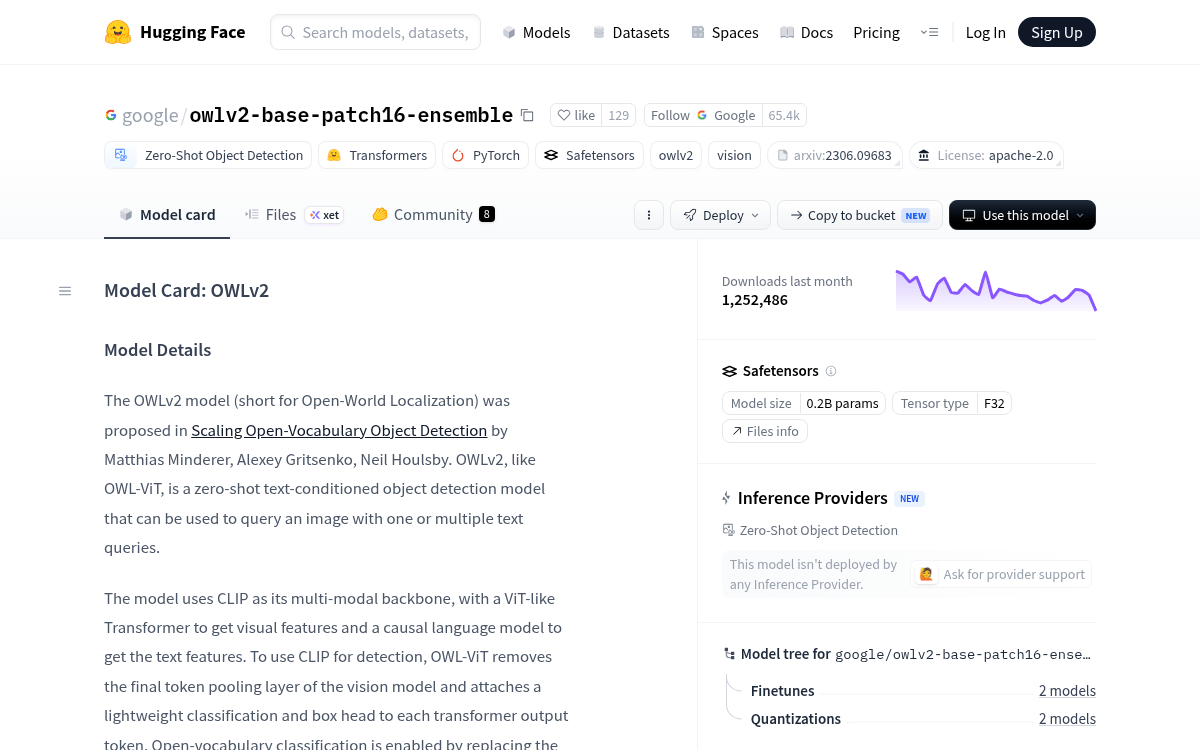
Google's OWLv2 detects any object you can describe in text, without training examples, and it's crossed 1.25 million downloads on Hugging Face.
 Pro
Takeaways
- Google's OWLv2 has passed 1.25M downloads on Hugging Face for zero-shot detection.
- Detects any object described by text prompts, no fine-tuning or fixed class list needed.
- OWL-ST self-training recipe scales detection data to over 1B image-text examples.
- Boosts LVIS rare-class AP from 31.2% to 44.6%, a 43% relative gain.
- 200M parameters, Apache 2.0 license, four lines of Transformers code to run.
- Paper shows web-scale training curves finally reaching object detection.
Google's OWLv2 base-patch16-ensemble has quietly become one of the most-downloaded vision models on Hugging Face, with over 1.25 million downloads. The model tackles a stubborn problem in computer vision: detecting objects you never explicitly trained on, using nothing but a natural language description as the query.
Like its predecessor OWL-ViT, OWLv2 is a zero-shot text-conditioned object detector that accepts one or more text queries against an image. Its multimodal backbone is CLIP, pairing a ViT-style Transformer for visual features with a causal language model for text. In practice, you hand it an image and a list of strings like ["a photo of a cat", "a forklift", "a person wearing a hard hat"], and it returns bounding boxes with confidence scores. No fine-tuning, no labeled dataset, no fixed class list.
The self-training trick that made it work
The real breakthrough sits in the training recipe rather than the architecture. Open-vocabulary detection had been bottlenecked by the shortage of human-labeled bounding boxes, which are expensive to produce at scale. Web image-text pairs can supply weak supervision, but nobody had used them at anything close to the scales seen in image-level pretraining. OWLv2's authors close that gap with self-training: an existing detector generates pseudo-box annotations across billions of image-text pairs, and those noisy labels train a much stronger student.
The team calls the recipe OWL-ST. Its three hard problems are the choice of label space, pseudo-annotation filtering, and training efficiency, each of which OWLv2 addresses head-on. The loop mirrors the self-training that pushed language models forward, now applied to bounding boxes.
The numbers back up the approach. OWLv2 already surpasses previous state-of-the-art open-vocabulary detectors at comparable training scales (~10M examples). Push further and the gains compound: scaling to over 1B examples with an L/14 architecture lifts AP on LVIS rare classes, for which the model has seen zero human box annotations, from 31.2% to 44.6%, a 43% relative jump.
Four lines of code, 200M parameters
The owlv2-base-patch16-ensemble checkpoint is a 200M-parameter model released under Apache 2.0, free to use commercially. Google also ships a larger patch14 variant and fine-tuned versions if you want more accuracy or a plug-and-play detector. Loading it takes about four lines of Transformers code:
from transformers import Owlv2Processor, Owlv2ForObjectDetection
processor = Owlv2Processor.from_pretrained("google/owlv2-base-patch16-ensemble")
model = Owlv2ForObjectDetection.from_pretrained("google/owlv2-base-patch16-ensemble")
texts = [["a photo of a cat", "a photo of a dog"]]
inputs = processor(text=texts, images=image, return_tensors="pt")
outputs = model(**inputs)
Under the hood, OWL-ViT removes CLIP's final token pooling layer and attaches a lightweight classification and box head to each transformer output token. Open-vocabulary classification comes from replacing the fixed classification weights with class-name embeddings pulled from the text model. Swap the text queries at inference time and the class set changes with them.
Where it shines, and where it doesn't
OWLv2 is strongest on the long tail. Standard detectors like YOLO or DETR need a fixed vocabulary and thousands of labeled examples per class. OWLv2 handles categories it has literally never seen boxes for, which is why the LVIS rare-class numbers matter. Practical fits include:
- Rapid prototyping when you don't have a labeled dataset yet
- Robotics pipelines that need to ground natural-language commands to pixel regions
- Content moderation and safety checks with categories that shift over time
- Document and product image search where queries are ad hoc
- Bootstrapping labels for a smaller, faster specialist model
The weaknesses are the usual ones for CLIP-family models. Fine-grained distinctions such as bird species or specific product SKUs still trip it up, and it inherits biases from web-scraped training data. As a stronger open-vocabulary foundation, OWLv2 can feed downstream tasks like instance segmentation, visual question answering, and robotic manipulation, though for a single well-defined class list with tight latency budgets a purpose-trained YOLO variant will usually be faster and cheaper to run.
Why it's still trending
Two years after release, OWLv2 keeps climbing because it slots neatly into modern multimodal stacks. The community has already built OWLSAM, which chains OWLv2 boxes into Segment Anything for text-driven segmentation, alongside tracking demos and combinations with Grounding DINO. It has also become a go-to teacher model for generating pseudo-labels to distill into smaller edge detectors. The OWL-ST paper argues that open-world localization can now ride the same web-scale training curves that reshaped classification and language modeling. Object detection no longer has to start with a labeling budget.