
Google's MedGemma 4B Becomes the Go-To Open Medical AI With 877K Downloads
Google's open 4B multimodal medical model brings radiology, pathology, and dermatology reasoning to a single GPU, with strong gains over base Gemma 3.
 Pro
Takeaways
- MedGemma 4B-it is Google's open Gemma 3 based multimodal medical model, 877K+ downloads.
- Handles chest X-rays, dermatology, pathology, ophthalmology and medical text in one 4B checkpoint.
- Uses a medical-pretrained SigLIP encoder plus 128K context Gemma 3 backbone at 896x896 input.
- Beats base Gemma 3 4B across every tested medical benchmark, often by 20+ points.
- Runs on one GPU via Transformers, vLLM, SGLang, Ollama; free for research and commercial use.
- Not cleared for clinical decisions; single-image only, prompt sensitive, requires validation.
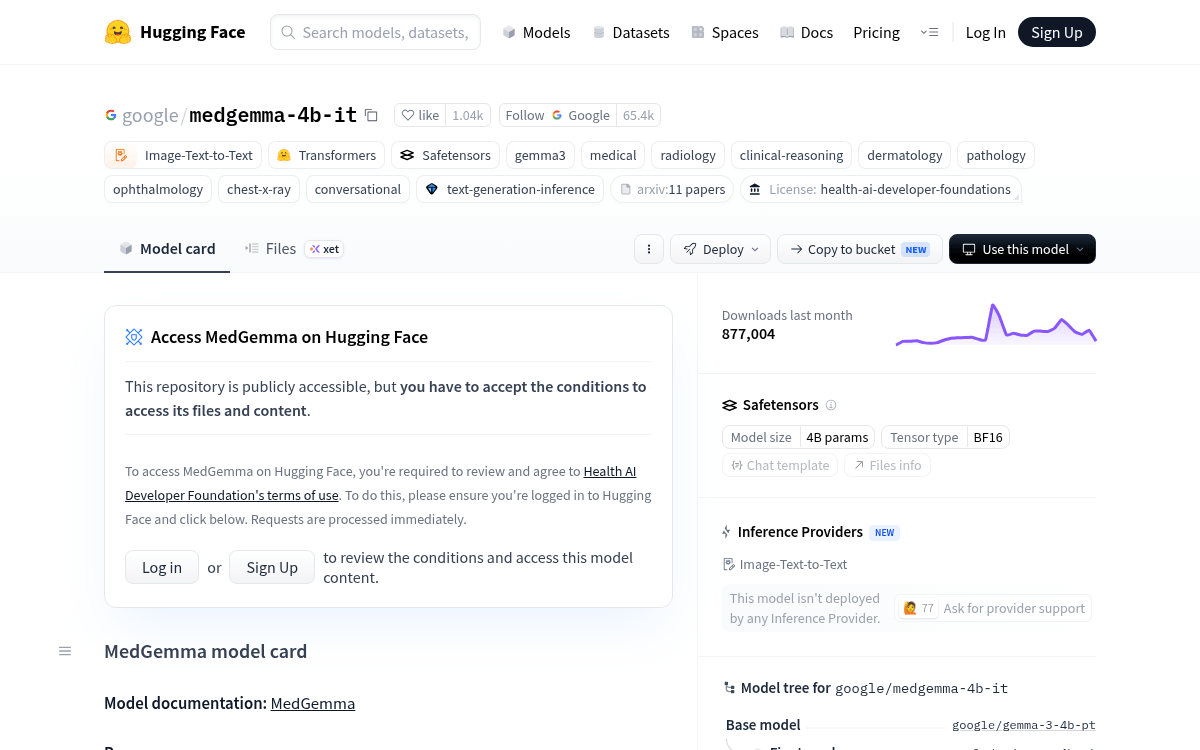
Google's MedGemma 4B instruction-tuned is a compact multimodal model built for medical text and image comprehension. It has quietly become one of the most downloaded medical models on Hugging Face, pulling in more than 877,000 downloads and over 1,000 likes, and it now anchors an expanding family that includes 27B text and multimodal variants plus a standalone image encoder.
The pitch to developers in life sciences and healthcare is straightforward: instead of adapting a general vision-language model to medicine from scratch, start from weights that already understand chest X-rays, skin lesions, retinal fundus images, and histopathology slides.
What's actually under the hood
MedGemma 4B pairs a SigLIP image encoder, pre-trained on de-identified chest X-rays, dermatology, ophthalmology, and histopathology images, with a language model trained on radiology, pathology patches, ophthalmology and dermatology images, and medical text. The backbone is Gemma 3, a decoder-only transformer using grouped-query attention with a 128K token context window. Images are normalized to 896x896 and encoded to 256 tokens each, and output length caps at 8192 tokens.
Two flavors ship at the 4B size: a pre-trained checkpoint (-pt) for researchers who want to do their own instruction tuning, and the instruction-tuned -it version that most application builders should start from.
Where the numbers land
The clearest story is the delta against base Gemma 3 4B. On medical image classification and visual question answering, MedGemma 4B posts sizable gains:
- MIMIC CXR macro F1 for top 5 conditions: 81.2 to 88.9
- CheXpert CXR macro F1: 32.6 to 48.1
- Histopathology multiple choice accuracy: 37.1 to 69.8
- Dermatology multiple choice: 52.5 to 71.8
- Retinal fundus classification: 14.4 to 64.9
- SLAKE radiology VQA (tokenized F1): 40.2 to 72.3
On text-only medical knowledge, MedQA jumps from 50.7 to 64.4 and PubMedQA from 68.4 to 73.4. For chest X-ray report generation, the pre-trained MedGemma 4B hits 29.5 RadGraph F1 on MIMIC-CXR, matching a fine-tuned PaliGemma 2 10B at a fraction of the size.
The caveats Google actually admits
The model card is unusually honest about limits. There is a risk of data contamination, where the model may have seen related medical information during pre-training, potentially inflating its apparent ability to generalize to novel concepts. Google recommends validating on private datasets to check for this. Multimodal evaluations were done on single images only, multi-turn behavior is untested, and the model is more prompt-sensitive than base Gemma 3. Outputs are explicitly not meant to drive clinical decisions without human verification.
Running it
MedGemma 4B fits on a single GPU and slots into the standard open-source stack. You can serve it through vllm serve google/medgemma-4b-it, SGLang, or Docker Model Runner, and there are community quantizations for llama.cpp, Ollama, and LM Studio. A minimal call through Transformers looks like this:
from transformers import pipeline
import torch
pipe = pipeline("image-text-to-text",
                model="google/medgemma-4b-it",
                torch_dtype=torch.bfloat16, device="cuda")
messages = [
  {"role": "system", "content": [{"type": "text", "text": "You are an expert radiologist."}]},
  {"role": "user", "content": [
    {"type": "text", "text": "Describe this X-ray"},
    {"type": "image", "image": image}]}
]
print(pipe(text=messages, max_new_tokens=200)[0]["generated_text"][-1]["content"])
Access requires accepting the Health AI Developer Foundations terms of use, but the weights are free for both research and commercial use. Google also publishes quick-start and fine-tuning notebooks in its GitHub repo, and the model is available through Vertex AI Model Garden for production deployment.
Why this matters
The practical breakthrough here is availability, not architecture. A 4B model that runs offline and handles chest X-ray reports, dermatology triage, pathology tile classification, and fundus grading in one checkpoint gives smaller teams a realistic starting point that previously required closed APIs or custom multi-model pipelines. Google's own guidance splits the family cleanly: MedGemma covers free-text tasks like report generation and VQA, while MedSigLIP handles structured outputs like classification and retrieval. All of the models run on a single GPU, and MedGemma 4B and MedSigLIP are adaptable to mobile hardware.
Momentum has continued since the initial drop. Google has since shipped MedGemma 1.5 4B, which analyzes 3D CTs, MRI scans, and histopathology slides, and adds longitudinal chest X-ray time-series review, anatomical localization in chest X-rays, and medical document understanding for extracting structured data from lab reports. Combined with 626 downstream fine-tunes and 115 adapters listed on the model page, MedGemma 4B has effectively become the default open baseline for anyone building healthcare AI on top of Gemma.