
Google's Gemma 3 4B Beats Models 7x Larger With 1.28M Downloads
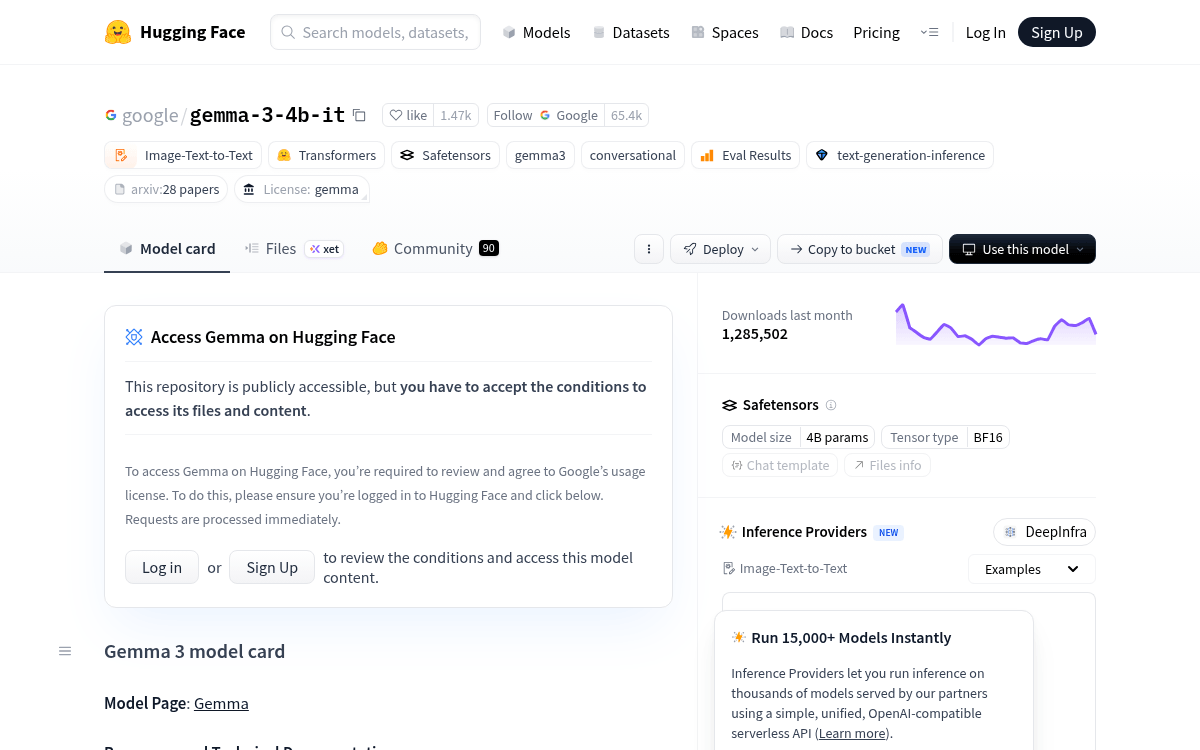
Google's compact vision-language model has crossed 1.28M downloads on Hugging Face, showing how a 4B multimodal model can rival 27B predecessors on real tasks.
 Pro
Takeaways
- Google's Gemma 3 4B IT has crossed 1.28M downloads on Hugging Face.
- Multimodal (text plus image), 128K context, 140+ language support in a 4B open-weights checkpoint.
- Google claims it matches Gemma 2 27B IT quality thanks to a new post-training recipe.
- Architecture uses 5:1 local-to-global attention ratio to keep KV cache small at long context.
- Runs in 8-12 GB VRAM; supported by Transformers, vLLM, SGLang, Ollama out of the box.
- See the Gemma 3 technical report for full benchmark tables.
Google's Gemma 3 4B instruction-tuned model has quietly become one of the most downloaded compact multimodal models on Hugging Face, sitting at 1.28 million downloads and 1.47k likes. The release itself is not new, but the sustained adoption is worth unpacking, because the design choices Google DeepMind made in this size class explain why a 4-billion-parameter model keeps showing up in production stacks that would previously have needed something two to six times larger.
Gemma 3 is a family of open-weight models ranging from 1B to 27B parameters, and the 4B instruction-tuned checkpoint (gemma-3-4b-it) is the smallest variant that ships with full vision-language capability. The models handle text and image input, generate text output, come with a 128K context window and multilingual support in over 140 languages, and are well-suited for question answering, summarization, and reasoning.
Why a 4B model punches above its weight
The headline claim from the Gemma 3 technical report is that the post-training recipe closes a full generational gap. Google's approach significantly improves math, chat, instruction-following, and multilingual abilities, making Gemma3-4B-IT competitive with Gemma2-27B-IT, and Gemma3-27B-IT comparable to Gemini-1.5-Pro across benchmarks. That is a roughly 7x parameter reduction for equivalent quality on the tasks Google measured.
Three architectural choices make this possible at 4B:
- Interleaved local/global attention. The architecture alternates five local-attention layers (1024-token sliding windows) with a global-attention layer, balancing short-range context modeling against long-range dependency tracking while trimming KV-cache memory. In practice, this is what lets the 128K context window run on a single consumer GPU.
- SigLIP vision encoder with pan-and-scan. The model ingests text and images through a custom SigLIP encoder combined with a pan-and-scan preprocessing step, converting visual data into compact 256-token soft representations. The 128K-token context window is 16x larger than in previous Gemma versions, enabling processing of extended multi-page text, large single documents, or hundreds of images in a single prompt.
- Distillation from a larger teacher. Gemma 3 4B is pretrained using supervised distillation where each token prediction is informed by sampling 256 logits weighted by teacher model probabilities, with the student trained under cross-entropy losses over these distributions. The student inherits representational and generative competency from larger teacher models.
Benchmarks, without the marketing gloss
The pretrained 4B checkpoint lands at roughly 59.6% on MMLU (5-shot), 38.4% on GSM8K (8-shot), 36.0% on HumanEval, and 72.8% on DocVQA. On multimodal reasoning, it hits 39.2% on MMMU and 63.6% on ChartQA. On document understanding it outperforms the larger PaliGemma 2 variant, and thanks to average pooling in the vision encoder, the Gemma 3 4B and 12B models are about 10x cheaper to transfer than the PaliGemma 2 9B and 27B models at the same 896 x 896 resolution.
Hard reasoning is where the ceiling shows. GPQA sits at 15.0% (5-shot) for the pretrained model, and code generation on LiveCodeBench lands in the low double digits. Competitive math and complex agentic coding loops are out of scope. Summarization, document Q&A, multilingual chat, and image description all hold up.
Deploying it
The model is released under the Gemma license, weights are free, and it is supported across the usual runtimes. The simplest path via Transformers:
from transformers import pipeline
import torch
pipe = pipeline(
    "image-text-to-text",
    model="google/gemma-3-4b-it",
    device="cuda",
    torch_dtype=torch.bfloat16,
)
messages = [{"role": "user", "content": [
    {"type": "image", "url": "https://example.com/chart.png"},
    {"type": "text", "text": "Summarize this chart."},
]}]
print(pipe(text=messages, max_new_tokens=200))
For higher throughput, vllm serve google/gemma-3-4b-it exposes an OpenAI-compatible endpoint, and SGLang works the same way. Selective KV cache management lets Gemma 3 4B operate within 8 to 12 GB of memory even at maximum context, which puts it on a single mid-range GPU or a well-equipped laptop.
Where it fits in the ecosystem
The 4B slot has become the pragmatic default for teams that want vision-language capability without hosting a 20B+ model. The Hugging Face model tree lists 765 finetunes, 475 adapters, and 485 quantizations, plus derivative work like MedGemma, where the 4B variant sets a new state of the art for a 4B-scale open foundation model on medical multimodal question answering with improvements of 2.6 to 10 percent, chest X-ray classification gains of 15.5 to 18.1 percent, and agentic tasks up 10.8 percent.
What a 4B model with 128K context and image input now covers is worth spelling out: RAG pipelines over mixed text-and-screenshot corpora, on-device document assistants, multilingual customer support, and lightweight visual QA. Those workloads used to require either a hosted API or a much larger self-hosted model. A single-GPU open-weights checkpoint that clears the Gemma 2 27B bar on most of them changes the build-versus-buy calculus for a lot of teams that never needed frontier reasoning in the first place.