
Google's Gemma 3 1B Squeezes a Full AI Model Into 529MB
Google's smallest Gemma 3 variant packs a 32K context window into 529MB, targeting on-device inference for phones, laptops, and edge apps.
 Pro
Takeaways
- Google's Gemma 3 1B IT is a 529MB text-only instruction-tuned model built for on-device use.
- Trained on 2 trillion tokens via distillation, RL, and model merging on TPUs using JAX.
- 32K context window, tokenizer covering 140+ languages, active support for 35+ languages.
- Runs through Transformers, vLLM, SGLang, llama.cpp, Ollama, and MediaPipe on Android.
- Strong at commonsense QA and chat, weak at math, multilingual reasoning, and factual recall.
- Available on Hugging Face, Kaggle, and Vertex AI under the Gemma license.
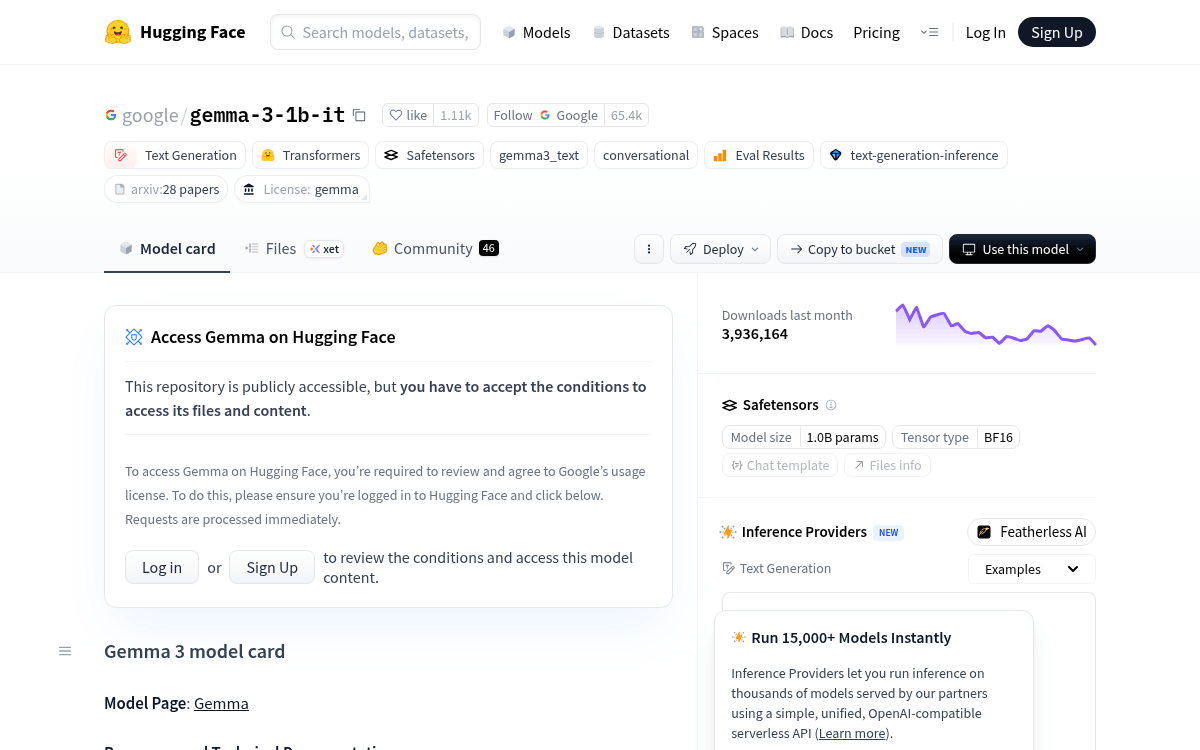
Google's Gemma 3 1B instruction-tuned model is the pocket-sized member of the Gemma 3 family, and its download counter tells the story: nearly four million pulls from Hugging Face and hundreds of community fine-tunes built on top. It is the variant most people will actually ship into production, because it is the only one that fits comfortably on a phone.
A Gemini-derived model that fits in a browser tab
Gemma 3 is a family of lightweight open models built from the same research that powers Gemini 2.0. The 1B instruction-tuned checkpoint is the smallest of four sizes (1B, 4B, 12B, and 27B), each shipped as both a pretrained base for domain fine-tuning and a general-purpose instruction-tuned version.
The functional split between 1B and its siblings is modality. The 4B, 12B, and 27B versions accept images and text; the 1B was kept text-only so it could run where multimodal inference would be too expensive. The weights come in at 529MB, throughput lands around 2,585 tokens per second on reference hardware, and the model covers 35+ languages. The official model card lists a 32K token input window for the 1B specifically, versus 128K for the larger sizes, so treat any higher figure you see in tooling as an upper bound rather than the trained context.
Why 529MB changes the deployment math
That footprint is the whole point. At 529MB, Gemma 3 1B is small enough to bundle with a mobile or web app without wrecking the install size or the first-run experience. Concretely, it opens up:
- Offline inference that works on a plane or a subway, with no cloud bill and no user data leaving the device.
- Natural-language layers inside an app that drive commands or generate content without a server round trip.
- Assistants, summarizers, and email drafting features embedded in Android apps through the MediaPipe LLM Inference API.
Google ships a sample Android chat app demonstrating text generation, retrieval, summarization, and email drafting. It uses the MediaPipe LLM Inference API, though the LiteRT stack works directly if you want more control.
How it was built
The training recipe is where the small size gets interesting. Rather than a straight next-token pretraining run, the Gemma team leaned heavily on distillation from bigger teachers, then layered reinforcement learning and model merging on top. Google credits that pipeline for the model's gains on math, coding, and instruction following. A new tokenizer improves coverage across 140+ languages.
Token budgets scale with model size: 2T tokens for the 1B, 4T for the 4B, 12T for the 12B, and 14T for the 27B. Two trillion tokens for a 1B model is a heavy diet. The corpus mixes web text across 140+ languages, code, and mathematics. The instruction-tuned gemma-3-1b-it was fine-tuned from the pretrained gemma-3-1b-pt checkpoint. Training ran on TPUv4p, TPUv5p, and TPUv5e clusters using JAX and ML Pathways.
Where it scores well and where it does not
A 1B model has real ceilings, and Google is unusually candid about them in the model card. The pretrained 1B numbers give a fair sense of the instruction-tuned model's raw capability:
| Benchmark | Metric | Gemma 3 PT 1B |
|---|---|---|
| HellaSwag | 10-shot | 62.3 |
| BoolQ | 0-shot | 63.2 |
| PIQA | 0-shot | 73.8 |
| ARC-e | 0-shot | 73.0 |
| TriviaQA | 5-shot | 39.8 |
| WinoGrande | 5-shot | 58.2 |
| BIG-Bench Hard | few-shot | 28.4 |
| DROP | 1-shot | 42.4 |
| MGSM (multilingual math) | - | 2.04 |
The pattern is predictable: solid on commonsense and easy reading comprehension, weak on multi-step reasoning and math. The MGSM score of 2.04 is a blunt reminder that multilingual chain-of-thought math is out of scope, as is deep factual recall. The intended jobs are on-device chat, summarization, structured output generation, and grounded Q&A where retrieved context does the heavy lifting.
Getting it running
Access is gated behind Google's Gemma license, but requests are approved instantly. Once you accept, the model drops into the standard Transformers pipeline:
from transformers import pipeline
import torch
pipe = pipeline(
    "text-generation",
    model="google/gemma-3-1b-it",
    device="cuda",
    torch_dtype=torch.bfloat16,
)
messages = [
    {"role": "system", "content": "You are a helpful assistant."},
    {"role": "user", "content": "Summarize the transformer architecture in one paragraph."},
]
print(pipe(messages, max_new_tokens=128))
Gemma 3 requires transformers 4.50.0 or newer. For serving, the model card lists vLLM, SGLang, and Docker Model Runner as first-class options. More than 460 community quantizations exist for llama.cpp, Ollama, and LM Studio if you want to skip GPU inference entirely.
Fine-tuning is where it gets sharp
Because the base model is small, LoRA-style adapters train quickly and the resulting checkpoint stays small enough to distribute. Google publishes a Colab notebook that walks through LoRA fine-tuning on a synthetic reasoning dataset, then converts the result to LiteRT (the new name for the TensorFlow Lite format). LiteRT is the target if you want the model to ship inside an Android app. The community has already produced hundreds of finetunes and merges from the 1B base, covering language-specific chat tuning, reasoning distillation, and domain adaptation.
The bigger picture
Gemma 3 landed inside a broader push toward small, capable open weights. Google's announcement positioned the family as the strongest single-accelerator open models available, with the 27B variant reportedly competitive with much larger closed models on Chatbot Arena. The 1B sits at the other end of that curve. It exists so the same tokenizer, license, and API surface can span a workstation deployment and a phone binary without the developer changing frameworks. That continuity, more than any single benchmark score, is what makes it worth reaching for when the target device does not have a GPU.