
Google's Gemma 3 12B Becomes the Open Vision Model Teams Actually Deploy
Google DeepMind's mid-size open model packs vision, a 128K context, and 140-language support into a form factor that fits on a single GPU.
 Pro
Takeaways
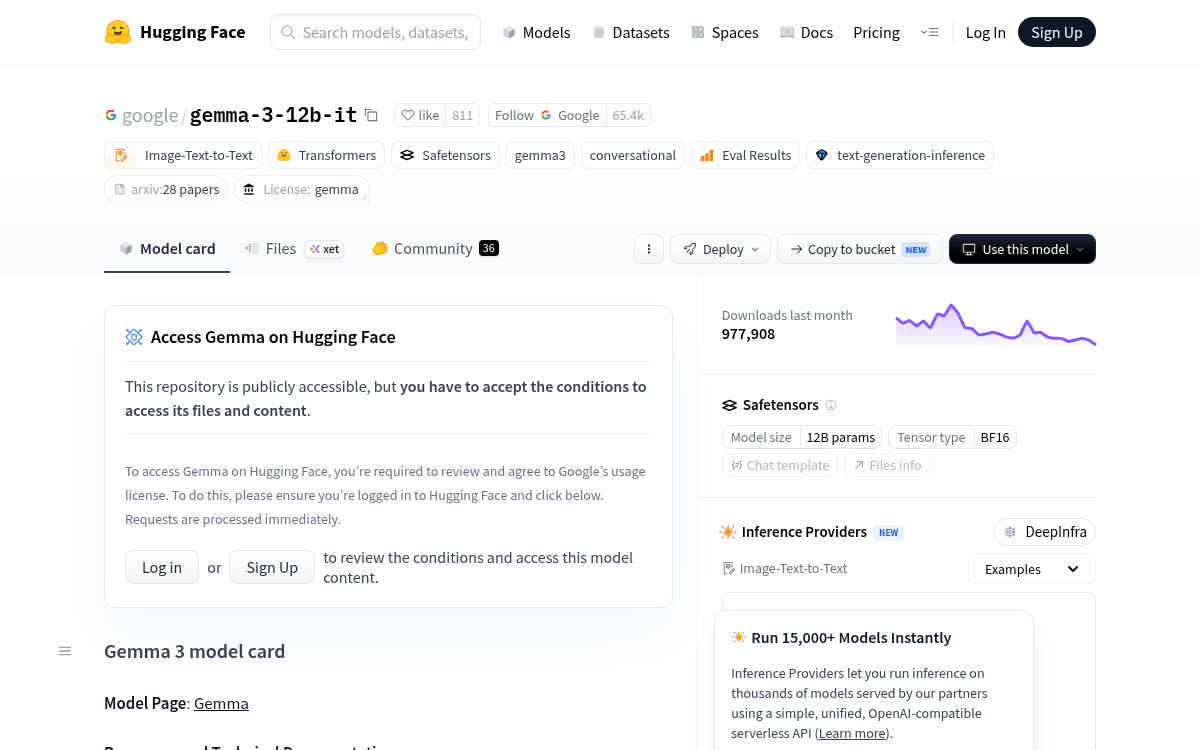
- Google DeepMind's Gemma 3 12B-IT hits 977K downloads as the mid-size open multimodal default.
- 128K context, 140+ languages, and images at 896x896 via a frozen SigLIP vision encoder.
- Trained on 12T tokens with distillation, RL, and model merging on TPUv4p/v5p/v5e using JAX.
- Architecture uses more local attention layers to keep KV-cache small enough for single-GPU serving.
- Strong on DocVQA (82.3), ChartQA (74.7), MMLU (74.5), GSM8K (71.0); weaker on GPQA (25.4).
- Runs on Transformers, vLLM, SGLang, Ollama, and llama.cpp with 167 available quantizations.
Google DeepMind's Gemma 3 12B instruction-tuned model has crossed 977,000 monthly downloads on Hugging Face and drawn more than 800 likes. It sits in the middle of a four-size lineup (1B, 4B, 12B, 27B) and has become the sweet spot most teams settle on: big enough to reason and see, small enough to fit on one accelerator.
Gemma is a family of lightweight open models from Google, built from the same research used to create Gemini. The 3 series is multimodal, taking text and image input and producing text output, with open weights for both pre-trained and instruction-tuned variants. That combination, plus a permissive license, is why the ecosystem around it now includes 113 finetunes of the base model, 389 adapters, and 167 quantizations ready to drop into llama.cpp, Ollama, LM Studio, and vLLM.
What's actually inside the box
Gemma 3 12B is a vision-language model with a specific shape. A custom SigLIP vision encoder handles image input, feeding a text decoder tuned for question answering, summarization, reasoning, and image understanding. Images are normalized to 896x896 resolution and encoded to 256 tokens each on the Gemma side. Text context maxes out at 128K tokens, and generation is capped at 8,192 output tokens.
The vision encoder has one clever detail worth flagging. It was kept frozen during training and is shared across the 4B, 12B, and 27B sizes, so the same visual capabilities show up regardless of which decoder you pick: analyze images, answer questions about them, compare them, identify objects, and read text embedded in a picture. Although the encoder was originally built for 896x896 inputs, a new adaptive window algorithm segments larger images, letting Gemma 3 handle high-resolution and non-square inputs. You can feed it a screenshot or a widescreen photo without pre-resizing everything to a square.
The attention rework that makes 128K viable
The bigger structural change happened inside attention. Naively serving a 128K-token context on a 12B model would blow past the memory budget of a single GPU because the KV cache grows linearly with context length. Gemma 3 addresses this by increasing the ratio of local to global attention layers and keeping the span on local attention short.
By interleaving many short-range local-attention layers with a few global ones, the KV cache stays small enough that a single card can actually use the full window in production. That is the practical unlock behind the 128K headline number.
How it was trained
Gemma 3 uses a new tokenizer with better multilingual coverage across 140+ languages. Training ran on Google TPUs with JAX: 2T tokens for the 1B, 4T for the 4B, 12T for the 12B, and 14T for the 27B. The corpus mixes web text, code, math, and images.
Post-training is where the biggest quality gains come from. Google combined distillation, reinforcement learning, and model merging, and the technical report claims the recipe bumps each model up a full tier. Gemma3-4B-IT lands competitive with Gemma2-27B-IT, and Gemma3-27B-IT reaches parity with Gemini-1.5-Pro on several benchmarks. Math, chat, instruction-following, and multilingual scores all move meaningfully.
Where the 12B lands on benchmarks
The 12B is the pragmatic pick between the 4B (fast but weaker at reasoning) and the 27B (better but harder to serve). A few pretrained numbers to anchor expectations:
| Benchmark | Gemma 3 4B | Gemma 3 12B | Gemma 3 27B |
|---|---|---|---|
| MMLU (5-shot) | 59.6 | 74.5 | 78.6 |
| GSM8K (8-shot) | 38.4 | 71.0 | 82.6 |
| MATH (4-shot) | 24.2 | 43.3 | 50.0 |
| HumanEval | 36.0 | 45.7 | 48.8 |
| MBPP (3-shot) | 46.0 | 60.4 | 65.6 |
| DocVQA (val) | 72.8 | 82.3 | 85.6 |
| ChartQA | 63.6 | 74.7 | 76.3 |
| MMMU | 39.2 | 50.3 | 56.1 |
The jump from 4B to 12B on math (GSM8K nearly doubles) and reasoning (BIG-Bench Hard goes from 50.9 to 72.6) is what makes 12B the default for agent workloads. GPQA sits at 25.4, though, and Google's own card warns the model may generate incorrect or outdated factual statements and can struggle with sarcasm and figurative language. Frontier reasoning it is not.
Getting it running
Weights are free under the Gemma license. Hosted serving costs land where you would expect for a mid-size open model, around $0.05 per million input tokens and $0.15 per million output tokens on OpenRouter. For self-hosting, the minimum viable path is Transformers 4.50 or newer.
from transformers import pipeline
import torch
pipe = pipeline(
    "image-text-to-text",
    model="google/gemma-3-12b-it",
    device="cuda",
    torch_dtype=torch.bfloat16,
)
messages = [{"role": "user", "content": [
    {"type": "image", "url": "https://.../chart.png"},
    {"type": "text", "text": "Summarize this chart."},
]}]
print(pipe(text=messages, max_new_tokens=200)[0]["generated_text"][-1]["content"])
For higher throughput, vLLM and SGLang expose OpenAI-compatible chat endpoints out of the box, and Docker Model Runner will pull the weights with a single docker model run hf.co/google/gemma-3-12b-it. To squeeze it onto consumer hardware, Unsloth claims 1.6x faster finetuning, 60% less VRAM, and 6x longer context than Flash Attention 2 environments on a 48GB GPU, and has published 2-8 bit GGUFs plus dynamic 4-bit variants.
What it is genuinely good for
The 12B is the model you self-host when you need vision plus a long context on private data. It targets enterprise workloads that balance capability against compute, and holds up well on document processing, content analysis, code generation, and conversational AI.
The concrete workloads people are shipping with it:
- Document AI, invoice parsing, and PDF question answering where DocVQA at 82.3 is more than enough
- Chart and diagram understanding for BI and analytics agents (ChartQA 74.7, AI2D 75.2)
- Multilingual customer support and translation across the 140+ supported languages
- On-device or single-GPU agents that need vision plus tool-calling and structured outputs
- Fine-tuning target for domain-specific vision-language models, where 12B is the largest size most teams can afford to train
The bigger picture
Useful multimodal models no longer require a datacenter's worth of accelerators. Gemma 3 12B runs on a single GPU or TPU, works on workstations and laptops, and its 128K-token window covers the kind of long-document workloads that used to demand hosted frontier APIs. Combined with an active fine-tuning ecosystem and quantizations that fit on a laptop, the 12B is quietly becoming the default open baseline for vision-language work, the same slot Llama 3 8B occupied for text-only tasks a year ago.