
Google's Gemma 2 9B Matches GPT-4 Quality on a Single Consumer GPU
Google's open 9B instruction-tuned model punches above its weight, matching GPT-4-class Elo scores while running comfortably on a single GPU.
 Pro
Takeaways
- Google's Gemma 2 9B IT is an open-weight instruction-tuned chat model built with Gemini research techniques.
- Trained on 8T tokens with knowledge distillation, sliding window attention, and logit soft-capping.
- Chatbot Arena Elo of 1187, matching the original GPT-4-0314 despite being roughly 10x smaller.
- Benchmarks: MMLU 71.3, GSM8K 68.6, HumanEval 40.2, ARC-C 68.4, BBH 68.2.
- Runs on a single GPU via Transformers, vLLM, SGLang, Ollama, and llama.cpp with a permissive commercial license.
- 8K context, English-only, no system messages, requires the specific Gemma chat template.
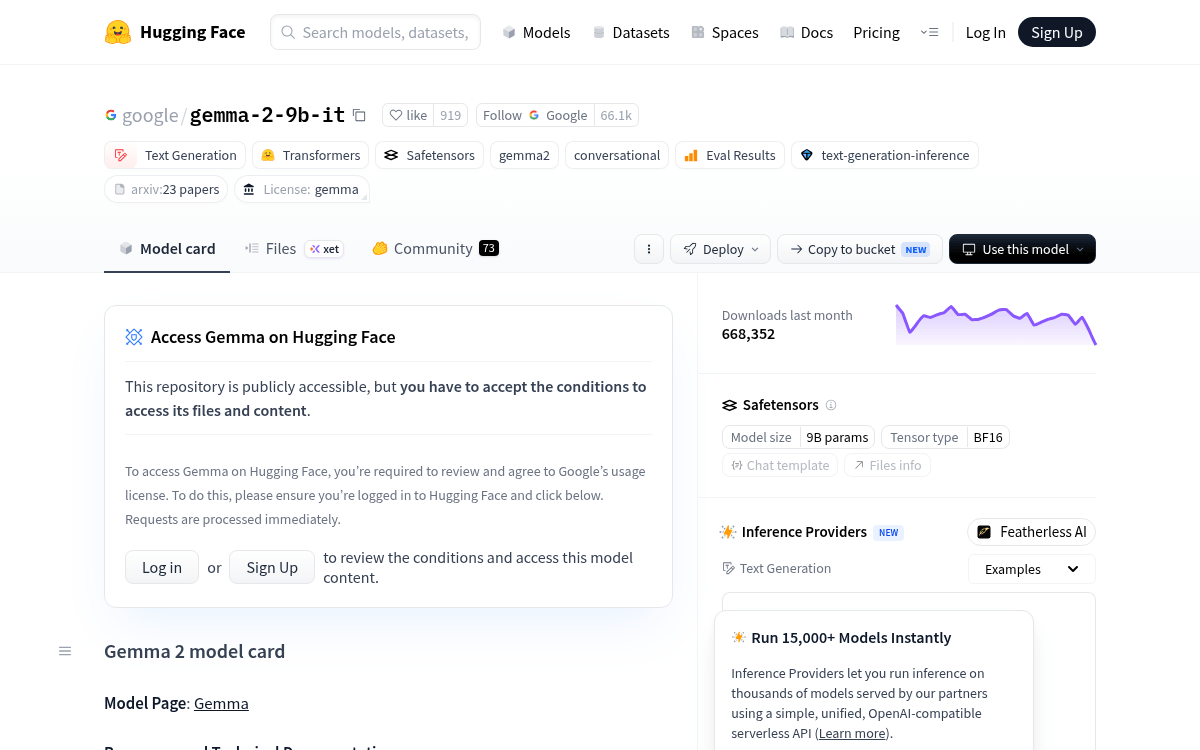
Google's Gemma 2 9B Instruction-Tuned has quietly become one of the most downloaded open models on Hugging Face. It is a 9-billion-parameter decoder-only chat model built from the same research stack as Gemini, released with open weights under the Gemma license that permits commercial use, and it delivers near-frontier chat quality at a size that fits on a single consumer or workstation GPU.
Elo scores that shouldn't fit the parameter count
On the LMSYS Chatbot Arena, Gemma 9B (Elo 1187) scored level with GPT-4-0314 (Elo 1186), while Gemma 27B (Elo 1218) ranked above Llama 3 70B (Elo 1206). Those are striking results for a model an order of magnitude smaller than what it is trading blows with.
The academic benchmarks hold up too. Reported scores for the 9B include:
- MMLU 5-shot: 71.3
- ARC-C 25-shot: 68.4
- GSM8K 5-shot: 68.6
- BBH 3-shot CoT: 68.2
- Winogrande: 80.6
- HumanEval pass@1: 40.2
- MBPP 3-shot: 52.4
- MATH 4-shot: 36.6
- AGIEval: 52.8
Gemma 2 shows up to a 10% improvement over the previous generation on some benchmarks for the 9B, and Google claims competitiveness with models more than twice its size across automated benchmarks and human evaluations.
Distillation is doing the heavy lifting
The 9B is a text-to-text decoder-only transformer trained on 8 trillion tokens of web data, code, and math. It uses sliding window attention, logit soft-capping, supervised fine-tuning, RLHF, and model merging via WARP. The architectural detail that most explains its benchmark numbers is knowledge distillation: rather than training purely on next-token prediction, Google trained it to imitate the token-level probability distributions of a much larger teacher model. A conventionally trained 9B would struggle to reach these scores.
The context window is 8K tokens, tight by current standards but adequate for most chat, summarization, and RAG-style workloads.
Getting it running
The model works as a drop-in with Transformers, vLLM, SGLang, Ollama, and llama.cpp. Native weights ship in bfloat16, and 4-bit and 8-bit quantized variants run comfortably on a single 24GB or even 12GB card:
from transformers import pipeline
import torch
pipe = pipeline(
    "text-generation",
    model="google/gemma-2-9b-it",
    model_kwargs={"torch_dtype": torch.bfloat16},
    device="cuda",
)
messages = [{"role": "user", "content": "Explain KV cache in one paragraph."}]
print(pipe(messages, max_new_tokens=256)[0]["generated_text"][-1]["content"])
One footgun worth flagging: the instruction-tuned variant expects a specific chat template with <start_of_turn> and <end_of_turn> delimiters and does not accept system messages the way OpenAI-style APIs do. Use tokenizer.apply_chat_template and put system-level instructions in the first user turn.
Where it fits and where it falls short
Gemma 2 9B IT is a strong pick for local chat at GPT-3.5-plus quality on a single GPU, for fine-tuning on domain data (one recent study reported gains of over 12 percentage points from LoRA fine-tuning, narrowing the gap substantially with Gemini 1.5 Flash), and for summarization, question answering, and reasoning tasks where 8K context is sufficient. Cost-sensitive inference at scale through vLLM or SGLang is another natural fit.
The weak spots follow directly from the design choices. English-only training means multilingual performance lags dedicated multilingual models. The 8K context rules out long-document workflows without chunking. Code generation at 40.2 HumanEval is respectable but well below dedicated coder models. Like every model at this scale, it will hallucinate facts confidently, so use it as a reasoning engine rather than a knowledge base.
Why the download numbers keep climbing
A 9B open model reaching rough parity with the original GPT-4 on human preference rankings collapses the case that frontier chat quality requires hundreds of billions of parameters and closed APIs. The 9B IT variant has accumulated more than 668,000 monthly downloads and 900-plus likes on Hugging Face. For teams where latency, cost, or data residency drive architecture decisions, it is the model to beat in its weight class and the natural starting point for specialization.