
Google's FLAN-T5 Proves a 250M Model Can Beat Giants on Zero-Shot Tasks
Google's FLAN-T5-base packs instruction tuning across 1,000+ tasks into a 250M parameter encoder-decoder that punches above its weight class.
 Pro
Takeaways
- Google released FLAN-T5-base, a 250M parameter instruction-tuned upgrade of T5 under Apache 2.0.
- Fine-tuned on 1,000+ additional tasks including chain-of-thought reasoning data across many languages.
- Detailed in the paper Scaling Instruction-Finetuned Language Models from Google Research.
- Trained on TPU v3/v4 pods using the t5x codebase with JAX.
- Flan-PaLM 540B hit 75.2% on five-shot MMLU, and FLAN-T5 checkpoints rival PaLM 62B few-shot.
- FLAN-T5-base beats T5-v1.1-base by roughly 9 points averaged across 36 downstream tasks.
Google's FLAN-T5-base is the 250M parameter member of the FLAN-T5 family released alongside the paper Scaling Instruction-Finetuned Language Models. It takes the original T5 backbone and pushes it through a much broader instruction tuning regime, producing a small, permissively licensed model that behaves surprisingly well on zero-shot and few-shot tasks that used to require models an order of magnitude larger.
The model card puts it bluntly: if you already know T5, FLAN-T5 is essentially a strict upgrade. For the same parameter count, these checkpoints have been fine-tuned on more than 1,000 additional tasks covering more languages. That extra tuning is the entire pitch.
What Google actually shipped
The release covers four checkpoint sizes (small, base, large, XL, XXL), all under Apache 2.0, all callable through the standard Hugging Face AutoModelForSeq2SeqLM interface. FLAN-T5-base sits at 0.2B parameters, making it the sweet spot for anyone who wants instruction-following behavior without hosting a multi-billion parameter model.
Getting a prediction out of it takes three lines once the tokenizer is loaded:
from transformers import T5Tokenizer, T5ForConditionalGeneration
tokenizer = T5Tokenizer.from_pretrained("google/flan-t5-base")
model = T5ForConditionalGeneration.from_pretrained("google/flan-t5-base")
input_ids = tokenizer("translate English to German: How old are you?",
                      return_tensors="pt").input_ids
print(tokenizer.decode(model.generate(input_ids)[0]))
The model card also documents FP16 and INT8 inference paths via torch_dtype=torch.float16 and load_in_8bit=True, which matters when you want to run this on a single consumer GPU or an edge device.
The recipe behind the numbers
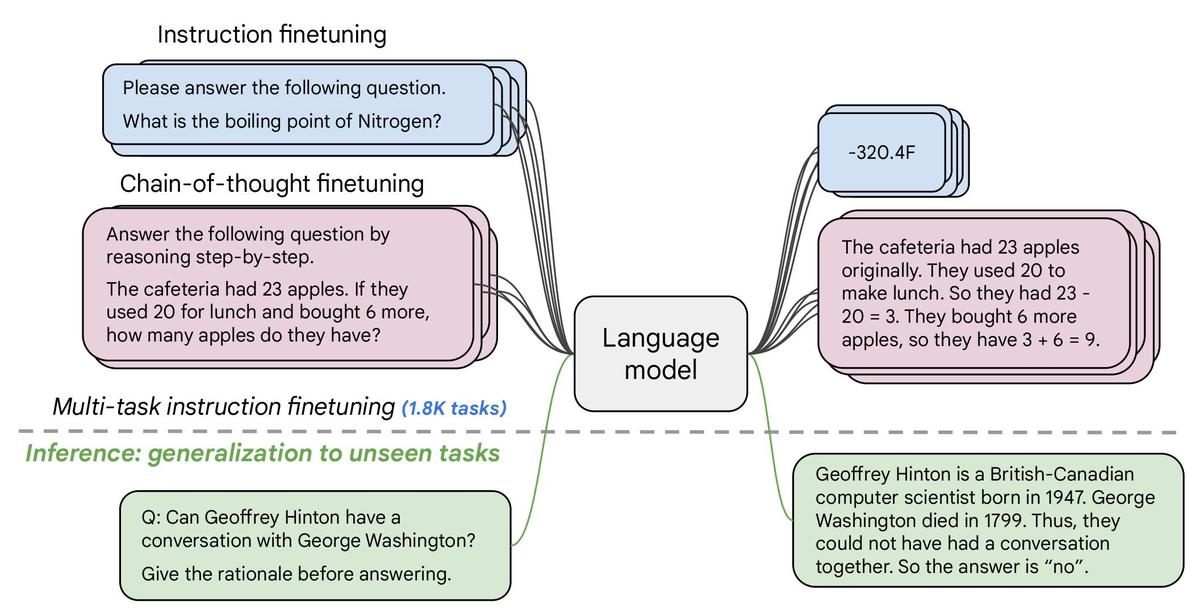
The paper focuses on three axes of scaling for instruction tuning: the number of tasks, the model size, and finetuning on chain-of-thought data. That last ingredient is the important addition. Mixing in examples that show step-by-step reasoning teaches the model to produce reasoning traces on its own rather than jumping straight to a final answer.
The training was not cheap in engineering terms. The checkpoints were fine-tuned on TPU v3 or v4 pods using the t5x codebase together with JAX, starting from the pretrained T5 weights rather than training from scratch. One FLAN checkpoint exists per T5 size, so the base variant is a T5-base put through the FLAN instruction mixture.
The task mixture pulls from datasets you would expect for a general-purpose instruction model, including GSM8K for grade-school math, AQuA-RAT for algebraic word problems, ESNLI for natural language inference with explanations, and code_contests for competitive programming prompts.
Why a 250M model still earns its keep
The headline result from the paper sits at the top of the scale: Flan-PaLM 540B instruction-finetuned on 1.8K tasks outperforms PaLM 540B by a large margin (+9.4% on average) and reaches state-of-the-art performance on several benchmarks, including 75.2% on five-shot MMLU. The more practical takeaway for anyone not sitting on a TPU pod is that the publicly released Flan-T5 checkpoints achieve strong few-shot performance even compared to much larger models such as PaLM 62B.
Independent evaluations back that up for the base checkpoint specifically. On IBM's Model Recycling leaderboard, using FLAN-T5-base as a fine-tuning starting point yields an average score of 77.98 across 36 downstream datasets, versus 68.82 for the equivalent T5-v1.1-base backbone. That gap of roughly nine points is essentially free performance from a better initialization.
Where it fits, and where it doesn't
Google's own framing of intended use is narrow. The paper argues that instruction finetuning is a general method for improving the performance and usability of pretrained language models, but the model card is explicit that the primary intended use is research: zero-shot and few-shot NLP tasks, reasoning, question answering, and studying fairness and safety in language models.
Practical strengths worth knowing:
- Encoder-decoder architecture makes it well suited for translation, summarization, and any input-to-output transformation task.
- Broad multilingual coverage across dozens of languages beyond English.
- Small enough to fine-tune on a single GPU, with quantization options built into the transformers integration.
- Apache 2.0 license, so commercial use is not gated.
Known limitations from the authors themselves:
- The training corpus was not filtered for explicit content or audited for bias, so the model can reproduce inherited biases.
- It has not been tested in real-world applications, meaning any deployment needs its own safety and fairness assessment.
- It should not be used for abusive generation or applied without prior domain-specific review.
The bigger shift it signaled
FLAN-T5 was one of the clearest demonstrations that raw parameter count can be decoupled from task generality. Before this line of work, the assumption was that scaling parameters was the primary lever for zero-shot performance. The paper argued that scaling the number of instruction tuning tasks, together with mixing in chain-of-thought examples, produces gains that compound with scale rather than plateauing.
That framing is now baked into how most modern open-weight models are trained. Every subsequent instruction-tuned release, from Llama chat variants to Mistral Instruct to Qwen chat, runs a version of this playbook. FLAN-T5-base remains a useful reference point because it isolates the effect: same architecture as T5, same parameter count, dramatically better behavior. For a small encoder-decoder aimed at classification, extraction, or structured generation, it is still one of the strongest starting points available.