
Google Releases TranslateGemma to Rival Closed APIs Across 55 Languages
Google released TranslateGemma, a Gemma 3 based open translation model family supporting 55 languages with both text and image inputs.
 Pro
Takeaways
- Google released TranslateGemma, open translation models in 4B, 12B, and 27B sizes based on Gemma 3.
- Supports 55 languages plus image-to-text translation via the Gemma 3 vision encoder at 896x896.
- Fine-tuned on 4.3B SFT tokens and 10.2M RL tokens, partly using Gemini-generated parallel data.
- 27B scores 84.4 COMET and 5.86 MQM on WMT25; 4B hits 81.6 COMET on WMT24++.
- Ships with strict chat template requiring explicit source and target ISO language codes.
- Runs on vLLM, SGLang, Ollama, llama.cpp, and even WebGPU in the browser.
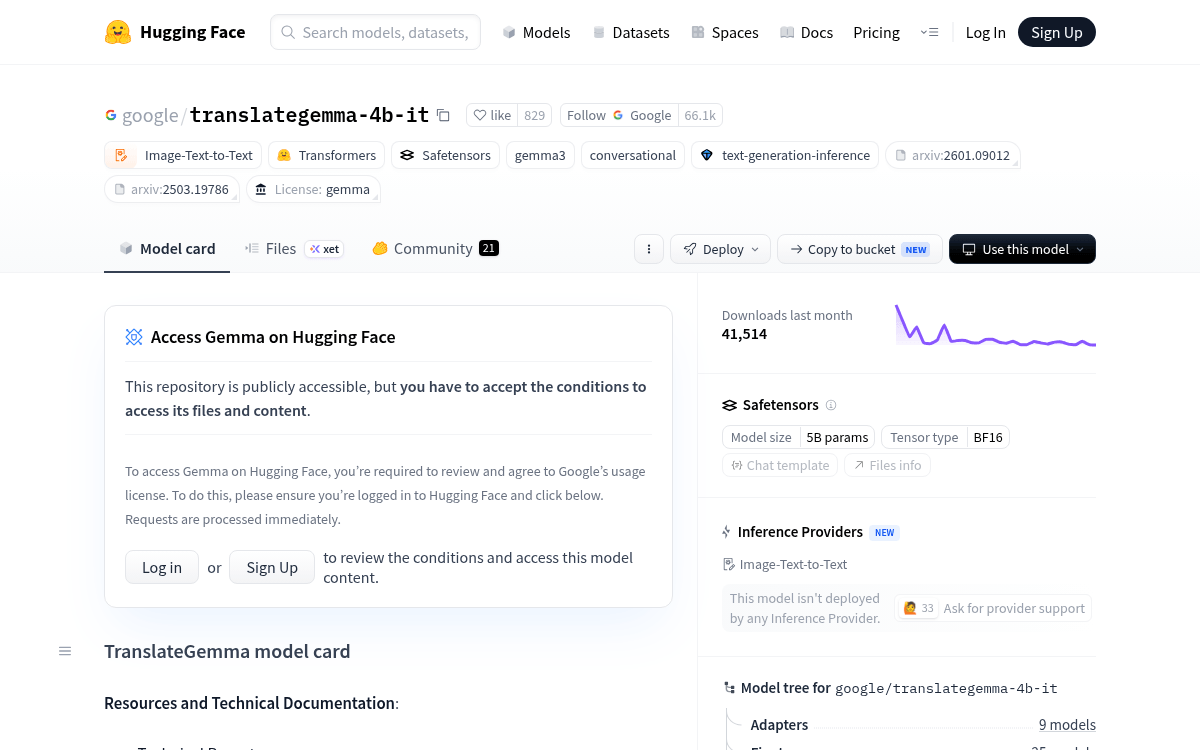
Google Translate's research team has quietly released TranslateGemma on Hugging Face, a set of translation-focused checkpoints fine-tuned from Gemma 3, available in 4B, 12B, and 27B sizes. The 4B variant already has over 41,000 downloads and 800+ likes. All three target developers who want a self-hostable alternative to closed translation APIs.
The approach: take Gemma 3's vision-language backbone, specialize it for translation across 55 languages, and ship it under the standard Gemma license so it runs on a laptop, a workstation, or your own cloud infrastructure.
What's in the box
Because TranslateGemma inherits Gemma 3's vision encoder, each checkpoint handles two distinct tasks:
- Direct text-to-text translation between any supported language pair.
- Text extraction and translation from an image, essentially OCR plus translation in a single forward pass.
Text inputs accept up to 2K tokens. Images are normalized to 896x896 and encoded to 256 tokens each. That 2K ceiling is worth flagging early: this is a sentence and paragraph translator, not a document-level one.
A strict chat template
Unlike most instruction-tuned Gemma variants, TranslateGemma refuses free-form prompting. The user role's content must be a list with exactly one entry specifying a type of either text or image, a source_lang_code, and a target_lang_code. Language codes follow ISO 639-1, optionally regionalized like en_US or pt-BR. Pass an unsupported pair and the template raises an error before the model ever runs.
A minimal text call looks like this:
from transformers import pipeline
import torch
pipe = pipeline("image-text-to-text",
    model="google/translategemma-4b-it",
    device="cuda", dtype=torch.bfloat16)
messages = [{"role": "user", "content": [{
    "type": "text",
    "source_lang_code": "cs",
    "target_lang_code": "de-DE",
    "text": "V nejhorším případě i k prasknutí čočky.",
}]}]
print(pipe(text=messages, max_new_tokens=200)[0]["generated_text"][-1]["content"])
Swap type to image and pass a url, and the same model pulls text from a photo and translates it, useful for reading foreign traffic signs or product packaging.

How it was trained
Google fine-tuned from the original Gemma 3 checkpoints using parallel data from multiple sources: 4.3 billion tokens for supervised fine-tuning and 10.2 million tokens for reinforcement learning. The training corpus combined monolingual web documents paired with high-quality translations generated by Gemini, plus publicly available parallel documents. Gemini effectively synthesized a chunk of the translation training data, distilling its multilingual capability into a much smaller open model. Training ran on TPUv4p, TPUv5p, and TPUv5e using JAX and ML Pathways. Full details are in the technical report.
Benchmark numbers
Google evaluated the family on WMT24++ across all 55 languages, on WMT25 for 10 languages using MQM (professional human ratings), and on a filtered subset of the Vistra image-translation corpus.
| Benchmark | 4B | 12B | 27B |
|---|---|---|---|
| WMT24++ MetricX (lower is better) | 5.32 | 3.60 | 3.09 |
| WMT24++ COMET (higher is better) | 81.6 | 83.5 | 84.4 |
| WMT25 MQM (lower is better) | N/A | 7.94 | 5.86 |
| Vistra MetricX (lower is better) | 2.57 | 2.08 | 1.57 |
The 27B closes much of the gap to frontier systems while still fitting on a single high-end GPU. The 4B is compact enough for edge and browser deployments, and a WebGPU demo already runs it directly in a browser.
Strengths and limitations
Based on the model card and benchmarks, the main strengths are sentence-level translation across a 55-language matrix including regional variants, image-based text extraction and translation in a single pass (useful for signage, menus, screenshots, and packaging), and compatibility with vLLM, SGLang, Ollama, and llama.cpp, with 42 community quantizations already available.
Several limitations are worth knowing before building on it. The 2K context makes long-document translation impractical without chunking. The team explicitly notes struggles with sarcasm, figurative language, and subtle nuance. The rigid chat template rules out glossary prompts and style controls; post-editing style prompts are possible but unsupported. And because it is purpose-built as a translator, Google makes no claims about other capabilities.
Who should pay attention
Open translation models have historically lagged well behind commercial APIs, forcing teams that need on-prem or offline translation to either accept lower quality or adapt general chat models that were never optimized for the task. TranslateGemma ships Google's translation research as a permissively licensed artifact: a 4B checkpoint small enough to embed in apps, and a 27B that posts competitive MQM numbers on WMT25. For anyone building localization pipelines, multilingual customer support, or on-device translation features, it is a strong candidate to benchmark against existing solutions.