
Google Drops Gemma 2B, a Free Open Model Running on Laptop Hardware
Google's 2-billion parameter open model brings Gemini-derived technology to laptops and single GPUs with permissive weights and strong small-model benchmarks.
 Pro
Takeaways
- Gemma 2B is Google's lightweight open weight LLM built from Gemini research.
- Trained on 6 trillion tokens with an 8,192 token context window on TPUv5e hardware.
- Scores 42.3 on MMLU and 71.4 on HellaSwag, weaker on math (GSM8K 17.7).
- Available in base and instruction-tuned variants under Google's Gemma license.
- Runs via Transformers, llama.cpp, Ollama, vLLM, and SGLang with GGUF quantizations.
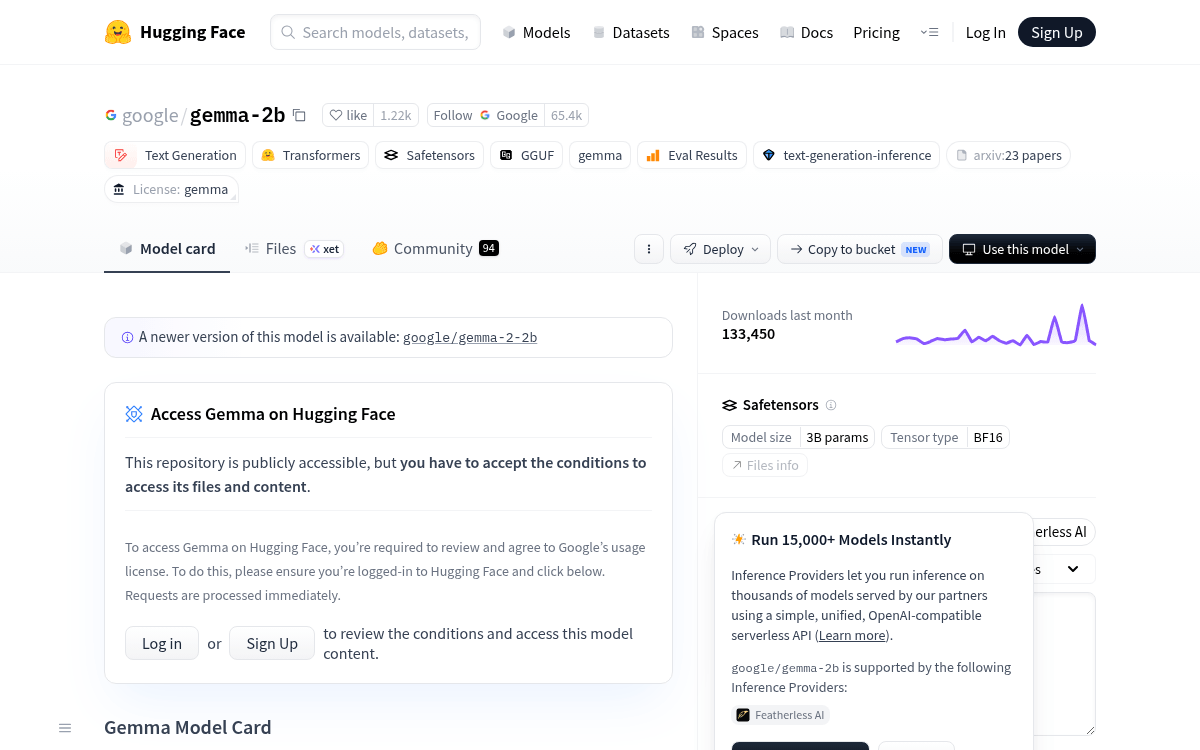
- A newer Gemma 2 2B now supersedes this original release.
Google's smallest open weight language model has arrived, aimed squarely at people who want to run competent text generation on hardware they actually own. Gemma 2B is a decoder-only transformer that ships with open weights, a permissive license, and enough polish to slot into the same tooling ecosystem as Llama and Mistral.
Gemini DNA in a laptop-sized package
The release includes weights in two sizes, Gemma 2B and Gemma 7B, each shipping in both pre-trained and instruction-tuned variants. The 2B version is the interesting one for local work. Google positions it as a high-performance open model designed from the ground up for Responsible AI development compared to similarly sized peers.
Gemma is a text-to-text, decoder-only model available in English, with an 8,192 token context window. Google trained it on roughly 6 trillion tokens spanning web documents, code, and mathematical text, a much larger training budget than most 2B-parameter models get. Training ran on TPUv5e hardware using JAX and Google's ML Pathways stack, the same infrastructure behind Gemini.
What the benchmarks actually say
Small models live and die by their evaluation numbers. Here are the headline scores from the Gemma technical report for the 2B base compared to its 7B sibling:
| Benchmark | Gemma 2B | Gemma 7B |
|---|---|---|
| MMLU (5-shot) | 42.3 | 64.3 |
| HellaSwag (0-shot) | 71.4 | 81.2 |
| PIQA (0-shot) | 77.3 | 81.2 |
| HumanEval (pass@1) | 22.0 | 32.3 |
| GSM8K (maj@1) | 17.7 | 46.4 |
| MATH (4-shot) | 11.8 | 24.3 |
| Average | 45.0 | 56.9 |
Gemma 2B does well on commonsense reasoning tasks like HellaSwag and PIQA, holds its own on general knowledge, and drops sharply on math and multi-step reasoning. GSM8K at 17.7 and MATH at 11.8 confirm what you'd expect from a model this size: it won't be solving calculus homework anytime soon.
Getting it running
Access requires accepting Google's Gemma license on Hugging Face, but requests are processed immediately and the weights are free. The model plugs into essentially every serving stack you'd want:
- Transformers, with a one-liner via
AutoModelForCausalLM.from_pretrained - llama.cpp and Ollama for CPU or Metal inference on Macs
- vLLM and SGLang for production-grade GPU serving with OpenAI-compatible APIs
- GGUF quantizations for edge deployment
- bitsandbytes 4-bit and 8-bit quantization for tight VRAM budgets
The minimal Transformers path looks like this:
from transformers import AutoTokenizer, AutoModelForCausalLM
tokenizer = AutoTokenizer.from_pretrained("google/gemma-2b")
model = AutoModelForCausalLM.from_pretrained("google/gemma-2b", device_map="auto")
input_ids = tokenizer("Write me a poem about ML.", return_tensors="pt").to("cuda")
outputs = model.generate(**input_ids)
print(tokenizer.decode(outputs[0]))
In bf16 the base model occupies roughly 5 to 6 GB of VRAM, which fits comfortably on consumer GPUs. Quantized down to 4-bit through bitsandbytes, it runs on a modest laptop.
What it's actually good for
Google provides toolchains for inference and supervised fine-tuning across JAX, PyTorch, and TensorFlow through native Keras 3.0, along with ready-to-use Colab and Kaggle notebooks and integrations with Hugging Face, MaxText, NVIDIA NeMo, and TensorRT-LLM. You can take the base weights and fine-tune them for a narrow domain without fighting the tooling.
Realistic use cases:
- On-device chat assistants where sending prompts to an API is a non-starter for privacy or latency reasons
- Domain-specific fine-tuning with QLoRA where a smaller base is cheaper to iterate on
- Structured extraction, classification, and rewriting tasks that don't require heavy reasoning
- Educational and research setups where you want a fully inspectable model that fits on a single GPU
- Draft models for speculative decoding, pairing Gemma 2B with a larger model to speed up generation
Where it falls short
Weak math and code scores are the honest limitation. If your product needs reliable arithmetic, code synthesis, or multi-step planning, a 2B parameter model is the wrong tool, and the benchmarks make that explicit. Google's own model card notes that LLMs at this scale can struggle with subtle nuance, sarcasm, and factual accuracy, and that responses come from statistical patterns rather than grounded knowledge.
The bigger picture
Gemma 2B set the template Google has been iterating on ever since. A follow-up 2.6B parameter Gemma 2 model was later released using knowledge distillation from the larger 27B sibling, and the Gemma 2 2B version was reported to outperform all GPT-3.5 models on the Chatbot Arena at a size runnable on edge devices. If you're picking a small open model today, a newer Gemma variant is likely the better choice, though the original 2B remains widely used as a fine-tuning base thanks to the enormous ecosystem of adapters and quantizations already published on Hugging Face.