
Google DeepMind's SigLIP 2 Replaces CLIP With a 1B Open Vision Encoder
Google DeepMind's upgraded vision-language encoder family adds native aspect ratios, 109 languages, and dense features that make it a stronger drop-in for VLM stacks.
 Pro
Takeaways
- Google DeepMind released SigLIP 2, an upgraded family of multilingual vision-language encoders under Apache 2.0.
- Four sizes ship: Base 86M, Large 303M, So400m 400M, and a new Giant 1B tier.
- Adds decoder-based captioning, self-distillation, and masked prediction on top of the sigmoid loss.
- NaFlex variants handle native aspect ratios and variable resolutions from a single checkpoint.
- Trained on WebLI covering 109 languages, with de-biasing techniques in the data mixture.
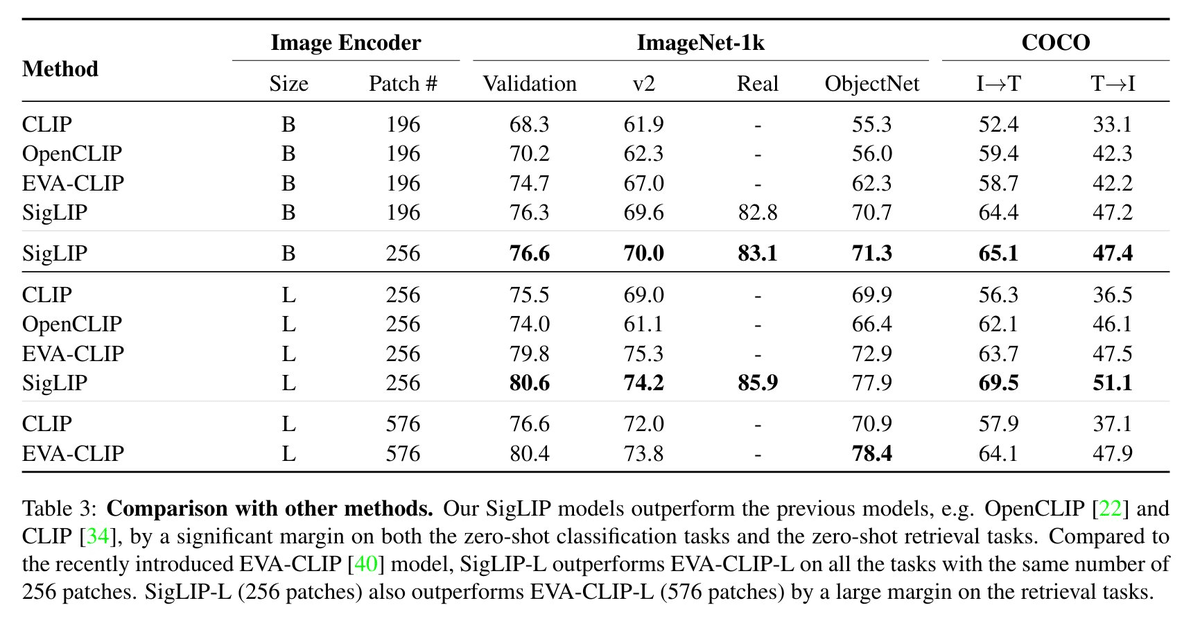
- Outperforms SigLIP 1 at every scale on zero-shot classification, retrieval, and VLM transfer per the paper.
Google DeepMind has released SigLIP 2, a family of multilingual vision-language encoders that replaces the original SigLIP as the default open-weight choice for CLIP-style tasks. The training objective extends SigLIP's sigmoid loss with additional signals for semantic understanding, localization, and dense features, and the checkpoints are drop-in compatible with existing SigLIP code paths.
The release lands on Hugging Face with weights, JAX checkpoints, and an accompanying paper, all under Apache 2.0. If you have been using the original as a vision tower for a VLM, embedding backbone for retrieval, or zero-shot classifier, this is the version to migrate to.
What actually changed under the hood
The original SigLIP swapped CLIP's contrastive softmax for a pairwise sigmoid loss, which scaled better and produced stronger encoders. SigLIP 2 keeps that loss and stacks three additional training signals on top of it, blending ideas from captioning pretraining and self-supervised learning into a single recipe.
The first addition is a text decoder attached to the vision and text encoders during pretraining. The decoder learns to predict full captions, predict bounding boxes given a region caption, and predict region captions given a box, forcing the vision encoder to become location-aware without any detection labels.
The second addition is self-distillation with two losses that only kick in for the last 20% of training to save compute:
- Global-Local Loss: the student sees a crop of the image and has to match the teacher's representation of the full image.
- Masked Prediction Loss: half of the student's image patches are replaced with mask tokens, and it has to reproduce the teacher's features at those masked positions.
The teacher is an exponential moving average of the student, a standard trick from methods like DINO. Together these objectives push the encoder toward denser, more spatially structured features, which matter for segmentation, detection heads, and dense retrieval.
NaFlex: one checkpoint, many aspect ratios
The most practically interesting new variant is NaFlex, which processes images at various resolutions and native aspect ratios from a single checkpoint. That preserves spatial information in tasks where the aspect ratio matters, such as document understanding and OCR.
NaFlex borrows from FlexiViT (variable sequence lengths) and NaViT (native aspect ratios), so you can push a wide document, a tall receipt, or a square photo through the same model without square-cropping and losing information. For OCR, screenshots, UI parsing, and document VLM pipelines, this removes one of the most annoying preprocessing tradeoffs in the CLIP-family lineage.
The lineup
Four backbone sizes ship, each in multiple resolutions, plus the NaFlex variants:
| Size | Params | Resolutions | NaFlex |
|---|---|---|---|
| Base | 86M | 224 / 256 / 384 / 512 | Yes |
| Large | 303M | 256 / 384 / 512 | No |
| So400m (shape-optimized) | 400M | 224 / 256 / 384 / 512 | Yes |
| Giant | 1B | 256 / 384 | No |
The Giant tier is new relative to SigLIP 1 and gives you a proper billion-parameter open contrastive encoder if you need every last point of accuracy.
Multilingual by default
SigLIP 1 was English-heavy. SigLIP 2 is trained on data covering 109 languages, with a more diverse mixture and de-biasing techniques that improve multilingual understanding and fairness. You can run zero-shot classification and image-text retrieval with non-English prompts without stapling on a separate multilingual text encoder like MEXMA or adding a translation step.
How to use it
The API is essentially unchanged from SigLIP, which is the point. If you were using SiglipModel, swap the checkpoint name and you are done. NaFlex variants use Siglip2Model, and the pipeline API handles the dispatch automatically.
from transformers import pipeline
ckpt = "google/siglip2-so400m-patch14-384"
pipe = pipeline(model=ckpt, task="zero-shot-image-classification")
out = pipe(
    "http://images.cocodataset.org/val2017/000000039769.jpg",
    candidate_labels=["2 cats", "a dog", "a plane"],
)
For embedding extraction, model.get_image_features(**inputs) returns the pooled vector you would feed into a retrieval index or a VLM projector. One gotcha worth flagging: the processor applies specific defaults for text inputs, and overriding them can degrade retrieval quality. In practice, pass padding="max_length" and max_length=64 to match how the text tower was trained.
Strengths and limits
SigLIP 2 improves on the original across zero-shot classification, retrieval, dense prediction, and localization. The dense features and localization signal make it a much better fit for downstream heads that need per-patch semantics: segmentation probes, open-vocabulary detection, and grounded VLMs.
Limits worth knowing:
- Text inputs are still capped at 64 tokens. Longer captions or queries need to be chunked and pooled.
- NaFlex is only available on the Base and So400m tiers, not Large or Giant.
- Multilingual coverage is still English-dominant in the mix; low-resource languages will trail high-resource ones.
- Community threads on the release blog show ongoing rough edges around the tokenizer and padding defaults, so pin a recent
transformersversion.
Why this matters for the stack
SigLIP has quietly become the default vision tower for a large chunk of open VLMs, PaliGemma being the most visible example. Swapping to SigLIP 2 hands that whole ecosystem a free upgrade path: better localization for grounding tasks, better dense features for downstream probes, multilingual text alignment out of the box, and NaFlex for aspect-ratio-sensitive workloads like documents and UI screenshots.
SigLIP 2 was pre-trained on WebLI (Chen et al., 2023) using up to 2048 TPU-v5e chips, a scale most labs cannot replicate. Shipping the recipe under Apache 2.0 with weights across four sizes resets the baseline for open contrastive encoders. If you are still on CLIP ViT-L/14 or the original SigLIP for retrieval, embeddings, or as a VLM backbone, the So400m checkpoint is the obvious thing to benchmark against next.