
Google DeepMind's SigLIP 2 Giant Hits 2.6M Downloads Reshaping Open Vision AI
Google DeepMind's 2B parameter vision encoder unifies sigmoid loss with captioning, self-distillation, and masked prediction into one recipe.
 Pro
Takeaways
- Google DeepMind released SigLIP 2 Giant, a 2B parameter multilingual vision-language encoder under Apache 2.0.
- Training adds captioning decoder loss, self-distillation, masked prediction, and online data curation on top of sigmoid loss.
- Beats original SigLIP at all scales on zero-shot classification, retrieval, VLM transfer, and dense prediction.
- Supports 109 languages, trained on WebLI dataset using up to 2048 TPU-v5e chips.
- Family covers ViT-B, L, So400m, and Giant sizes plus NaFlex variants for native aspect ratios.
- Paper on arXiv and drop-in support via Hugging Face Transformers pipeline.
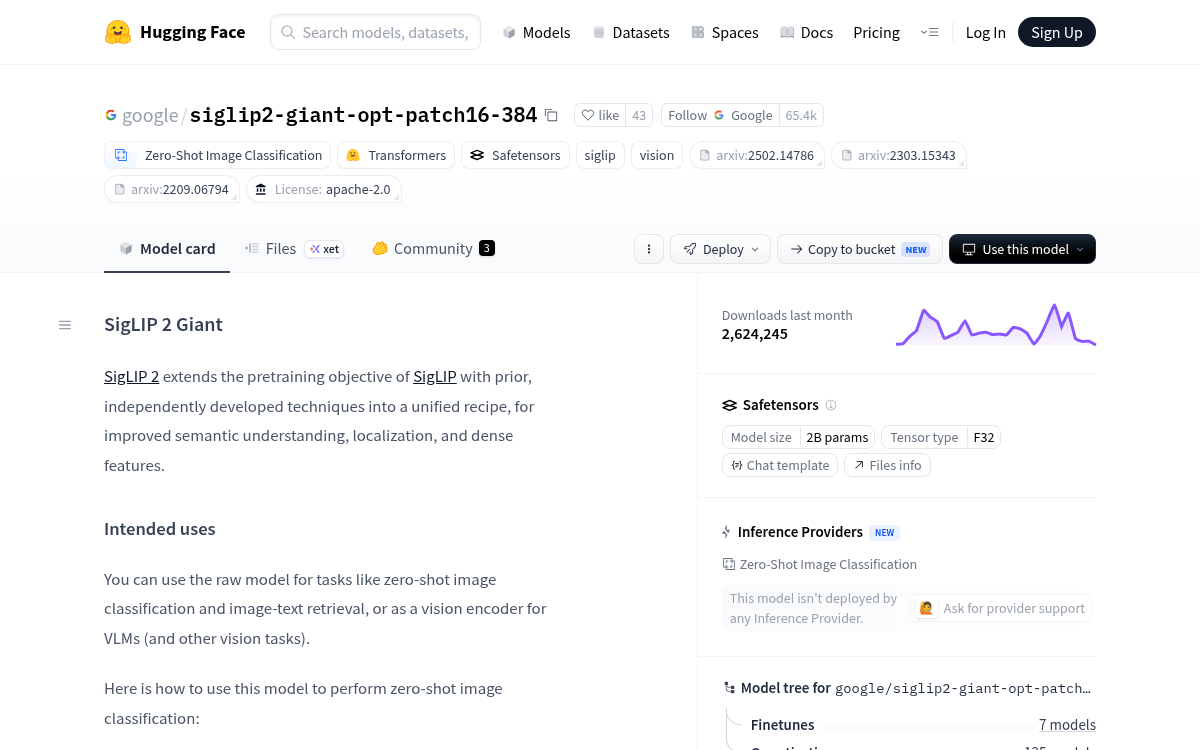
Google DeepMind has quietly pushed one of the most consequential vision encoder releases in recent memory. The SigLIP 2 Giant checkpoint, a 2 billion parameter multilingual vision-language encoder trained at 384x384 resolution with patch size 16, has already crossed 2.6 million downloads on Hugging Face. It sits at the top of a family that ranges from a lightweight ViT-B up to this Giant variant, and it is being adopted as the default vision tower for a new wave of open VLMs.
A unified recipe on familiar bones
SigLIP 2 keeps the same Vision Transformer skeleton as the original SigLIP but changes how it is trained. The authors extend the original image-text objective with several prior, independently developed techniques into a unified recipe, including captioning-based pretraining, self-supervised losses (self-distillation, masked prediction) and online data curation. On the model card, Google summarizes the additions as three training objectives layered on top of the original sigmoid contrastive loss:
- Decoder loss, which forces the encoder to produce features useful for generating captions
- Global-local and masked prediction loss, where the model must reconstruct features of hidden patches from surrounding context
- Aspect ratio and resolution adaptability, so a single checkpoint can handle non-square images without letterboxing
The last point is delivered through a variant called NaFlex, which is useful for downstream tasks sensitive to aspect ratio and resolution. That matters for OCR, document understanding, and UI screenshots, where cropping to 384x384 destroys layout information.
Why the sigmoid loss still earns its keep
The original SigLIP replaced CLIP's softmax contrastive loss with a per-pair sigmoid loss, which scales better because it does not require a full similarity matrix across the batch. SigLIP 2 keeps that objective and adds a decoder head during pretraining that has to caption the image and predict masked regions, borrowing ideas from LocCa and SILC. The payoff shows up beyond retrieval: SigLIP 2 outperforms its predecessor at every model scale on zero-shot classification, image-text retrieval, and transfer performance when extracting visual representations for VLMs, with significant gains on localization and dense prediction tasks.

Scale, data, and compute
SigLIP 2 ships in four sizes so you can fit it to your compute budget: ViT-B (86M), L (303M), So400m (400M), and g (1B). The Giant checkpoint on Hugging Face reports 2B parameters once the text tower is counted. Training data is Google's WebLI corpus, and the model supports 109 languages, which is what makes retrieval and classification work outside English without a translation step. The Giant model was trained on up to 2048 TPU-v5e chips.
Using it in five lines
The Giant checkpoint slots into the standard transformers pipeline with no custom code. For zero-shot classification:
from transformers import pipeline
ckpt = "google/siglip2-giant-opt-patch16-384"
classifier = pipeline(model=ckpt, task="zero-shot-image-classification")
out = classifier(
    "http://images.cocodataset.org/val2017/000000039769.jpg",
    candidate_labels=["2 cats", "a plane", "a remote"],
)
print(out)
For VLM training or retrieval indexing, you can pull image embeddings directly from the vision tower with model.get_image_features(**inputs). The license is Apache 2.0, and derivatives are already piling up: the community has pushed 135 quantizations and 7 fine-tunes of this single checkpoint.
Where it shines and where it struggles
The Giant model is the strongest option in the family for anything that leans on rich semantic features: multilingual retrieval, zero-shot classification over long-tail categories, and use as a frozen backbone inside a VLM. The trade-offs are the usual ones for a 2B parameter encoder. Inference is heavier than the So400m variant, which many teams pick as the sweet spot for VLM pretraining because it hits close to Giant quality at roughly a quarter of the compute. Teams that need native-resolution inputs should reach for the NaFlex variants in the same collection rather than this fixed 384 checkpoint.
What this means for open VLMs
The vision tower is often the ceiling on a VLM's performance. Swapping SigLIP for SigLIP 2 in a PaliGemma-style setup gives an immediate lift on OCR- and localization-heavy benchmarks without touching the LLM. The Hugging Face team notes that PaliGemma 2 pairs SigLIP with the Gemma 2 LLM, and swapping in SigLIP 2 in a PaliGemma-like setting would be worth evaluating. With the full family under Apache 2.0 and a reference implementation in big_vision, teams building open multimodal systems now have a serious alternative to OpenAI CLIP and EVA-CLIP as their default frozen encoder.