
Google DeepMind's Gemma 4 Hits Frontier Scores Running on a Single GPU
Google's open MoE runs like a 4B model but hits 82.6% on MMLU Pro, matching last year's frontier scores on a single consumer GPU
 Pro
Takeaways
- Google shipped Gemma 4 26B A4B, a 25.2B MoE with only 3.8B active parameters, under Apache 2.0.
- Scores 82.6% MMLU Pro, 88.3% AIME 2026, 77.1% LiveCodeBench v6, and 82.3% GPQA Diamond.
- Supports 256K context, text plus image input, video frames, and native function calling for agents.
- Hybrid local plus global attention with unified KV and Proportional RoPE keeps long-context memory practical.
- Deployable via Transformers, vLLM, SGLang, llama.cpp, Ollama, and Google Cloud.
- Configurable thinking mode toggled via a control token in the system prompt.
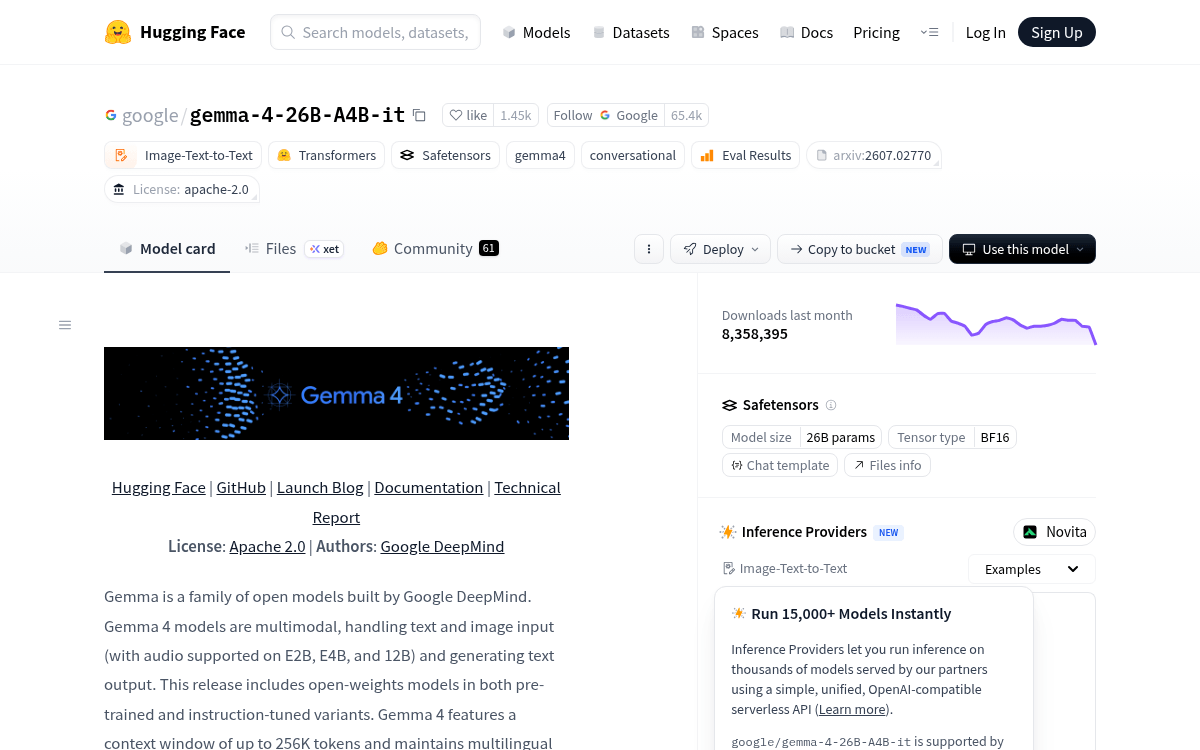
Google DeepMind's Gemma 4 26B A4B is the Mixture-of-Experts entry in the Gemma 4 family, and it is the one worth paying attention to if you want frontier-adjacent quality without paying frontier inference costs. The instruction-tuned variant has already crossed 8 million downloads on Hugging Face, and it ships under a permissive Apache 2.0 license that removes most of the friction that hampered earlier Gemma generations.
Built from the same research as Gemini 3, the model extends beyond chat with context windows up to 256K tokens, native vision and audio processing, and fluency in over 140 languages, targeting complex logic, offline code generation, and agentic workflows. The 26B A4B slot is designed for a single high-end consumer GPU or workstation.
A 26B model that inferences like a 4B
The naming scheme is doing real work here. By activating only a 4B subset of parameters during inference, the MoE model runs much faster than its 26B total suggests. The architecture uses 8 active experts out of 128 plus 1 shared expert, 30 layers, a 262K vocabulary, and a 256K token context window. Total parameters land at 25.2B, with 3.8B active per token.
The attention design interleaves local sliding window attention with full global attention, and the final layer is always global. That hybrid keeps the memory footprint close to a lightweight model while preserving the deep awareness required for long-context tasks. Global layers use unified Keys and Values plus Proportional RoPE to keep the KV cache manageable at long context lengths.
Where it actually lands on benchmarks
The instruction-tuned checkpoint punches well above what a 4B active model has any right to. Here are the headline numbers Google published:
| Benchmark | Gemma 4 26B A4B | Gemma 4 31B Dense | Gemma 3 27B (no think) |
|---|---|---|---|
| MMLU Pro | 82.6% | 85.2% | 67.6% |
| AIME 2026 (no tools) | 88.3% | 89.2% | 20.8% |
| LiveCodeBench v6 | 77.1% | 80.0% | 29.1% |
| Codeforces ELO | 1718 | 2150 | 110 |
| GPQA Diamond | 82.3% | 84.3% | 42.4% |
| MATH-Vision | 82.4% | 85.6% | 46.0% |
The jump on math and code against Gemma 3 27B is the eye-catching part. A Codeforces ELO climbing from 110 to 1718 in one generation puts the model in a different class entirely. The trade-off is that the MoE variant trails the 31B dense model on the hardest reasoning tasks, most visibly on Humanity's Last Exam, where it scores 8.7% without tools versus 19.5% for the 31B, and on long-context recall, where it hits 44.1% on MRCR v2 128k against the dense model's 66.4%.
Thinking mode, on demand
Built-in reasoning mode lets the model work through problems step by step before answering. Unlike Gemma 3, thinking is controlled explicitly through a control token in the system prompt, and the model uses standard system, assistant, and user roles. Turning it on is a one-line change:
from transformers import AutoProcessor, AutoModelForMultimodalLM
processor = AutoProcessor.from_pretrained("google/gemma-4-26B-A4B-it")
model = AutoModelForMultimodalLM.from_pretrained(
    "google/gemma-4-26B-A4B-it", dtype="auto", device_map="auto"
)
messages = [{"role": "user", "content": "Prove sqrt(2) is irrational."}]
inputs = processor.apply_chat_template(
    messages, tokenize=True, return_dict=True,
    return_tensors="pt", add_generation_prompt=True,
    enable_thinking=True,
).to(model.device)
out = model.generate(**inputs, max_new_tokens=1024)
One subtlety worth remembering: in multi-turn conversations, strip the internal reasoning from previous assistant turns before sending them back, otherwise you burn context on stale scratchpads. Tool-call turns are the exception, where thinking should be preserved.
Multimodal, with caveats at this size
The 26B A4B handles text and images. Audio is only supported natively on the E2B, E4B, and 12B checkpoints, so if you need speech recognition or translation you have to drop down in size. On the vision side, the model handles object detection, document and PDF parsing, screen and UI understanding, chart comprehension, multilingual OCR, handwriting recognition, and pointing. Video works by decomposing clips into frames.
Google exposes a knob for image detail via visual token budget. Images can be processed at variable aspect ratios and resolutions, with supported budgets of 70, 140, 280, 560, and 1120 tokens. Use the low end for classification, captioning, or dense video frames. Use the high end for OCR, document parsing, or reading small text. The result is a much cleaner API than the fixed-tile approach in most competing open VLMs.
Getting it running
Deployment surfaces are unusually broad on release, one of the concrete benefits of Google publishing under Apache 2.0. Working paths today include:
- Transformers:
AutoModelForMultimodalLMhandles chat templating, thinking parsing, and multimodal preprocessing in one processor. - vLLM:
vllm serve "google/gemma-4-26B-A4B-it"exposes an OpenAI-compatible endpoint with image_url support. - SGLang: launches a server with the same OpenAI-compatible schema, useful for structured generation or better throughput on batched agent workflows.
- llama.cpp / Ollama / LM Studio: GGUF quantizations are already up, with Q4_0 at 14.6 GB and Q8_0 at 26.9 GB, plus QAT-tuned Q4 checkpoints for lower quality loss at 4-bit.
- Google Cloud: Vertex AI, Cloud Run, GKE, and Sovereign Cloud all have first-party support.
Google recommends temperature=1.0, top_p=0.95, and top_k=64 across use cases. Worth knowing, because the defaults in many inference stacks (temperature 0.7) will noticeably hurt reasoning quality on this family.
Why the industry should recalibrate
The interesting shift is the pricing implicit in these numbers. An open-weight, Apache 2.0 model with a 3.8B active parameter footprint is now scoring 82.6% on MMLU Pro and 88.3% on AIME 2026. A year ago that class of score required either a closed API or a much larger dense model that most teams could not self-host. Google frames Gemma 4 as delivering unprecedented intelligence per parameter, building on developer downloads of more than 400 million and a Gemmaverse of over 100,000 variants.
For teams building agentic systems, the practical implication is that the local-first architecture that seemed premature a year ago is now viable for a much broader set of tasks. Function calling is native, long-context is real up to 256K, coding scores sit close to the dense 31B, and inference cost tracks a 4B model. If your workload is code generation, structured extraction, document parsing, or tool-using agents that need to run inside a customer's VPC, this is the checkpoint that changes the build-versus-buy math.