
Google DeepMind's Gemma 2 2B Beats GPT-3.5 Running on a Laptop
Google's 2.6B open model uses distillation to beat GPT-3.5 on Chatbot Arena while running on a free NVIDIA T4 or even a laptop.
 Pro
Takeaways
- Google released Gemma 2 2B, a 2.6B instruction-tuned open model trained via knowledge distillation.
- Claims to beat all GPT-3.5 variants on LMSYS Chatbot Arena despite its small footprint.
- Trained on 2T tokens with a larger teacher model, plus SFT, distillation, and RLHF.
- Uses sliding-window attention, GQA, logit soft-capping, and 8192-token RoPE context.
- Runs on a free NVIDIA T4, laptops, or edge devices; ~5GB in bf16, under 2GB in 4-bit.
- Weak on math (GSM8K 23.9) and code (HumanEval 17.7); strong on conversational tasks.
Google DeepMind quietly shipped what might be the most interesting entry in the small-model race: Gemma 2 2B, a 2.6B parameter instruction-tuned model that punches far above its weight class. It joins the earlier 9B and 27B siblings, and the real story is what aggressive knowledge distillation can do: turn a laptop-friendly model into something that outperforms GPT-3.5 on the LMSYS Chatbot Arena leaderboard.
Small model, big teacher
The headline trick is distillation at extreme scale. Google uses a large language model as a teacher to train the 2B and 9B models on more than 50 times the compute-optimal token count predicted by Chinchilla scaling theory, alongside a 27B model trained from scratch. Rather than predicting only the next token, the student learns to match the full probability distribution the teacher assigns across the vocabulary, which carries far more information per training example than a single hard target.
The payoff shows up in the ablations. Distilling from a larger teacher, even with an equal number of training tokens, delivers significant quality gains. Swapping multi-head attention for grouped-query attention yields comparable performance with better parameter efficiency and faster inference, and a deeper model slightly beats a wider one at matched parameter count. Gemma 2 2B was trained on 2T tokens versus 3T for Gemma 1, yet still improves noticeably, confirming that distillation lifts quality even at fewer training tokens.
What is under the hood
Architecturally, Gemma 2 stays close to a standard decoder-only Transformer but pulls in a few important tweaks:
- Context length of 8192 tokens with Rotary Position Embedding (RoPE).
- Sliding window attention interleaved with full-quadratic attention for quality generation.
- Logit soft-capping, which prevents logits from growing excessively by scaling them to a fixed range, improving training stability.
- Grouped-Query Attention (GQA) from Ainslie et al. 2023 for memory-efficient inference.
- Instruction-tuned via supervised fine-tuning on synthetic and human prompt-response pairs, distillation from a larger model, and RLHF with a conversation-oriented reward model.
Training itself ran on Google Cloud TPU (the 27B on v5p, the 9B on TPU v4) using JAX and ML Pathways.
Where it lands on benchmarks
On the standard suite, the 2B instruction-tuned model sits where you would expect a strong small model to sit, and higher on reasoning-heavy tasks than most 2B-class peers:
| Benchmark | Gemma 2 2B | Gemma 2 9B | Gemma 2 27B |
|---|---|---|---|
| MMLU (5-shot) | 51.3 | 71.3 | 75.2 |
| HellaSwag (10-shot) | 73.0 | 81.9 | 86.4 |
| ARC-c (25-shot) | 55.4 | 68.4 | 71.4 |
| GSM8K (5-shot) | 23.9 | 68.6 | 74.0 |
| HumanEval (pass@1) | 17.7 | 40.2 | 51.8 |
| MATH (4-shot) | 15.0 | 36.6 | 42.3 |
The interesting comparison is external. DeepMind claims the 2B model outperforms all GPT-3.5 variants on the LMSYS Chatbot Arena leaderboard, a conversational quality proxy where humans blind-vote between model outputs. Math and code are the weak spots: 15.0 on MATH and 17.7 on HumanEval mean you should not point this at your production coding agent.
Why the size matters
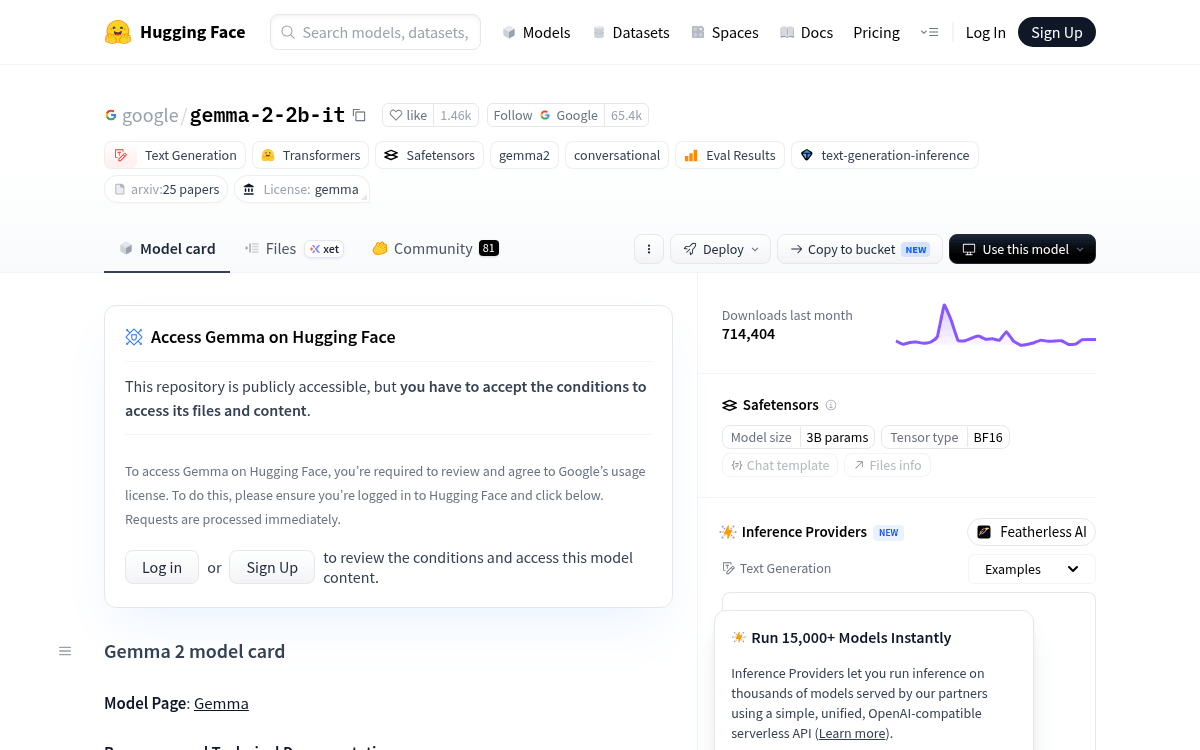
Gemma 2 2B runs across a wide range of hardware, from laptops to edge devices to cloud deployments on Vertex AI and Google Kubernetes Engine (GKE), and it fits on the free tier of the NVIDIA T4 accelerator. With bfloat16 weights the model occupies roughly 5 GB of memory, and 4-bit quantization through bitsandbytes drops it well under 2 GB, opening up genuinely local inference on consumer GPUs and higher-end Apple Silicon.
Getting it running is a two-liner:
from transformers import pipeline
pipe = pipeline("text-generation", model="google/gemma-2-2b-it")
pipe([{"role": "user", "content": "Explain distillation in one paragraph."}])
The Hugging Face integration notes one gotcha worth knowing: the team observed very minor differences when soft-capping is removed at inference, but stable fine-tuning still requires soft-capping enabled, so fine-tune with eager attention rather than SDPA. That is the difference between a working LoRA run and a diverging loss curve.
Where it actually fits
The natural use-cases follow from the strengths and constraints. Good fits include:
- On-device chat assistants and dialogue interfaces where GPT-3.5-class quality is enough.
- Summarization, rewriting, and classification over English text.
- Retrieval-augmented generation front-ends where the model synthesizes retrieved facts rather than recalling them.
- Cheap synthetic data generation for smaller downstream models.
- Fine-tuning bases for domain-specific chatbots. The 2B model is slightly less format-robust than its larger siblings, so consistent prompt templates matter.
Poor fits: multi-step math, competitive coding, long-context document QA beyond 8k tokens, and anything requiring non-English fluency at scale. The technical report is candid that these are total-parameter comparisons chosen because total memory usage often limits the use of open models on standard devices.
Rewriting the Chinchilla assumption
The old Chinchilla-era belief that pretraining beyond compute-optimal is wasteful needs updating. Training a 2B model on 50x the compute-optimal token count, with a big teacher supplying rich soft targets, produces a model competitive with peers two to ten times its size on conversational quality. That is a different curve than pure scaling, and it explains why small open models have suddenly become interesting again for anyone whose deployment target is a browser tab, a phone, or a single consumer GPU.