
Google DeepMind's FunctionGemma Turns Voice Commands Into API Calls at 288MB
Google's new 270M parameter model turns natural language into structured function calls on-device, small enough to run on a phone with no server.
 Pro
Takeaways
- Google released FunctionGemma, a 270M Gemma 3 variant tuned specifically for function calling.
- Model is 288 MB quantized, runs at 126 decode tokens/sec on a Samsung S25 Ultra CPU.
- Not a chatbot: outputs structured function-call blocks from JSON schemas via a
developerrole prompt. - Base BFCL Simple score is 61.6; Mobile Actions finetune jumps from 58% to 85% accuracy.
- Trained on 6T tokens using JAX and TPUs, with a 256K vocabulary optimized for JSON.
- Reference demos ship in the Google AI Edge Gallery app.
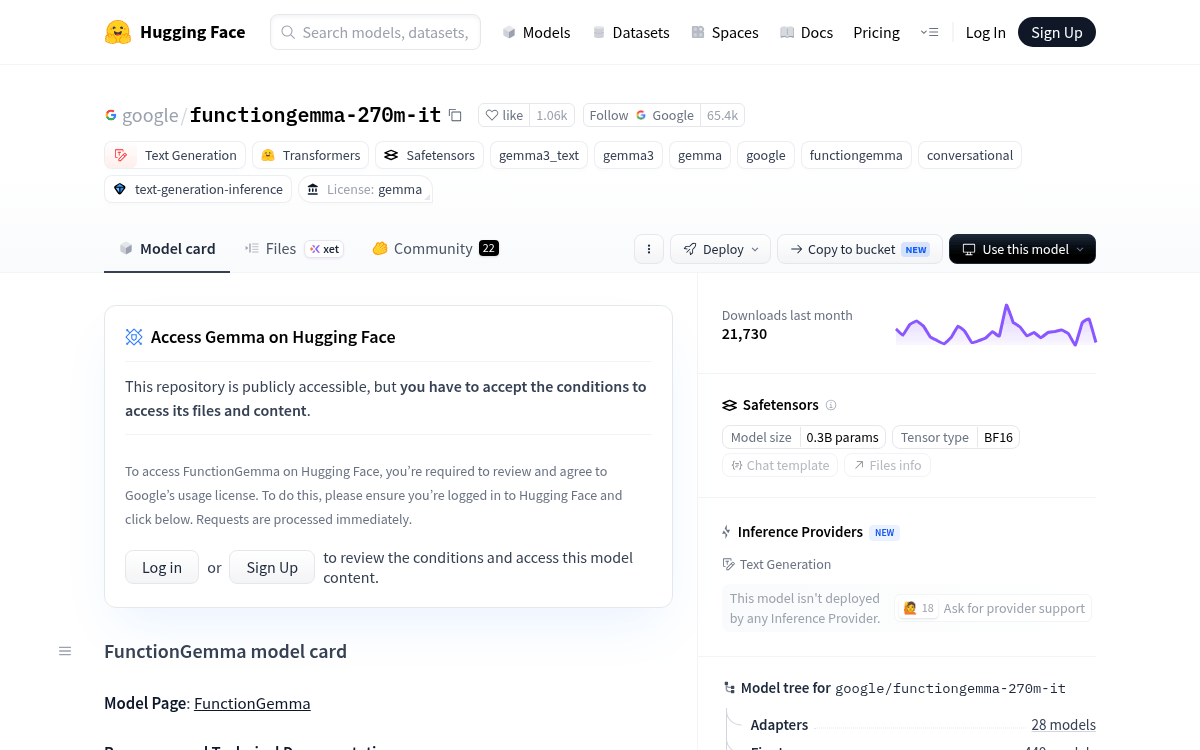
Google DeepMind has released FunctionGemma, a 270 million parameter model built as a specialized base for function calling. It is a fine-tuned variant of Gemma 3 270M, intended to be further tuned and deployed as a small, private agent that turns natural language into structured API calls.
Since launching Gemma 3 270M, the top request Google received from developers was native function calling. As the industry shifts from conversational interfaces to active agents, models need to act, not just talk. FunctionGemma is Google's answer for the edge.
Under the hood
FunctionGemma is a 270M parameter text-only transformer based on Gemma 3 270M, released under the Gemma license. It shares the Gemma 3 architecture and the research stack behind Gemini, but uses a different chat format. The context window handles up to 32K tokens in and out.
Treat it as a component, not a chatbot. Direct dialogue is out of scope, and, as is typical for models this size, real performance shows up after further fine-tuning. You give it a JSON schema describing your functions along with a user query, and it emits a function call block.
Wiring it up
Loading it looks like standard Transformers, with one important detail: you must include a system prompt with the developer role to activate the function-calling logic. Here is the core pattern from the model card:
from transformers import AutoProcessor, AutoModelForCausalLM
processor = AutoProcessor.from_pretrained("google/functiongemma-270m-it")
model = AutoModelForCausalLM.from_pretrained("google/functiongemma-270m-it", dtype="auto", device_map="auto")
message = [
    {"role": "developer", "content": "You are a model that can do function calling with the following functions"},
    {"role": "user", "content": "What's the temperature in London?"}
]
inputs = processor.apply_chat_template(message, tools=[weather_function_schema], add_generation_prompt=True, return_dict=True, return_tensors="pt")
out = model.generate(**inputs.to(model.device), max_new_tokens=128)
The output uses custom tokens like <start_function_call> and <end_function_call> that wrap the function name and arguments. It runs in vLLM, SGLang, Ollama, llama.cpp, and LM Studio out of the box, and Unsloth already ships LoRA and full finetune notebooks.
Why 270M matters here
Size is the whole point. FunctionGemma inherits Gemma's 256K vocabulary, which is optimized for JSON structures and multilingual text. That improves token efficiency for function schemas and tool responses, and shortens sequences for edge deployments where latency and memory are tight. Google benchmarked the finetuned model on a Samsung S25 Ultra CPU with dynamic int8 quantization:
- Prefill: ~1,718 tokens/sec
- Decode: ~126 tokens/sec
- Time to first token: 0.3 seconds
- Model size: 288 MB
- Peak RSS memory: 551 MB
Fast enough to feel instant, and small enough that a 270M model can drive multi-turn logic behind custom game mechanics on a mobile phone without pinging a server.
The benchmarks, honestly
Zero-shot scores on the Berkeley Function Calling Leaderboard (BFCL) are modest by design. Selected results:
| Benchmark | Score |
|---|---|
| BFCL Simple | 61.6 |
| BFCL Multiple | 63.5 |
| BFCL Parallel | 39.0 |
| BFCL Live Simple | 36.2 |
| BFCL Irrelevance | 73.7 |
Parallel and live scores drop hard, which is why Google is upfront that you need to finetune. As a proof point, after applying the Mobile Actions recipe, accuracy on that dataset jumped from 58% to 85%. That is the shape of the deal on offer: a base weight tuned for structural fluency in tool calls that you specialize into a small expert.
What ships alongside
To make specialization concrete, Google published three reference apps and the recipes behind them:
- Mobile Actions: Translates inputs like "Create a calendar event for lunch" or "Turn on the flashlight" into function calls that trigger Android OS system tools.
- Tiny Garden: A voice-controlled mini-game where players manage a virtual plot of land. A prompt like "Plant sunflowers in the top row and water them" gets decomposed into specific app functions like
plantCroporwaterCroptargeting grid coordinates. - Physics Playground: Runs entirely in the browser using Transformers.js and lets users solve physics puzzles via natural language instructions that the model converts into simulation actions.
How it was trained
The model was trained on 6T tokens, with a knowledge cutoff of August 2024. Training data centers on public tool definitions scraped from common web APIs, plus tool-use interactions containing prompts, function calls, function responses, and follow-up natural language summaries. Training ran on TPUv4p, v5p, and v5e using JAX and ML Pathways, the same stack behind Gemini.
Where it fits
The pitch from the official docs is direct: use it if you have a defined API surface such as smart home, media, or navigation, and you are ready to fine-tune for consistent, deterministic behavior instead of the variability of zero-shot prompting. It replaces the awkward pattern of shipping a 7B model to a phone just to parse "turn on the flashlight," or worse, calling out to a hosted frontier model for every voice command.
The broader signal: Google is betting on a two-tier world where tiny specialists handle the 80% of agent traffic that is structural (parse intent, emit tool call), and the big models are reserved for the reasoning-heavy tail. If that pattern holds, production agent stacks are about to get a lot cheaper.