
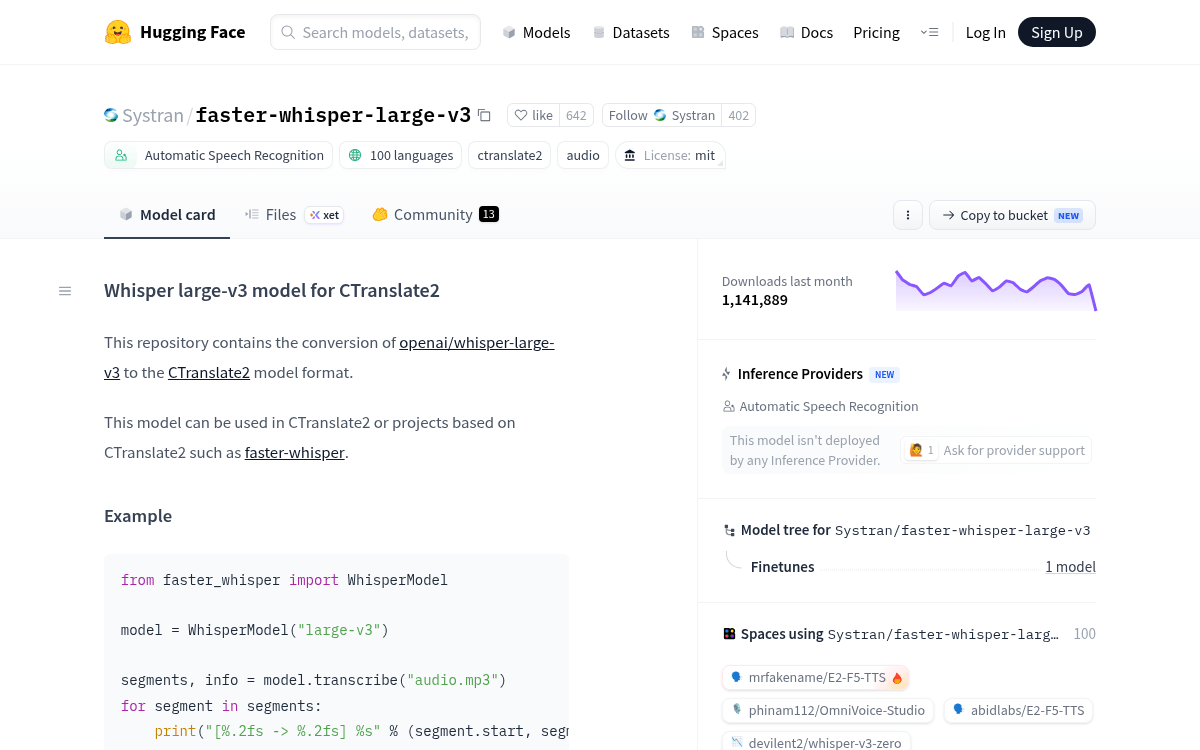
faster-whisper-large-v3 Hits 1.1M Downloads Running Whisper 4x Faster
The CTranslate2 port of Whisper large-v3 keeps racking up downloads by delivering 4x faster transcription and roughly half the VRAM at identical accuracy.
 Pro
Takeaways
- Systran/faster-whisper-large-v3 has surpassed 1.1M downloads as the go-to Whisper deployment format.
- It is a CTranslate2 conversion of openai/whisper-large-v3, up to 4x faster at identical accuracy.
- 13-minute audio: 4m30s and 11GB VRAM in PyTorch, 54s and 4.7GB with faster-whisper FP16.
- INT8 quantization cuts VRAM roughly 40% and doubles speed with under 0.1% WER impact.
- Powers WhisperX, whisper-diarize, and most production CUDA pipelines; MIT licensed, 100 languages.
- No Apple Metal support; Mac users still need whisper.cpp for GPU acceleration.
Speech-to-text pipelines have quietly converged on one workhorse: the faster-whisper-large-v3 checkpoint on Hugging Face. It has crossed 1.1 million monthly downloads, making it one of the most-used audio models in production. The repo is the CTranslate2 conversion of OpenAI's Whisper large-v3, and it is what most people actually run when they say they are running Whisper.
What the checkpoint actually is
The repo ships no new weights. Faster-whisper reimplements Whisper on top of CTranslate2, a fast inference engine for Transformer models, and hits up to 4x the throughput of openai/whisper at the same accuracy while using less memory. Eight-bit quantization improves things further on both CPU and GPU.
Weights ship in FP16 by default, and CTranslate2 lets you swap the compute type at load time to INT8, INT8_FLOAT16, or BF16 depending on the hardware. The whole thing is MIT licensed and covers the full 100-language Whisper vocabulary.
Why people bother converting Whisper at all
On a 13-minute clip with beam size 5, the reference openai/whisper implementation takes 4m30s and uses 11.3 GB of GPU memory. faster-whisper at FP16 finishes the same clip in 54 seconds using 4.75 GB, and INT8 lands at 59 seconds with 3 GB of VRAM. On CPU the gap widens against whisper.cpp, cutting a 10-minute job on a Xeon down to about two minutes.
Independent benchmarks on newer hardware line up with that. On a single NVIDIA A100 with FP16, the reference OpenAI Whisper large-v3 processes a 60-minute audio file in 4-6 minutes; faster-whisper processes the same file in 1.5-2.5 minutes. An RTX 3090 chews through a full hour of audio in under a minute with large-v3, fast enough for real-time transcription of multiple concurrent streams. Word Error Rate is identical between both backends, since the CTranslate2 optimizations touch only the compute path.
How the speedup happens
Faster-whisper converts Whisper's PyTorch weights to the CTranslate2 format, which applies layer fusion, INT8/FP16 quantization, and batched decoding. The result is much lower memory usage and higher throughput without changing the model architecture. Voice activity detection filtering skips silent sections, which usually delivers the largest wall-clock win on real recordings.
The INT8 path is the most interesting knob. CTranslate2 int8 quantization reduces VRAM by roughly 40% and roughly doubles inference speed versus float16, with a WER impact under 0.1% absolute. That combination makes real-time transcription on a laptop GPU practical.
Using it
Installation is a single pip command, with no FFmpeg system dependency because audio decoding is bundled through PyAV. The minimum working example is short:
from faster_whisper import WhisperModel
model = WhisperModel("large-v3", device="cuda", compute_type="int8")
segments, info = model.transcribe("audio.mp3", beam_size=5, vad_filter=True)
for segment in segments:
    print(f"[{segment.start:.2f}s -> {segment.end:.2f}s] {segment.text}")
The compute_type flag is where you trade accuracy for VRAM. vad_filter=True uses Silero VAD to skip silence before decoding. GPU inference requires CUDA 12 and cuDNN 9 with recent ctranslate2 releases.
Where it fits in the current stack
faster-whisper is now the default engine underneath much of the ecosystem you might already be using. It powers WhisperX (which adds forced alignment and diarization), it is what whisper-ctranslate2, whisper-diarize and whisper-standalone-win wrap, and it accepts Distil-Whisper checkpoints directly, including distil-large-v3, which was designed around the faster-whisper transcription algorithm.
Practical picks look roughly like this:
- General multilingual transcription: large-v3 at FP16 on GPU, INT8 if VRAM is tight.
- English-only, latency-sensitive: distil-large-v3, roughly 6x faster than large-v3 at about 1% higher WER.
- Subtitles or interviews with speaker labels: WhisperX on top of faster-whisper.
- Long-form batch jobs: large-v3 with
vad_filter=Trueto drop silence before decoding. - CPU-only servers: INT8 quantization, roughly 4x whisper.cpp on the same hardware.
Where it falls down
The accuracy ceiling is still Whisper large-v3's ceiling. Noisy multi-speaker conference calls, code-switching between more than two languages mid-sentence, or heavy domain jargon will defeat any CTranslate2 trick. There is also no Apple Metal path: the runtime supports CPU (with int8 quantization) and NVIDIA CUDA GPUs, and falls back to CPU-only on Mac. Mac users who want GPU acceleration are still better off with whisper.cpp and its Metal backend.
For the majority of transcription workloads on NVIDIA hardware, this remains the pragmatic default. Same weights, same accuracy, a fraction of the compute bill.