
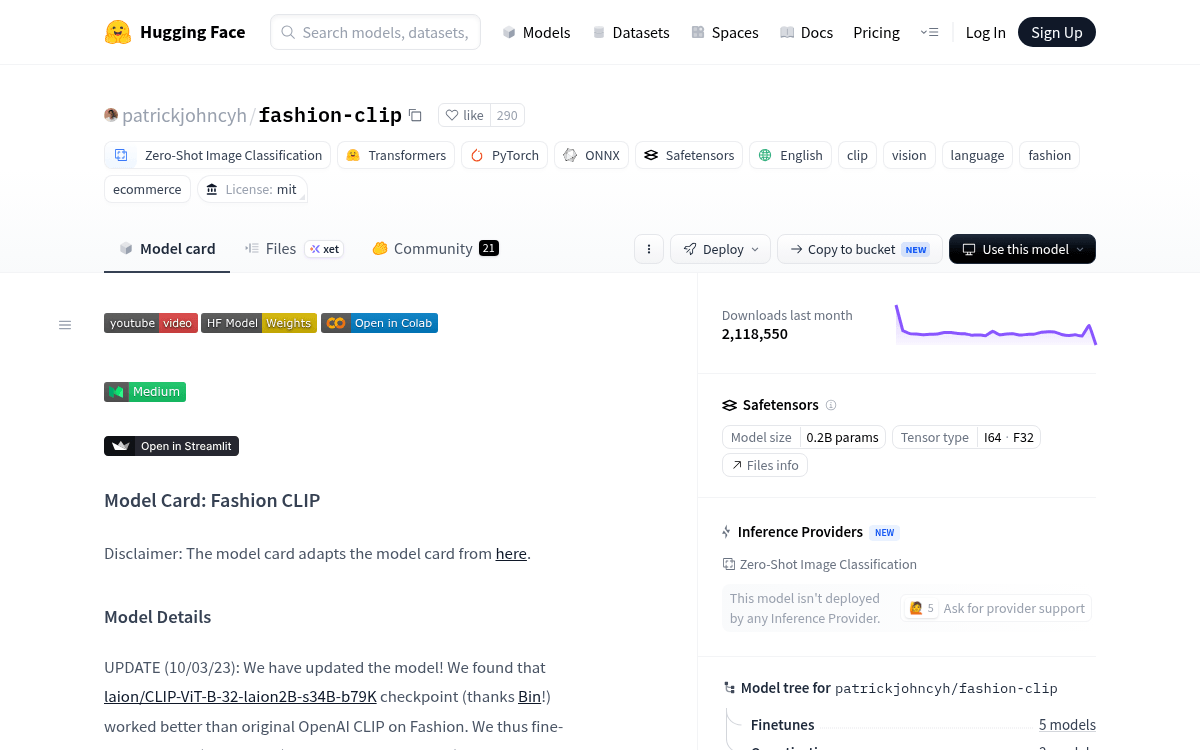
FashionCLIP 2.0 Beats OpenAI's CLIP on Apparel Search With 2.1M Downloads
A CLIP model fine-tuned on 800K fashion products beats OpenAI and Laion baselines at zero-shot classification for e-commerce catalogs.
 Pro
Takeaways
- FashionCLIP hits 2.1M downloads on Hugging Face as a domain-specific CLIP for e-commerce.
- FashionCLIP 2.0 fine-tunes Laion CLIP ViT-B/32 on 800K Farfetch product-caption pairs.
- Weighted macro F1 of 0.83 on FMNIST, 0.73 on Kaggle, 0.62 on DeepFashion, beating base CLIP.
- Ships in PyTorch, ONNX, and Safetensors under an MIT license, roughly 200M parameters.
- Best for catalog retrieval and zero-shot attribute tagging on clean white-background product images.
- Underlying research published in Nature Scientific Reports, code on GitHub.
A domain-specific vision-language model has quietly become one of the most downloaded models on Hugging Face for e-commerce workloads. FashionCLIP is a CLIP variant fine-tuned on fashion catalog data, and it now sits at over 2.1 million downloads with more than 4,000 likes on the Hub. General-purpose CLIP struggles with the fine-grained vocabulary of apparel, from fabric types to silhouette names to brand-specific aesthetics, and this model targets exactly that gap.
The pitch in one sentence
FashionCLIP produces general product representations for fashion concepts by adapting an existing CLIP checkpoint to the vocabulary and visual conventions of online retail. The resulting embeddings transfer well across catalogs the model has never seen, without requiring anyone to train from scratch.
What is actually inside
The image encoder is a ViT-B/32 Transformer, paired with a masked self-attention Transformer for text. Weights come in at roughly 200M parameters, shipped in PyTorch, ONNX, and Safetensors formats under an MIT license. The current release, FashionCLIP 2.0, skips a full retrain: the team found that the laion/CLIP-ViT-B-32-laion2B-s34B-b79K checkpoint worked better than the original OpenAI CLIP on fashion, so they fine-tuned that newer base while keeping the architecture identical.
How it was trained
Training used 800K fashion products from the Farfetch dataset, spanning more than 3K brands across dozens of object types. Each image is a standard product shot: the item over a white background, no humans. The paired text concatenates the highlight field (for example, stripes, long sleeves, Armani) with the short description (for example, 80s styled t-shirt). The contrastive objective matches vanilla CLIP, pulling matching image-text pairs together in embedding space and pushing mismatches apart.
The underlying paper appeared in Nature Scientific Reports, and the authors report training time, costs, and emissions, alongside open-source training code, a demo app, and plug-and-play checkpoints.
The benchmark numbers
The team reports weighted macro F1 across three fashion classification datasets: Fashion-MNIST (FMNIST), a Kaggle catalog (KAGL), and DeepFashion (DEEP).
| Model | FMNIST | KAGL | DEEP |
|---|---|---|---|
| OpenAI CLIP | 0.66 | 0.63 | 0.45 |
| FashionCLIP (v1) | 0.74 | 0.67 | 0.48 |
| Laion CLIP | 0.78 | 0.71 | 0.58 |
| FashionCLIP 2.0 | 0.83 | 0.73 | 0.62 |
The jump from Laion CLIP to FashionCLIP 2.0 on DeepFashion (0.58 to 0.62) is the most telling number, since DeepFashion contains real-world, in-the-wild photos rather than the clean product shots used during training.
Where it wins, where it stumbles
The strengths track what you would expect from a domain-adapted encoder: zero-shot classification of garments, retrieval by natural-language query, and grounding of fashion-specific attributes like fabric, sleeve length, or era. The authors evaluated FashionCLIP on retrieval, classification, and fashion parsing, and report that fine-tuning captures domain-specific concepts and generalizes them zero-shot, with concepts grounded in visual space unlocking linguistic generalization.
The limitations are worth flagging before you drop it into production:
- The model is biased toward standard product images centered on a white background, so user-generated content and street photography degrade quality.
- Long queries outperform short ones, because most training captions are long.
- The training data bakes in gendered assumptions about clothing categories.
- Model selection during fine-tuning remains an open challenge; loss on an in-domain validation dataset is a poor criterion when out-of-domain generalization is the goal, even when the validation set is relatively diverse and large.
Dropping it into a pipeline
Usage is standard Transformers, which explains much of the adoption. The zero-shot classification pipeline works out of the box:
from transformers import pipeline
pipe = pipeline("zero-shot-image-classification",
                model="patrickjohncyh/fashion-clip")
pipe(image_url,
     candidate_labels=["leather jacket", "denim jacket", "blazer"])
For retrieval or vector-search use cases, load the encoders directly and index the image embeddings in your vector database of choice. The reference repo also ships a small Python API and a Streamlit demo that walks through catalog retrieval end to end.
A template for verticalized CLIP
FashionCLIP is a template as much as a model. A modestly sized team took a strong general-purpose CLIP checkpoint, fine-tuned it on a few hundred thousand domain pairs, and produced embeddings that beat the base model by 4 to 15 F1 points on domain benchmarks. The authors position FashionCLIP as a foundational toolkit for practitioners in the space and a template for other verticalized CLIP models. If you run a catalog, a media library, or any product corpus with its own dialect, the same recipe (curated pairs, contrastive fine-tuning on a Laion-2B checkpoint, careful out-of-domain validation) is now a documented path rather than a research bet.